
Blog
Best Mortgage Options Ontario – Strategies for First-Time Buyers


Over 60% of Canadian first-time buyers feel uncertain about which mortgage option suits their finances best. For Vaughan residents stepping into homeownership, the choices can appear complex with so many loan types, terms, and requirements shaping monthly payments. Understanding tailored Canadian mortgage solutions can help you manage cash flow with confidence and unlock a path to long-term financial success in Ontario.
Table of Contents
- Ontario Mortgage Options Explained For Buyers
- Types Of Mortgages Available In Ontario
- Government Programs And Incentives Overview
- Qualifying Requirements For Different Mortgages
- Comparing Lenders And Choosing A Broker
- Refinance, Debt Consolidation, And Home Equity Loans
Key Takeaways
| Point | Details |
|---|---|
| Understanding Mortgage Types | Ontario offers fixed-rate, variable-rate, and hybrid mortgages, each with distinct advantages and varying levels of risk and payment stability. |
| Government Support for Homebuyers | Programs like the Home Buyers’ Plan and First-Time Home Buyer Incentive provide critical financial assistance to ease home purchase costs for eligible buyers. |
| Qualifying for Mortgages | Key factors such as credit score, income stability, and debt ratios are crucial in determining mortgage eligibility, influencing overall borrowing costs. |
| Role of Mortgage Brokers | Utilizing a mortgage broker can simplify the lending process by providing access to diverse loan options and personalised advice, crucial for informed decision-making. |
Ontario mortgage options explained for buyers
Understanding mortgage options in Ontario requires strategic financial planning tailored to your unique homebuying circumstances. Mortgage choices in Canada depend on multiple factors that impact long-term financial stability, including income, credit history, and personal financial goals.
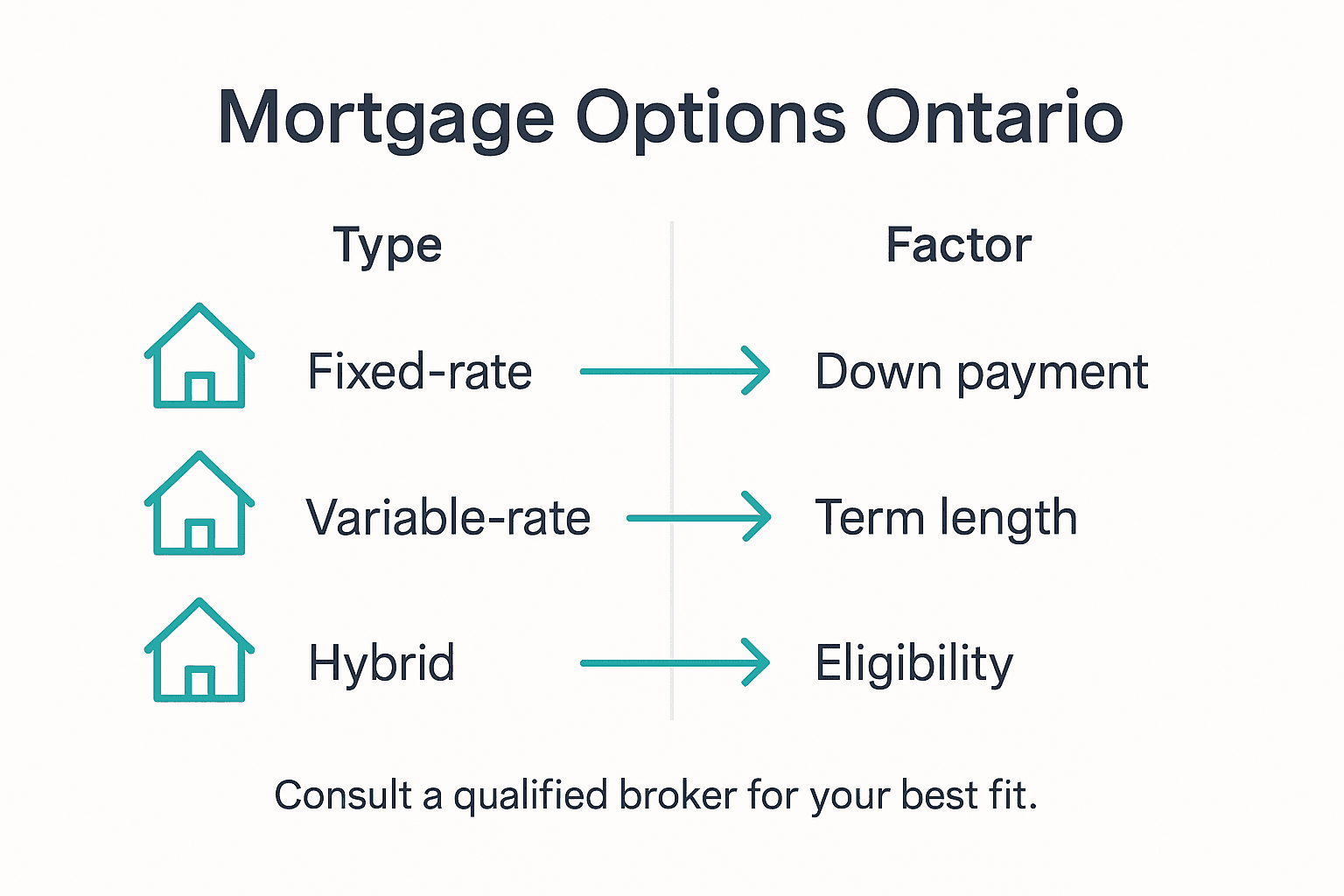
Ontario homebuyers typically encounter several primary mortgage types: fixed-rate mortgages, variable-rate mortgages, and hybrid mortgages. Fixed-rate mortgages provide consistent payment schedules and predictable interest rates, making them attractive for first-time buyers seeking financial certainty. Variable-rate mortgages, conversely, fluctuate with market conditions and can offer potential savings during periods of low interest rates.
When exploring mortgage options, Canadian buyers should consider critical factors like down payment requirements, mortgage insurance, and loan terms. Most Ontario lenders require a minimum down payment of 5% for homes under $500,000, with higher down payments potentially reducing monthly mortgage costs and eliminating mandatory mortgage insurance. Mortgage pre-approval processes help buyers understand their borrowing capacity and establish realistic home purchase expectations.
Navigating mortgage selection demands careful research and professional guidance. Comparing offerings from multiple lenders, understanding penalty clauses, and evaluating prepayment options can significantly impact your long-term financial strategy.
Pro tip: Before committing to a mortgage, request a comprehensive comparison of at least three lenders to ensure you secure the most competitive rates and terms for your specific financial profile.
Types of mortgages available in Ontario
Ontario homebuyers have access to several mortgage types designed to accommodate diverse financial situations and homeownership goals. Different mortgage structures offer unique advantages for borrowers depending on their income, risk tolerance, and long-term financial planning strategies.
The primary mortgage categories in Ontario include fixed-rate mortgages, variable-rate mortgages, adjustable-rate mortgages, and hybrid mortgages. Fixed-rate mortgages provide stable monthly payments with interest rates locked in for specific terms typically ranging from one to five years. Variable-rate mortgages, by contrast, fluctuate with market conditions and can potentially offer lower initial rates, though they carry more uncertainty regarding future payment amounts.

Specialized mortgage options cater to unique borrower needs, such as high-ratio mortgages for buyers with smaller down payments, conventional mortgages requiring 20% or more down, and alternative mortgages for self-employed individuals or those with non-traditional income streams. Each mortgage type has distinct qualifying criteria, interest rates, and potential insurance requirements that significantly impact overall borrowing costs.
Mortgage terms in Ontario can vary from short-term (one to three years) to long-term (up to 10 years), with most borrowers selecting five-year terms as a balanced approach. Understanding the nuances of each mortgage type helps buyers make informed decisions aligned with their financial capabilities and homeownership objectives.
Here is a quick comparison of major mortgage types available in Ontario and their typical advantages:
| Mortgage Type | Rate Stability | Best For | Typical Term Length |
|---|---|---|---|
| Fixed-rate | Always predictable | Risk-averse buyers | 1 to 5 years |
| Variable-rate | Changes with market | Those seeking savings | Usually 5 years |
| Hybrid | Mix of fixed/variable | Flexible planners | 3 to 7 years |
| Adjustable-rate | Adjusts with Prime | Risk-tolerant investors | 1 to 5 years |
Pro tip: Consider consulting a mortgage professional who can analyse your specific financial profile and recommend the most suitable mortgage type based on your income, credit history, and long-term financial goals.
Government programs and incentives overview
Canadian government programs offer substantial support for first-time homebuyers seeking to enter the Ontario housing market. These initiatives are designed to reduce financial barriers and make homeownership more accessible for individuals with varying income levels and financial backgrounds.
The primary government incentives for Ontario homebuyers include the Home Buyers’ Plan (HBP), which allows first-time buyers to withdraw up to $35,000 from their Registered Retirement Savings Plan (RRSP) tax-free for a home purchase. Additionally, the First-Time Home Buyer Incentive provides shared equity mortgages that can help reduce monthly mortgage payments by offering 5% or 10% of the home’s purchase price as a government loan.
Recent updates to mortgage regulations have introduced new opportunities for first-time homebuyers, including an extended 30-year amortization option for new home constructions. This change allows buyers to spread their mortgage payments over a longer period, potentially reducing monthly financial strain. Other notable programs include the GST/HST New Housing Rebate, which provides tax relief for newly constructed or substantially renovated homes, and various provincial tax credits designed to support first-time homeownership.
Eligibility for these programs typically depends on factors such as household income, employment status, and previous homeownership history. First-time buyers must carefully review specific program requirements, including income caps, purchase price limits, and residency conditions to maximize their potential benefits.
Below is a summary of key government programs supporting Ontario homebuyers:
| Program Name | Main Benefit | Maximum Value/Support | Key Eligibility Factor |
|---|---|---|---|
| Home Buyers’ Plan (HBP) | RRSP withdrawal tax-free | Up to $35,000 | First-time homebuyer status |
| First-Time Home Buyer Incentive | Shared equity mortgage | 5% or 10% home price | Income and residency limits |
| GST/HST New Housing Rebate | Tax relief for new homes | Partial rebate on HST/GST | Newly built or renovated home |
| 30-year Amortization option | Lower monthly payments | Applies to new homes | New construction purchases |
Pro tip: Consult with a mortgage professional and review official government websites to fully understand the latest incentives and ensure you qualify for maximum financial support.
Qualifying requirements for different mortgages
Mortgage qualification criteria in Canada involve a comprehensive assessment of a borrower’s financial health and ability to manage long-term loan payments. Lenders evaluate multiple factors to determine mortgage eligibility, with each mortgage type carrying unique qualifying standards that potential homebuyers must carefully navigate.
The primary qualifying requirements typically include credit score, income stability, debt service ratios, and down payment. Conventional mortgages generally require a minimum credit score of 680, while alternative mortgage options might accommodate lower scores around 600. Lenders calculate two critical debt service ratios: the Gross Debt Service (GDS) ratio, which should not exceed 35% of gross income, and the Total Debt Service (TDS) ratio, which must remain under 42% of gross income.
Specialized mortgage categories have distinct qualifying parameters. High-ratio mortgages for buyers with smaller down payments require mandatory mortgage default insurance and stricter qualification standards. Self-employed borrowers face additional documentation requirements, including two years of consistent income verification, tax returns, and potentially more extensive financial statements. The mortgage stress test remains a critical component, requiring borrowers to demonstrate they can afford payments at a higher interest rate than their current mortgage rate.
Documentation plays a crucial role in mortgage qualification. Potential borrowers must typically provide proof of income (including pay stubs, T4 slips, and employment letters), tax returns, bank statements, identification documents, and a comprehensive breakdown of existing debts and financial obligations. The specific documentation can vary depending on employment type, income source, and the selected mortgage product.
Pro tip: Obtain a copy of your credit report and address any potential issues at least six months before applying for a mortgage to improve your chances of approval and secure more favourable terms.
Comparing lenders and choosing a broker
Ontario mortgage brokers play a strategic role in navigating complex lending landscapes by offering personalized guidance and access to diverse mortgage products that individual banks might not provide. These financial professionals act as intermediaries, connecting borrowers with multiple lenders and helping them identify the most suitable mortgage options.
When comparing lenders, homebuyers should evaluate key factors including interest rates, loan terms, prepayment options, and overall flexibility. Traditional banks typically offer standard mortgage products with consistent terms, while credit unions might provide more personalized service and slightly more flexible qualifying criteria. Alternative lenders can be particularly valuable for borrowers with unique financial situations, such as self-employed individuals or those with non-traditional income streams.
Choosing an effective mortgage broker requires careful consideration of their professional credentials, experience, and network of lenders. Look for brokers with Canadian Mortgage Broker Association membership, a proven track record of successful mortgage placements, and a transparent fee structure. Ideal brokers should offer comprehensive services including mortgage pre-approval, rate negotiation, and ongoing financial advice throughout the home purchasing process.
Mortgage professionals should demonstrate deep understanding of various mortgage products, from conventional to alternative lending solutions. Their expertise becomes crucial in helping borrowers understand complex terms, navigate potential financial challenges, and select mortgage options that align with long-term financial goals.
Pro tip: Request references and review a potential broker’s professional history, ensuring they have successfully assisted clients with mortgage scenarios similar to your own financial circumstances.
Refinance, debt consolidation, and home equity loans
Debt consolidation and mortgage refinancing represent powerful financial strategies for Ontario homeowners seeking to optimize their financial management. These approaches enable individuals to leverage home equity, potentially reduce overall interest payments, and streamline multiple debt obligations into more manageable financial structures.
Mortgage refinancing allows homeowners to replace their existing mortgage with a new loan, often at more favourable interest rates or with different terms. This strategy can be particularly beneficial when market conditions have changed or a homeowner’s credit profile has improved. Debt consolidation specifically focuses on combining multiple high-interest debts into a single, lower-interest loan, typically using home equity as collateral, which can significantly reduce monthly payment burdens.
Home equity loans provide an alternative mechanism for accessing accumulated property value, offering homeowners the ability to borrow against their home’s equity for various purposes such as home improvements, educational expenses, or investment opportunities. These loans typically come in two primary formats: home equity lines of credit (HELOC), which function like a revolving credit account, and fixed-rate home equity loans, which provide a lump sum with predictable repayment terms.
When considering these financial tools, homeowners must carefully evaluate potential risks and benefits. Factors such as current interest rates, remaining mortgage balance, home value, credit score, and long-term financial goals all play crucial roles in determining the most appropriate strategy. Professional financial advice can help navigate the complexities of these financial instruments and ensure alignment with individual financial objectives.
Pro tip: Always calculate the total cost of refinancing, including potential penalties and closing costs, to determine whether the strategy will genuinely provide meaningful financial advantages.
Unlock the Best Mortgage Options with Expert Guidance in Ontario
Navigating the complex landscape of mortgage choices as a first-time homebuyer can feel overwhelming. From understanding fixed-rate versus variable-rate mortgages to qualifying requirements and government incentives, the path to homeownership requires clear, strategic planning tailored to your unique financial situation. Key challenges include securing the right down payment, managing credit score concerns, and finding mortgage products that fit your long-term goals without costly surprises.
At Miracle Financial, we understand these pain points deeply. As a trusted Ontario mortgage broker, our Vaughan-based team offers personalized solutions designed to simplify your homebuying journey. Whether you need assistance with a first-time homebuyer mortgage, refinancing options, or navigating alternative lending for self-employed borrowers, our experts combine industry insight with modern technology to secure fast approvals and transparent communication from start to finish.

Take control of your homeownership dreams today by partnering with Miracle Financial. Benefit from strategic advice on mortgage types, down payment strategies, and government program eligibility so you can confidently choose the best mortgage suited for your needs. Visit Miracle Financial now and get started with a consultation. Your future home awaits with solutions crafted just for you.
Frequently Asked Questions
What are the main types of mortgages available for first-time buyers?
Ontario homebuyers can choose from several mortgage types, including fixed-rate, variable-rate, hybrid, and adjustable-rate mortgages. Each type offers different benefits related to interest rate stability and payment predictability, helping buyers select one that aligns with their financial goals.
How can I qualify for a mortgage as a first-time buyer?
Mortgage qualification typically requires meeting criteria related to credit score, income stability, debt service ratios, and down payment amounts. Conventional mortgages often require a minimum credit score of 680, while alternative options may accommodate lower scores.
What government programs are available for first-time homebuyers?
First-time homebuyers may benefit from programs like the Home Buyers’ Plan (HBP), which allows tax-free RRSP withdrawals of up to $35,000, and the First-Time Home Buyer Incentive, which offers shared equity mortgages to help reduce monthly payments. Other incentives include the GST/HST New Housing Rebate.
How can I compare mortgage offers from different lenders?
To compare mortgage offers, assess interest rates, loan terms, prepayment options, and lender flexibility. Engaging a mortgage broker can simplify this process, as they can provide access to multiple lenders and help negotiate the best terms tailored to your financial situation.
Recommended
- First Mortgage Ontario – Miracle Financial
- 7 Examples of Mortgage Solutions for Ontario Homeowners
- Mortgage Terminology Explained: Complete Ontario Guide – Miracle Financial
- Types of Mortgage Lenders Ontario – Choosing the Right Fit
- The Basics of Estate Planning for New Homeowners – Law Office of Eric Ridley
- Understanding Removals for First Time Buyers – Schott Removals