
Blog
Why consolidate debt with mortgage in Ontario 2026


Many homeowners believe consolidating debt with a mortgage always saves money, but the full financial impacts are more complex than they appear. Rolling high-interest credit cards and loans into your mortgage can dramatically improve monthly cash flow, yet it often increases total interest paid over time. This guide explains how mortgage debt consolidation works in Ontario, when it makes sense, and what costs you need to consider before making this significant financial decision.
Table of Contents
- Understanding Debt Consolidation With A Mortgage
- The Pros And Cons Of Consolidating Debt With A Mortgage
- Key Considerations Before Consolidating Debt With Your Mortgage
- Summary: Is Consolidating Debt With Your Mortgage Right For You?
- How Miracle Financial Can Help With Debt Consolidation And Mortgage Refinancing In Ontario
- Frequently Asked Questions
Key takeaways
| Point | Details |
|---|---|
| Lower monthly payments | Consolidating debt with a mortgage reduces immediate payment obligations and improves cash flow. |
| Higher total interest | Longer repayment periods typically increase the total interest paid over the life of the loan. |
| Home equity required | You need sufficient equity in your property to qualify for debt consolidation through refinancing. |
| Prepayment penalties apply | Breaking your existing mortgage early can trigger penalties costing thousands. |
| Professional guidance essential | A mortgage broker helps you evaluate all costs and alternatives before committing to consolidation. |
Understanding debt consolidation with a mortgage
Debt consolidation through your mortgage means rolling unsecured debt into an existing mortgage, combining multiple bills into one payment. Instead of juggling credit card statements, personal loans, and lines of credit with varying interest rates, you fold everything into a single mortgage payment. This approach works because mortgage rates remain significantly lower than credit card rates, which often exceed 19% annually.
Refinancing can produce a lower interest rate compared to high-interest debt, easing monthly payments substantially. When you borrow against home equity to pay off debts, you leverage your property’s value to secure better terms. Home equity loans in Ontario let homeowners access equity built up over years of mortgage payments and property appreciation.
This process simplifies finances with fewer payments to manage each month. Consider these common consolidation scenarios:
- Combining $25,000 in credit card debt at 19.99% with a mortgage at 5.5% annual interest
- Rolling three separate personal loans into one mortgage payment with a single due date
- Eliminating variable-rate debt by incorporating it into a fixed-rate mortgage for payment predictability
- Using debt consolidation in Ontario strategies to reduce stress from managing multiple creditors
The fundamental appeal lies in immediate relief from overwhelming monthly obligations, making budgeting simpler and reducing financial anxiety.
The pros and cons of consolidating debt with a mortgage
Understanding both advantages and disadvantages helps you make an informed decision about whether consolidation suits your situation.
Advantages of mortgage debt consolidation
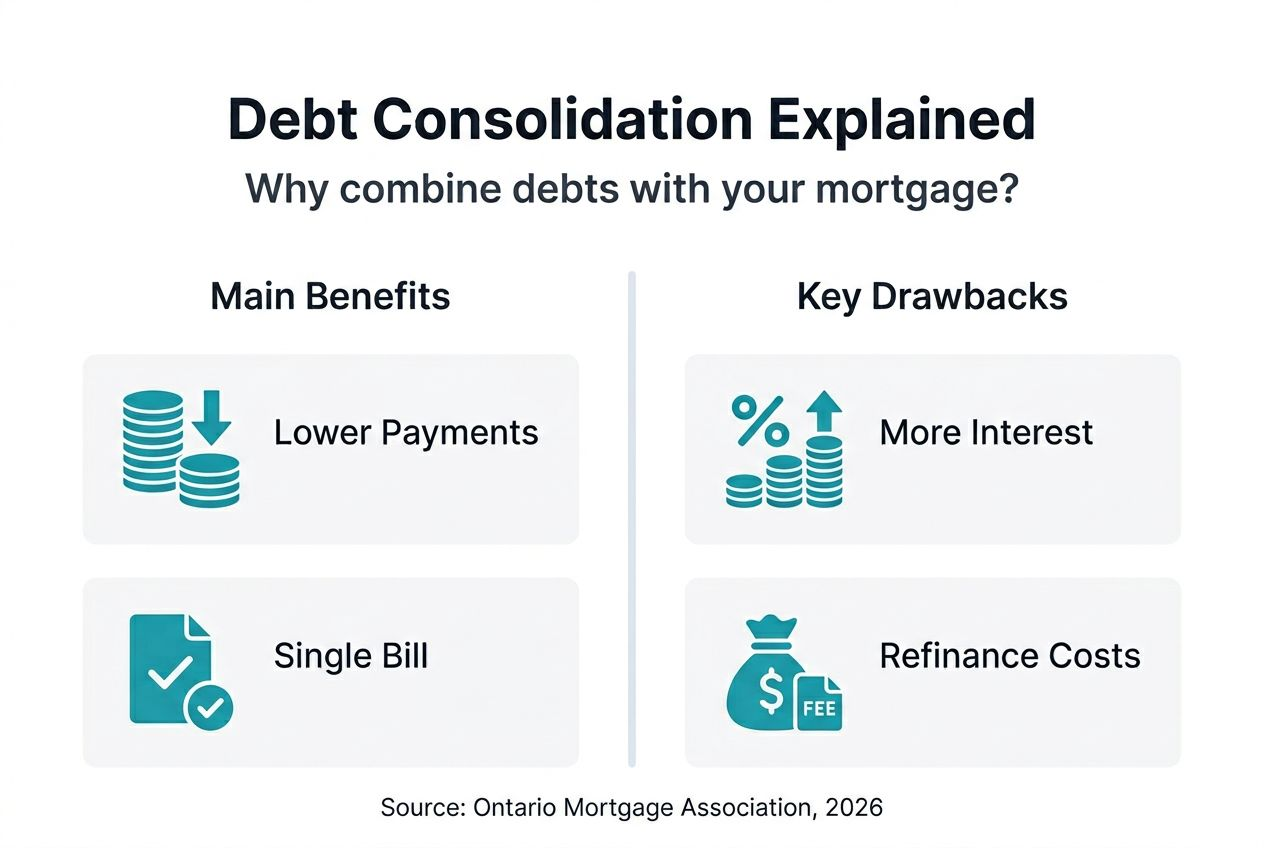
Lower monthly payments stand out as the primary benefit. When you spread debt repayment across 20 or 25 years instead of five years, each payment drops considerably. Simplified finances mean dealing with one lender, one payment date, and one interest rate rather than tracking multiple creditors.

Potentially lower interest rates compared to credit cards create genuine savings on interest charges each month. A mortgage at 5.5% costs far less than credit cards charging 19.99%, reducing the amount going toward interest rather than principal reduction.
Disadvantages and risks
Debt consolidation can improve cash flow by lowering monthly payments but usually increases total interest paid over the mortgage term. Refinancing extends repayment periods to 25 or 30 years, increasing overall interest costs dramatically. A $20,000 debt paid over 25 years accumulates substantially more interest than the same debt cleared in five years, even at a lower rate.
High mortgage prepayment penalties and fees when refinancing can eliminate initial savings. Breaking your mortgage early triggers penalties calculated using interest rate differential or three months’ interest, whichever costs more. These penalties frequently reach $5,000 to $15,000 depending on your remaining term and rate.
| Pros | Cons |
|---|---|
| Significantly lower monthly payments | Much higher total interest over time |
| Single payment simplifies budgeting | Prepayment penalties can cost thousands |
| Lower interest rate than credit cards | Requires home equity and lender approval |
| Reduced financial stress | Risk losing home if payments aren’t maintained |
| Potential credit score improvement | Temporary credit score dip from application |
Refinancing requires qualifying under lender rules and may temporarily impact credit scores. Lenders assess your income, employment stability, credit history, and debt-to-income ratio. Debt consolidation vs refinancing options each carry different qualification requirements and cost structures.
Pro Tip: Calculate the total interest you’ll pay under both scenarios before deciding. Multiply your current monthly payments by the remaining months to find total cost, then compare against the proposed mortgage amount multiplied by its term in months. The difference reveals your true cost.
Key considerations before consolidating debt with your mortgage
Before proceeding with consolidation, assess several critical factors that determine whether this strategy genuinely improves your financial position.
Calculate all costs comprehensively
Homeowners should assess total costs, including penalties, fees, and interest, before consolidating debt. Beyond prepayment penalties, expect appraisal fees ($300 to $500), legal fees ($800 to $1,500), and potential lender administration charges. These upfront costs must be factored into your break-even calculation.
Understand mortgage prepayment penalties
Mortgage prepayment penalties can cost thousands when refinancing or breaking the mortgage. Fixed-rate mortgages typically calculate penalties using the greater of three months’ interest or the interest rate differential for your remaining term. Variable-rate mortgages usually charge three months’ interest, making them less expensive to break.
Evaluate your refinancing eligibility
Follow these steps to determine if you qualify for mortgage refinance in Ontario:
- Calculate your home equity by subtracting your current mortgage balance from your property’s current market value
- Verify you have at least 20% equity remaining after consolidation, as lenders typically allow refinancing up to 80% loan-to-value
- Review your credit score and ensure it meets lender minimums, usually 650 or higher for competitive rates
- Document stable income sufficient to cover the new mortgage payment plus other obligations
- Gather recent pay stubs, tax returns, and debt statements for mortgage preapproval considerations
Address underlying spending habits
Consolidation treats the symptom, not the cause. If overspending created the debt, consolidating without addressing spending patterns leads to accumulating new debt on top of the larger mortgage. Create a realistic budget that prevents recurring debt problems post-consolidation.
Understand credit score impacts
Refinancing involves a hard credit pull that may temporarily affect your credit score. Most borrowers see a five to ten point temporary reduction from the inquiry. However, reducing your overall debt utilisation and maintaining consistent payments can improve your score significantly over six to twelve months.
Pro Tip: Request mortgage quotes within a 14-day window. Credit bureaus typically count multiple mortgage inquiries within two weeks as a single inquiry, minimising impact on your score.
Consult professionals for personalised guidance
Every financial situation differs. A mortgage broker analyses your specific circumstances, compares lender options, and identifies the most cost-effective consolidation approach. Professional advice helps you avoid costly mistakes and ensures you understand long-term implications.
Summary: is consolidating debt with your mortgage right for you?
Mortgage debt consolidation can simplify payments and improve monthly cash flow substantially, making it an attractive option for homeowners struggling with multiple high-interest debts. The immediate relief of lower monthly obligations provides breathing room in tight budgets and reduces the stress of juggling various payment deadlines.
However, consolidation helps manage multiple debts and improve cash flow but can increase total interest payments and may not suit everyone. Extending repayment from five years to 25 years means paying interest for two decades longer, potentially costing tens of thousands more despite the lower rate.
Other options like consumer proposals offer alternative debt solutions with 0% interest and asset protection, presenting another option to refinancing. Consumer proposals let you repay a portion of debts over a fixed timeline without touching home equity, making them worth exploring if you want a definite payoff date.
Careful consideration of personal finances and professional advice is key to making the right choice. Review these factors:
- Your current interest rates compared to potential mortgage rates after refinancing
- Total prepayment penalties and fees against potential monthly savings
- Your ability to maintain consistent payments over a longer timeline
- Whether spending habits have changed to prevent accumulating new debt
- Alternative solutions like debt consolidation vs refinancing approaches
No one-size-fits-all solution exists, so balance benefits against long-term costs. The right decision depends on your income stability, equity position, future financial goals, and commitment to avoiding new unsecured debt. Taking time to analyse your complete financial picture ensures you choose the path that genuinely improves your long-term financial health rather than simply postponing problems.
How Miracle Financial can help with debt consolidation and mortgage refinancing in Ontario
Navigating debt consolidation in Ontario requires expertise in both mortgage products and debt management strategies. Miracle Financial offers expert guidance to homeowners seeking debt consolidation through mortgage refinance in Ontario, helping you understand whether consolidation truly improves your financial position.

Our Ontario mortgage brokers assess your unique financial situation to find suitable options that balance immediate cash flow relief with long-term cost considerations. We help you understand prepayment penalties, refinancing costs, and eligibility requirements before you commit to any solution. Our team compares multiple lender options to secure competitive rates and terms that align with your goals. Connect with us for mortgage broker debt consolidation services to simplify your finances and improve your cash flow effectively.
Frequently asked questions
Is consolidating debt with my mortgage the best option?
Consolidation suits homeowners with sufficient equity who need immediate monthly payment relief and can commit to a longer repayment period. It works best when you’ve addressed underlying spending habits and want to simplify multiple high-interest debts into one manageable payment. Evaluate your financial goals, compare total costs, and consider alternatives like consumer proposals before deciding. Professional guidance from debt consolidation in Ontario experts helps determine if this approach aligns with your situation.
What are the costs associated with consolidating debt into a mortgage?
Costs include extended interest payments due to longer loan terms, refinancing fees typically ranging from $1,500 to $3,000, and possible mortgage prepayment penalties that can cost thousands. Appraisal fees, legal costs, and lender administration charges add to upfront expenses. Calculate all fees carefully before consolidating to understand the total cost compared to maintaining separate debts. The break-even point often takes two to four years depending on penalty size and interest savings.
Can consolidating debt with my mortgage affect my credit score?
Refinancing involves a hard credit inquiry that can temporarily lower credit scores by five to ten points. This dip typically recovers within three to six months. Responsible management post-refinancing, including consistent on-time payments and reduced debt utilisation, can improve your credit score significantly over the following year. The long-term credit benefits often outweigh the short-term inquiry impact.
What alternatives exist if mortgage refinancing isn’t right for me?
Consumer proposals offer a 0% interest payment plan with set payoff timelines and asset protection, making them attractive for those wanting debt freedom within five years. Debt management programmes, balance transfer credit cards, and personal consolidation loans provide other options depending on your debt level and creditworthiness. Seek advice from financial professionals to find the best fit for your financial needs and lifestyle, ensuring you choose a solution that addresses both immediate relief and long-term stability.