
Blog
Lower your monthly payments: debt consolidation mortgage guide Ontario


TL;DR:
- Debt consolidation mortgages lower payments by combining high-interest debts into a single, lower-rate mortgage.
- Proper preparation, including credit reports and debt details, is crucial to successful consolidation.
- Changing financial habits after consolidation is essential to ensure long-term debt reduction and financial health.
For many Ontario homeowners, high monthly payments across multiple debts have become a serious strain on household finances. Credit card balances, car loans, and lines of credit all carry interest rates that can reach 20% or higher, making it increasingly difficult to stay ahead. A debt consolidation mortgage offers a practical path forward by rolling those high-interest obligations into your existing mortgage at a significantly lower rate. This guide walks you through exactly how the process works, what you need to prepare, and the key considerations that will determine whether this strategy is right for your situation.
Table of Contents
- Understanding debt consolidation mortgages in Ontario
- Preparing to consolidate: What you need and common pitfalls
- Step-by-step: How to get a debt consolidation mortgage in Ontario
- What to expect: Results, risks, and how to make the most of your consolidation
- Our perspective: Why quick fixes fail and what works for Ontario homeowners
- Take the next step toward lower payments with expert help
- Frequently asked questions
Key Takeaways
| Point | Details |
|---|---|
| Lower payments possible | A debt consolidation mortgage can combine debts and lower your monthly payment, but isn’t right for every homeowner. |
| Careful preparation needed | Gather documents, assess penalties, and check spending habits before starting the process. |
| Long-term habits matter | Real progress comes from using the new structure to pay off debt faster and changing spending patterns, not just reducing payments. |
| Know the risks | Understand potential long-term costs and the risk to your home if you default after consolidating debts into your mortgage. |
Understanding debt consolidation mortgages in Ontario
A debt consolidation mortgage is a secured loan that uses your home’s equity to pay off multiple outstanding debts. Instead of juggling several payments at varying interest rates, you combine them into one mortgage payment, typically at a much lower rate than unsecured credit products carry. The result is a single, predictable monthly obligation that is often substantially lower than the sum of your previous payments.
In Ontario, this strategy is most commonly structured in one of two ways: through a mortgage refinance, where your existing mortgage is replaced with a larger one that includes your consolidated debts, or through a second mortgage that sits behind your primary mortgage and draws on available equity. Each path has distinct costs and qualifying criteria, which is why working with an experienced broker matters.
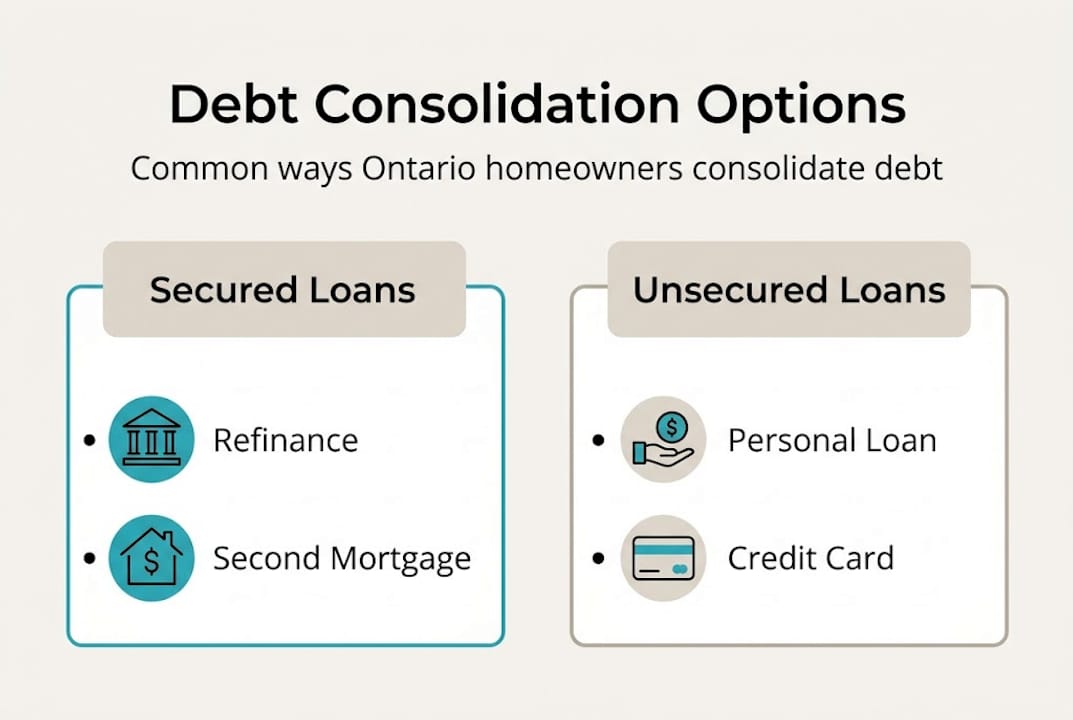
Unsecured vs. secured consolidation options
| Feature | Unsecured consolidation | Secured consolidation mortgage |
|---|---|---|
| Interest rate | 10%–29% typical | 4%–8% typical |
| Collateral required | No | Yes (your home) |
| Credit score impact | Moderate | Moderate short-term |
| Risk to home | None | Yes, if payments missed |
| Best for | Small debts, renters | Homeowners with equity |
Who benefits most from this approach? Homeowners who carry significant high-interest debt, have built meaningful equity in their property, and have a stable income are the strongest candidates. Those who are already close to their home’s maximum loan-to-value ratio, plan to sell soon, or have not addressed the spending patterns that created the debt in the first place are generally poor candidates.
The Financial Services Regulatory Authority of Ontario (FSRA) oversees mortgage brokers in the province and requires them to disclose all material risks before proceeding. This means your broker must explain the full cost of consolidation, including any penalties and long-term interest implications, before you sign anything.
As the Government of Canada notes on debt consolidation, consolidation mortgages can provide lower payments, simpler finances, and potential credit improvement, but they also carry real risks including foreclosure and increased long-term interest if the term is extended.
Important: If you are behind on mortgage payments, have little equity, or have not addressed the habits that led to your current debt load, a consolidation mortgage may worsen your financial position rather than improve it. Speak with a qualified broker before proceeding.
Understanding debt consolidation vs refinancing is also essential, as the two strategies differ in structure, cost, and long-term impact on your mortgage.
Preparing to consolidate: What you need and common pitfalls
Once you understand the core concept, the next step is proper preparation to avoid common mistakes and wasted effort. Arriving at a broker consultation without the right documents or a clear picture of your finances can delay approval or lead to a poorly structured deal.
Documents and information you will need:
- Current mortgage statement showing your balance, rate, and renewal date
- Details of all debts to be consolidated (balances, interest rates, minimum payments)
- Two years of income verification (T4s, NOAs, or business financials if self-employed)
- Recent property assessment or appraisal
- Credit report (your broker can pull this with your consent)
- Bank statements from the past 90 days
Are you a good candidate? Check these points:
- Your combined debt load exceeds $15,000
- You have at least 20% equity remaining after consolidation
- Your income is stable and verifiable
- You are committed to not accumulating new high-interest debt
The Government of Canada advises avoiding consolidation if your debt is small, you plan to sell your home soon, face high prepayment penalties, have unaddressed spending habits, or already carry a low mortgage rate. Each of these scenarios can turn a seemingly smart move into a costly one.
Numbered steps to prepare your finances:
- Pull your credit report and review it for errors before your broker does.
- List every debt with its current balance, interest rate, and monthly payment.
- Calculate your home’s approximate current market value and subtract your mortgage balance to estimate available equity.
- Contact your lender to confirm prepayment penalty amounts if you are mid-term.
- Review your monthly budget to identify and address any ongoing spending issues.
- Gather all required documents into a single organised folder before your first broker meeting.
Working with an experienced broker, particularly one focused on finding the right mortgage broker for your specific situation, can make the difference between a smooth process and a frustrating one. Reviewing mortgage solution examples from real Ontario homeowners can also help you set realistic expectations.

Pro Tip: Before your broker meeting, write down three specific questions about FSRA-required disclosures, including what the total interest cost will be over the new term and what penalties apply if you want to exit the mortgage early.
Step-by-step: How to get a debt consolidation mortgage in Ontario
With your documents gathered and pitfalls clear, you’re ready for the step-by-step walkthrough to consolidate your debts with a mortgage.
The application process, step by step:
- Consult a licensed mortgage broker. A broker who specialises in consolidation can assess your equity, debts, and income to determine the best structure and lender match.
- Review your options. Your broker will present refinance and second mortgage scenarios, including rate comparisons and total cost projections.
- Submit your application. Your broker packages your documents and submits to appropriate lenders, which may include banks, credit unions, or private lenders depending on your profile.
- Receive and review the commitment letter. Read every condition carefully, paying attention to prepayment privileges, penalties, and the amortisation period.
- Arrange a property appraisal. Most lenders require an independent appraisal to confirm your home’s value before approving the consolidation amount.
- Work with a real estate lawyer. In Ontario, mortgage transactions require a lawyer to register the new mortgage and disburse funds to pay off your debts.
- Funds are disbursed. Your lawyer pays off the listed debts directly, and you begin making your new, single mortgage payment.
Broker vs. direct-to-lender comparison:
| Factor | Using a mortgage broker | Going direct to your bank |
|---|---|---|
| Lender access | Multiple lenders, including private | Single institution |
| Rate negotiation | Broker negotiates on your behalf | Limited to that bank’s offerings |
| Approval flexibility | Higher for complex situations | Stricter qualification criteria |
| Cost | Broker fee may apply (disclosed upfront) | No broker fee |
| Best for | Self-employed, bruised credit, high debt | Strong credit, simple refinance |
The FSRA requires that Ontario consolidation mortgages are structured with full risk disclosure to protect borrowers throughout the process. Reviewing best mortgage options available in Ontario can help you understand the full range of products before committing.
Pro Tip: Once your consolidation is complete and paid-off accounts are closed, redirect the money you were spending on those old minimum payments directly to your new mortgage as a prepayment. Even modest extra payments can shorten your amortisation period and reduce total interest significantly.
What to expect: Results, risks, and how to make the most of your consolidation
With the process underway, it’s crucial you set clear expectations about your results and know how to keep your finances healthy going forward.
Most Ontario homeowners who consolidate high-interest debts into their mortgage see a meaningful reduction in their monthly payment obligations. A typical scenario involves replacing $30,000 in credit card and line-of-credit debt at 19%–22% interest with mortgage debt at 5%–7%, which can translate to monthly savings of $400 to $800 depending on the amounts and terms involved. Payment reductions in the range of 20%–40% are common for successful consolidations, though the exact outcome depends on your specific debt profile and the rate you qualify for.
Positive signs that consolidation is working for you:
- Your total monthly debt payments have dropped noticeably
- You are no longer carrying a balance on credit cards month to month
- Your credit score is trending upward after six to twelve months of consistent payments
- You have closed or reduced the limit on high-interest accounts
- You have a written budget that you are following consistently
However, risks are real. Extending your amortisation period means you may pay more total interest over the life of the loan, even at a lower rate. Missing mortgage payments puts your home at risk in a way that missing a credit card payment does not. And if the spending patterns that created the original debt remain unchanged, many homeowners find themselves with a larger mortgage and rebuilt credit card balances within two to three years.
As the Government of Canada warns, consolidation may extend debt if you do not address the spending habits that led to it in the first place. Lower monthly payments are only a lasting benefit if they are paired with a genuine change in financial behaviour.
Understanding the full range of mortgage types in Ontario can also help you evaluate whether a refinance, second mortgage, or another product best suits your long-term goals.
Our perspective: Why quick fixes fail and what works for Ontario homeowners
After seeing the expected outcomes, here is a candid perspective on what actually leads to lasting financial improvement for Ontario homeowners.
At Miracle Financial, we have seen many homeowners approach debt consolidation as a reset button. They consolidate, their monthly payments drop, and they feel immediate relief. But within two years, a significant number have rebuilt their credit card balances while still carrying the larger mortgage. The consolidation worked mechanically. The financial behaviour did not change.
The Government of Canada is clear that consolidation may extend debt if habits are unchanged, and our experience confirms this consistently. Consolidation is a tool, not a solution on its own.
What genuinely works is treating the lower payment as a starting point, not a finish line. The homeowners who benefit most are those who immediately redirect freed-up cash flow toward building an emergency fund or accelerating their mortgage paydown. They close paid-off accounts rather than leaving them open as a temptation. They work with a broker who explains not just the mechanics but the long-term cost implications of every decision.
Consolidation alone is not enough without changing your financial approach. Exploring debt consolidation solutions with a broker who asks the hard questions about your spending habits is the difference between a one-time fix and a lasting financial turnaround.
Pro Tip: Each time you receive a raise or bonus, set up an automatic increase to your mortgage payment by even $50 to $100 per month. Over a five-year term, this can reduce your amortisation period by years and save thousands in interest.
Take the next step toward lower payments with expert help
If you are carrying high-interest debt and your monthly payments are putting real pressure on your household budget, Miracle Financial can help you evaluate whether a debt consolidation mortgage is the right fit for your situation.
Our team works with banks, credit unions, alternative lenders, and private lenders across Ontario to structure solutions around your real financial picture, not just your credit score. Whether you need a mortgage refinance or want to explore debt consolidation solutions in Ontario, we provide straightforward analysis and honest guidance. Book a consultation today and speak to an expert who will walk you through your options without pressure or obligation.
Frequently asked questions
What is the minimum debt level to consider a debt consolidation mortgage?
Debt consolidation mortgages are generally most effective for debts above $15,000, since closing costs and refinancing fees can outweigh the savings on smaller amounts. The Government of Canada advises avoiding this strategy when your total debt is small.
How much can I expect my payments to drop?
Ontario homeowners consolidating higher-interest debts may see monthly payments drop by 20% to 40%, depending on the interest rates involved and the new mortgage term. Keep in mind that lower monthly payments can come with a higher total cost if the repayment period is extended.
Will a debt consolidation mortgage hurt my credit?
There may be a short-term dip in your credit score when the new mortgage is registered and existing accounts are closed, but consistent on-time mortgage payments typically lead to credit score improvement over the following months.
What if I have bad credit or no equity?
If you lack sufficient equity or carry poor credit, a consolidation mortgage may not be accessible or appropriate. Alternatives such as consumer proposals can address debt without putting your home at risk, and a broker can help you assess which path makes sense.
Can I get out of debt faster by consolidating?
Consolidation lowers your payments, but getting out of debt faster requires you to make extra payments or avoid accumulating new debt. Without those steps, the total repayment period may actually lengthen, costing you more over time.
Recommended
- Mortgage Brokers and Debt Consolidation in Ontario
- Debt Consolidation vs Refinancing: Choosing What Fits Vaughan Homeowners
- 7 Examples of Mortgage Solutions for Ontario Homeowners
- 7 Key Benefits of Refinancing for Ontario Homeowners – Miracle Financial
- Custom Home Financing Guide | Mighton Construction Ontario