
Blog
Debt consolidation mortgage Vaughan: real examples


TL;DR:
- Vaughan homeowners can significantly reduce their monthly debt payments by consolidating high-interest obligations into their home equity. Qualification requires maintaining at least 20% equity and meeting lender-specific credit scores, with various options like refinancing, HELOCs, or second mortgages available depending on individual finances. Effective debt consolidation relies on a well-planned exit strategy and careful consideration of costs, risks, and repayment timelines.
Many Vaughan homeowners carrying credit card balances at 19–22%, personal loans, and car payments know the feeling of watching minimum payments consume their paycheque without making a dent in the actual debt. Debt consolidation mortgage Vaughan real examples and scenarios show that rolling these high-interest obligations into your home equity can cut monthly outflows significantly and replace five separate bills with one manageable payment. This guide walks through the qualification requirements, step-by-step processes, second mortgage scenarios, and verified before-and-after case studies so you can assess what this strategy could realistically do for your finances.
Table of Contents
- Key takeaways
- Qualifying for debt consolidation in Vaughan
- Refinancing and HELOCs: a step-by-step guide
- Second mortgages for debt consolidation: real Vaughan scenarios
- Pitfalls to avoid when consolidating debt
- Verified outcomes: before and after comparisons
- What I have learned working with Vaughan clients
- How Miraclefinancial helps Vaughan homeowners consolidate debt
- FAQ
Key takeaways
| Point | Details |
|---|---|
| Equity is the entry point | You need at least 20% equity remaining after consolidation to qualify through any lender type. |
| Three main consolidation tools | Mortgage refinancing, HELOCs, and second mortgages each suit different credit and income situations. |
| Real savings are substantial | Homeowners consolidating 22% credit card debt into 5% mortgage products save thousands annually. |
| Penalties can offset short-term gains | Prepayment penalties on fixed mortgages must be calculated before breaking your term early. |
| Exit strategies matter | A clear plan to refinance out of higher-cost second mortgages protects your long-term financial health. |
Qualifying for debt consolidation in Vaughan
Before you explore which product fits your situation, you need to understand what lenders actually look at. The requirements differ considerably depending on whether you approach a bank, a B-lender, or a private lender.
Equity requirements apply universally. Every consolidation route, whether refinancing, a HELOC, or a second mortgage, requires that you retain at least 20% equity in your home after the new financing is in place. For a Vaughan home currently valued at $1.1 million with a $700,000 mortgage balance, that means you have access to roughly $180,000 before hitting the 80% loan-to-value ceiling.
Credit score thresholds vary meaningfully by lender type:
- Banks and credit unions (A-lenders): Generally require 680 or above for refinancing and HELOC qualification
- B-lenders (trust companies and monoline lenders): Will typically work with scores between 550 and 680, at modestly higher rates
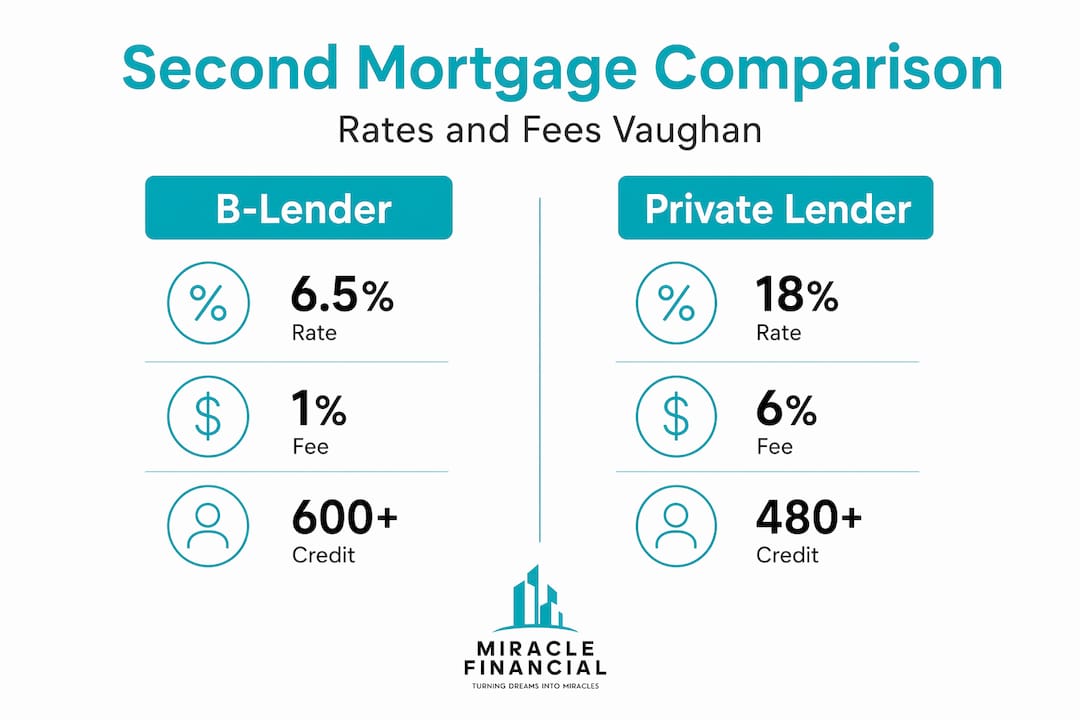
- Private lenders: Approve borrowers with scores as low as 480 if home equity is sufficient, focusing primarily on the property value rather than the credit profile
A significant 2026 regulatory change affects how you shop lenders at renewal. The stress test no longer applies when switching lenders at renewal for uninsured mortgages, provided the loan amount and amortisation period remain unchanged. This opens meaningful opportunities for homeowners with 20% or more equity to secure better rates without re-qualifying at the higher stress test threshold.
| Lender type | Typical rate (2026) | Minimum credit score | Best suited for |
|---|---|---|---|
| A-lender (bank/credit union) | 4.69%–5.49% | 680+ | Strong credit, T4 income |
| B-lender | 5.50%–7.50% | 550–679 | Bruised credit, self-employed |
| Private lender (second mortgage) | 8%–18% | 480+ | Poor credit, urgent need |
Pro Tip: Before submitting any application, request a copy of your credit report from both Equifax and TransUnion and dispute any inaccurate items. A 30-point improvement in your score can shift you from B-lender pricing to A-lender pricing, saving thousands over your term.
Upfront costs also factor into your decision. Expect mortgage discharge fees, legal fees, an appraisal, and potential lender administrative charges. These fees vary by province and lender and can add $2,000 to $5,000 or more to your total consolidation cost, so they need to be weighed against projected monthly savings.
Refinancing and HELOCs: a step-by-step guide
Mortgage refinancing and home equity lines of credit are the two lowest-cost paths for debt consolidation. They work differently, and the right choice depends on your mortgage’s current term, your credit profile, and how much flexibility you need.
When refinancing makes sense: If your mortgage is near its renewal date or if the interest rate differential (IRD) penalty is small relative to your projected savings, breaking your mortgage early to consolidate high-interest debt can pay off quickly. Cash-out refinancing can produce payback on closing costs under six months when the eliminated debt carries rates above 15%.
The step-by-step process for a Vaughan refinance or HELOC consolidation typically looks like this:
- Assess your equity position. Order a current property appraisal or use a recent comparable sale to estimate your home’s value, then calculate 80% of that figure minus your current mortgage balance. That remainder is your available equity.
- Calculate your prepayment penalty. Contact your current lender and request the penalty amount in writing. For fixed-rate mortgages, penalties are typically the greater of three months’ interest or the IRD. IRDs can reach tens of thousands of dollars mid-term.
- Gather documentation. Lenders require two years of NOAs (Notices of Assessment), recent pay stubs or business financials, a mortgage statement, and a list of all debts to be consolidated.
- Compare lender options. A mortgage broker submits your application across multiple lenders simultaneously, which is far more efficient than approaching banks one at a time.
- Review the cost-benefit calculation. Take your total projected savings over 12 months and subtract all upfront fees and penalties. If you recover costs within a reasonable timeframe, the refinance is financially sound.
- Close and discharge. Your lawyer discharges existing debts from the proceeds and registers the new mortgage. Outstanding credit card balances, lines of credit, and personal loans are paid off at closing.
HELOC qualification follows a slightly different path. You need a minimum credit score of around 650 to 680 with most A-lenders, and HELOC rates in 2026 run approximately 5.45% to 5.95% variable. The key advantage of a HELOC is flexibility: you draw only what you need, repay it, and re-borrow without reapplying. The risk is that the variable rate can rise, increasing your borrowing cost over time.
Pro Tip: If you have prepayment privileges on your existing mortgage (typically 10%–20% of the original principal annually), use them before refinancing. Reducing your principal balance lowers the IRD penalty and reduces the amount you need to refinance.
For a real Vaughan mortgage refinancing example: a homeowner on Dufferin Street with a $650,000 mortgage balance on a $950,000 home consolidates $55,000 in credit card and personal loan debt. After refinancing to $705,000 at 5.10%, their monthly payment rises by $180, but they eliminate $1,650 per month in minimum payments on unsecured debt. Net monthly savings exceed $1,400 with closing costs recovered within five months.
Second mortgages for debt consolidation: real Vaughan scenarios
For homeowners who cannot qualify for refinancing due to credit issues, recent self-employment, or a mortgage term that carries prohibitive penalties, second mortgages serve as a practical bridge. The costs are higher, but the alternative, carrying $60,000 in credit card debt at 22%, is often worse.
Second mortgages in Ontario carry rates between 6.5% and 18% with upfront lender fees ranging from 1% to 6%. Despite those numbers, they make financial sense in specific situations.
Scenario A: Self-employed homeowner in Vaughan with credit challenges
Marco is a contractor who owns a $1.05 million home in Woodbridge with a $620,000 first mortgage. He has $80,000 in credit card and line of credit debt at an average of 21%. His credit score is 590 and his stated income makes A-lender refinancing unavailable. He takes a private second mortgage in Ontario for $80,000 at 11.5%, paying a 4% lender fee ($3,200) upfront.

| Item | Before consolidation | After second mortgage |
|---|---|---|
| Credit card minimum payments | $2,400/month | $0 |
| Second mortgage payment | $0 | $895/month |
| Net monthly saving | — | $1,505/month |
| Upfront cost (fee + legal) | — | $5,200 |
| Payback period | — | Under 4 months |
Marco’s plan: spend 18 months rebuilding his credit score above 650, then roll the second mortgage into a refinanced first mortgage at renewal under B-lender or A-lender terms.
Scenario B: Vaughan couple managing multiple consumer debts
Priya and Dev own a $1.2 million home with a $750,000 first mortgage. They have $45,000 spread across three credit cards, a car loan, and a department store line of credit. Their credit scores are 620 and 605. A B-lender approves a second mortgage at 9.25% for $45,000 with a 2% lender fee.
Monthly minimum payments on the five debts total $1,850. The new second mortgage payment is $690 per month. Monthly savings: $1,160. Total upfront costs including legal and appraisal: $3,100. Payback period: under three months.
Key risks to keep in mind with second mortgages:
- Higher interest rates mean you pay significantly more over the full term compared to refinancing
- Lender and legal fees are due upfront and add to your total cost of borrowing
- Failure to service the second mortgage can result in power-of-sale proceedings on your home
- Without a clear exit strategy, a temporary bridge loan can become a long-term financial burden
The importance of a clear exit strategy cannot be overstated. Brokers who specialise in this space plan the refinance out before the second mortgage is even funded.
Pitfalls to avoid when consolidating debt
Mortgage debt consolidation done poorly can leave you worse off than before. These are the situations Vaughan homeowners most commonly encounter.
“The most expensive mistake I see is homeowners who consolidate debt into their mortgage, free up their credit cards, and then max them out again within 18 months. You have turned 20 years of mortgage payments into credit card debt twice over.”
Prepayment penalties are the most common unexpected cost. IRD penalties can reach tens of thousands of dollars mid-term, particularly on fixed-rate mortgages held with major banks. Always request the exact penalty in writing before signing anything.
Extending short-term debt over long amortisation periods is a subtler trap. Consolidating a $40,000 personal loan into a 25-year mortgage at 5% does lower your monthly payment dramatically, but the total interest paid over two decades can exceed the original debt. The debt management strategies that work best pair mortgage consolidation with an accelerated repayment plan on the consolidated amount.
Rising rates on variable products present a real risk. A HELOC at 5.45% today could rise if the Bank of Canada adjusts its policy rate. Stress test your budget at 7% before relying on a variable-rate product for large-scale consolidation.
Not accumulating new unsecured debt post-consolidation is the single most critical behavioural commitment. Successful debt consolidation in Ontario requires treating cleared credit cards as closed accounts, at least for the period it takes to stabilise your financial position.
Verified outcomes: before and after comparisons
These figures illustrate actual-type results seen in Ontario consolidation cases, structured around the Vaughan market.
| Scenario | Debts consolidated | Rate before | Rate after | Monthly saving | Payback period |
|---|---|---|---|---|---|
| Refinance (A-lender) | $55,000 credit cards + personal loan | 21% average | 5.10% | $1,404/month | Under 6 months |
| B-lender second mortgage | $45,000 across 3 debts | 19.5% average | 9.25% | $1,160/month | Under 3 months |
| Private second mortgage | $80,000 credit + LOC | 21% average | 11.5% | $1,505/month | Under 4 months |
The Barrie couple referenced in independent Ontario research paid $8,400 in total closing costs and saved $9,724 per year in interest after consolidation, recovering their full costs in well under a year. Similar outcomes are achievable in Vaughan given the strong equity positions many homeowners hold.
Pro Tip: Ask your broker to model three scenarios side by side: refinancing, a HELOC, and a second mortgage. Each has different break-even timelines and risk profiles. Seeing all three on paper makes the right choice much clearer.
For homeowners exploring Ontario mortgage refinancing examples and wanting to see personalised numbers, consulting with a broker before making any decisions is the most efficient use of your time.
What I have learned working with Vaughan clients
I have worked with enough homeowners in Vaughan carrying high-interest debt to say this with confidence: the risk is rarely the mortgage product. The risk is the plan behind it, or the absence of one.
Most articles on this topic tell you the rates and stop there. What they miss is the exit strategy conversation. When I help a client into a private second mortgage, the first document I model is not the payment schedule. It is the 18-month credit rebuilding plan that gets them refinanced into an A-lender product at renewal. Without that, the second mortgage becomes a lifestyle, not a bridge.
The 2026 stress test changes at renewal genuinely shift the math for homeowners who have been trapped at their current lender. More competition, better rates, and easier switching are real benefits available right now.
What I have also found is that homeowners with credit challenges consistently underestimate how much private lenders value equity over credit scores. A 590 credit score with $350,000 in home equity is a much stronger application than many people realise. You need a broker who knows which lenders operate in that space and how to structure the deal correctly.
— Miracle
How Miraclefinancial helps Vaughan homeowners consolidate debt
If your bank has declined your refinancing application or your credit profile makes traditional qualification difficult, Miraclefinancial has the lender relationships and structuring experience to find you a workable path forward.
Miraclefinancial works with A-lenders, B-lenders, and private lenders across Ontario, specialising in debt consolidation solutions for homeowners dealing with high-interest debt, self-employment income, or past credit challenges. Whether you need a full cash-out refinance, a HELOC, or a second mortgage to bridge to better terms, the team structures each deal around your actual financial picture rather than a rigid approval checklist. Vaughan homeowners can also access private lending options when banks say no. Book a consultation today to see exactly what your equity position could do for your monthly cash flow.
FAQ
How much equity do I need to consolidate debt in Vaughan?
You need at least 20% equity remaining in your home after the new financing is in place. For a $1 million Vaughan property, that means your total mortgage debt cannot exceed $800,000 after consolidation.
Will I qualify if my credit score is below 650?
Yes, through B-lenders or private lenders. Private lenders approve applicants with scores as low as 480, provided sufficient home equity exists, though rates and fees are higher than A-lender products.
What are the biggest costs when breaking a mortgage early?
The main costs are the prepayment penalty (typically the greater of three months’ interest or the IRD), plus discharge fees, legal fees, and an appraisal. These can total $5,000 to $20,000 or more depending on your lender and remaining term.
Does the 2026 stress test change affect debt consolidation?
Yes. Homeowners switching lenders at renewal for uninsured mortgages no longer need to re-qualify under the stress test if the loan amount and amortisation remain unchanged, making it easier to shop for better consolidation rates.
How long does the consolidation process take?
A standard refinance or HELOC approval typically takes two to four weeks. Private second mortgages can close in as few as five to ten business days, which makes them useful when debt pressure is urgent.