
Blog
Debt consolidation mortgage Vaughan: real scenarios guide


TL;DR:
- Managing multiple high-interest debts alongside a mortgage can be challenging, but debt consolidation mortgages may lower payments and simplify finances for Vaughan homeowners. Qualification depends on stress tests, income ratios, and lender criteria, with alternatives like second mortgages or private lenders available if needed. Proper preparation and working with a knowledgeable broker can help homeowners achieve better financial outcomes through tailored consolidation strategies.
Managing multiple high-interest debts while keeping up with a mortgage is one of the most stressful financial situations an Ontario homeowner can face. For many Vaughan residents juggling credit card balances, car loans, and lines of credit on top of their monthly mortgage payment, the numbers simply stop adding up. Debt consolidation mortgage Vaughan real examples and scenarios show that this strategy, when applied correctly, can meaningfully reduce monthly payments and simplify your financial life. This guide walks through exactly how these mortgages work, who qualifies, and what realistic outcomes look like for homeowners in situations just like yours.
Table of Contents
- Understanding debt consolidation mortgages and qualifying criteria
- Real Vaughan homeowner scenarios: how debt consolidation mortgages work
- Preparing for your debt consolidation mortgage application
- Executing your debt consolidation mortgage: steps and common pitfalls
- Verifying results and managing your mortgage post-consolidation
- Why conventional advice on debt consolidation mortgages often misses the mark
- Miracle Financial solutions for your debt consolidation mortgage needs in Vaughan
- Frequently asked questions
Key Takeaways
| Point | Details |
|---|---|
| Understand OSFI B-20 Stress Test | You must qualify at the higher of 5.25% or contract rate + 2% with loan-to-income limits. |
| Calculate prepayment penalties | Refinancing mid-term often incurs penalties; weigh these against your savings. |
| Prepare thoroughly before application | Collect income proof, check credit, and understand lender requirements to improve approval odds. |
| Explore real scenarios | Personalized examples help reveal how consolidation may affect your monthly payments and finances. |
| Work with expert brokers | Experienced Vaughan brokers can uncover options beyond banks to fit your unique debt situation. |
Understanding debt consolidation mortgages and qualifying criteria
A debt consolidation mortgage allows you to roll multiple high-interest debts into your existing mortgage or a new mortgage product, replacing several monthly payments with one, typically at a much lower interest rate. The appeal is straightforward: credit cards often charge 19.99% or more, while a mortgage rate might sit at 5% to 6%. Combining those balances into your mortgage can generate significant monthly savings.
However, qualifying is not automatic. In Ontario, federally regulated lenders must follow OSFI’s B-20 guideline, which requires you to qualify at the higher of 5.25% or your contract rate plus 2%. This is often called the stress test. For uninsured mortgages, which include most refinance situations, lenders are also subject to loan-to-income (LTI) caps set at 4.5 times your gross annual income. This means if your household earns $120,000 per year, your maximum mortgage exposure is $540,000.
Beyond the stress test rate, lenders calculate two debt service ratios to determine affordability:
- Gross Debt Service (GDS) ratio: Your housing costs (mortgage payment, property taxes, heating, and 50% of condo fees if applicable) must not exceed 39% of your gross income.
- Total Debt Service (TDS) ratio: All monthly debt obligations, including housing costs and any remaining unsecured debts, must not exceed 44% of your gross income.
- Prepayment penalties: Refinancing mid-term often triggers a penalty equal to three months’ interest or an interest rate differential (IRD) calculation. You must verify break-even timing before proceeding.
- Municipal taxes and heating: Vaughan homeowners, particularly those in newer builds with higher assessed values, need to account for above-average property tax figures in their GDS calculation.
| Qualifying factor | Requirement |
|---|---|
| Stress test rate | Higher of 5.25% or contract rate + 2% |
| LTI cap (uninsured) | Maximum 4.5x gross annual income |
| GDS ratio limit | Up to 39% of gross income |
| TDS ratio limit | Up to 44% of gross income |
Working with mortgage brokers specialising in debt consolidation gives you access to lenders across the full spectrum, including those whose documentation requirements differ from standard bank checklists. For example, notarising loan documents is a common requirement for certain lender types, and knowing how notarisation works in Ontario can prevent unexpected delays at closing.
Pro Tip: Before applying, run your own TDS calculation using your current debts and proposed mortgage payment. If you are already close to 44%, consolidating may require you to reduce your amortisation period or bring in a co-borrower to qualify.
With the rules clear, next we explore personalised Vaughan homeowner scenarios showing these principles in action.
Real Vaughan homeowner scenarios: how debt consolidation mortgages work
Understanding the theory is useful, but real life debt consolidation decisions are made when you look at actual numbers. The following scenarios are representative of the types of situations Vaughan homeowners regularly navigate.
Scenario one: full consolidation with clear savings
Marco and Priya own a detached home in Woodbridge valued at $1.2 million with a mortgage balance of $620,000 and three years remaining in their term. They carry $42,000 in credit card debt at 19.99% and a $28,000 car loan at 8.4%. Their combined income is $185,000.

Their TDS ratio with current debts sits at 46%, which is above the 44% threshold. By refinancing their mortgage at renewal and consolidating both debts into a new mortgage at 5.5%, their TDS drops to 40%. Monthly savings: approximately $1,200. The key here was timing the refinance to coincide with their mortgage renewal, avoiding any prepayment penalty entirely.
Scenario two: failed stress test, alternative route taken
Daniela is a self-employed contractor in Concord carrying $55,000 in unsecured debt. Her home is worth $900,000 with a $560,000 mortgage balance. Her declared income on her most recent Notice of Assessment is $72,000, giving her a maximum LTI of $324,000. Her current mortgage already exceeds what she could qualify for under today’s rules. A full refinance is not available to her through a federally regulated lender.
Instead, a second mortgage at a higher rate but for a shorter term allowed her to consolidate $40,000 of high-interest debt. While the second mortgage rate was 9.5%, it was still well below her credit card rates, and her monthly cash flow improved by $680. This is precisely the kind of situation where a single mortgage product is not the solution and a hybrid approach serves better.
Scenario three: partial consolidation to protect cash flow
Roberto in Maple has a mortgage renewal coming in five months. He has $30,000 in a line of credit and $18,000 in credit card balances. Rather than rushing to refinance immediately and triggering penalties, a refinance timed to renewal means he waits, then rolls all debts into the new mortgage. Total monthly savings: $890, with zero penalty cost.
These examples of mortgage consolidation illustrate a core truth: many homeowners adjusting to rate changes have found that timing and structure matter as much as the interest rate itself.
Key factors affecting outcome in each scenario:
- Current mortgage term remaining and penalty exposure
- Verified income for stress test purposes
- Combined LTV (loan-to-value) after consolidation
- Whether a federally or provincially regulated lender is the right fit
- Whether a second mortgage or private lender fills the gap
| Scenario | Debt consolidated | Monthly saving | Strategy used |
|---|---|---|---|
| Marco and Priya | $70,000 | $1,200 | Refinance at renewal |
| Daniela | $40,000 | $680 | Second mortgage |
| Roberto | $48,000 | $890 | Delayed refinance at renewal |
Now that you have seen examples, let us look at the practical steps to prepare for consolidation.
Preparing for your debt consolidation mortgage application
Preparation separates a smooth application from one that stalls at the lender level. Vaughan homeowners applying for a debt consolidation mortgage need to gather specific documentation and address any issues before the file goes to a lender.
Documents and information you will need:
- Two years of personal tax returns and Notices of Assessment from the CRA
- Recent pay stubs (typically the last 60 to 90 days) or, for self-employed applicants, business financial statements
- A current mortgage statement showing your balance, rate, and remaining term
- Statements for all debts to be consolidated, including balances and minimum payments
- A current property tax bill, since Vaughan property taxes factor directly into your GDS calculation
- Proof of home insurance
Credit report review is essential before you apply. Errors on your Equifax or TransUnion report can suppress your score and affect lender approval. Request both reports and dispute any inaccuracies at least 30 to 60 days before your planned application date.
It is also worth noting that provincially regulated lenders such as credit unions are not required to follow OSFI B-20 in the same way federally regulated banks are. This matters significantly if your income or debt ratios put you just outside bank qualification thresholds. A credit union may assess your file under slightly different criteria, giving you another avenue to explore.
For borrowers with bruised credit or non-traditional income, reviewing bad credit mortgage options specific to Vaughan early in the process sets realistic expectations and avoids wasted time with lenders who will not approve the file.
Pro Tip: Use the mortgage approval checklist designed for Vaughan homeowners to organise your documents in advance. Lenders respond faster and more favourably to complete, well-organised application packages.
Having prepared, here is how to execute your consolidation mortgage application successfully.
Executing your debt consolidation mortgage: steps and common pitfalls
With your documents in order, the application process follows a clear sequence. Skipping steps or misunderstanding lender requirements at this stage is where many borrowers lose money or time.
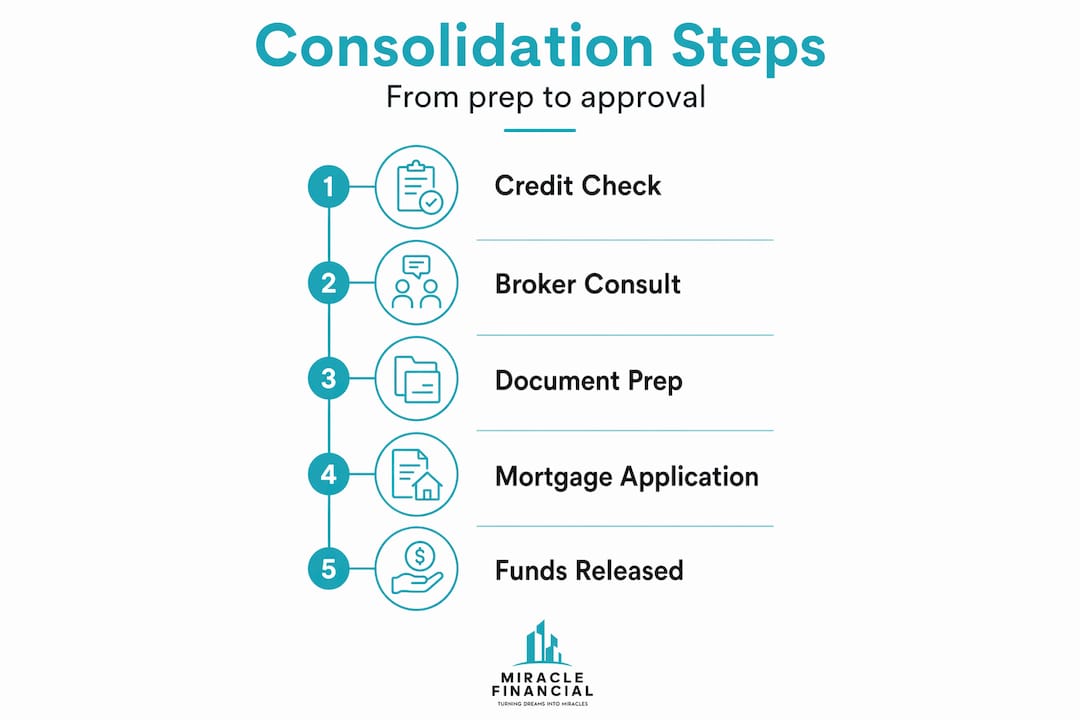
Step-by-step process:
- Select the right lender type. Work with a broker who can assess whether a bank, credit union, alternative lender, or private lender is best suited to your current financial profile.
- Request pre-approval. Confirm your income, debt ratios, and property value support the requested loan amount before committing to any lender.
- Submit complete documentation. Provide all required notarised or certified documents your lender specifies. Missing paperwork is the most common cause of delays.
- Review and negotiate mortgage terms. Focus on the interest rate, prepayment privileges, and penalty structure. A mortgage with generous prepayment privileges can save thousands over the term.
- Close and allocate funds. Once the debt consolidation mortgage closes, use the proceeds immediately to repay the high-interest debts identified in your application. Do not let funds sit unallocated.
Common mistakes to avoid:
- Ignoring prepayment penalties: mid-term refinancing penalties can range from three months’ interest to a much larger IRD calculation. Always model this before proceeding.
- Underestimating the stress test impact on loan size: many borrowers discover they qualify for less than expected because the qualifying rate significantly reduces their purchasing power.
- Consolidating without addressing spending habits: rolling debt into a mortgage and then rebuilding credit card balances is a costly pattern that leaves you worse off in five years.
- Choosing the lowest rate without reviewing penalty terms: a 0.1% lower rate on a closed mortgage with a steep IRD penalty often costs more than a slightly higher rate with a flexible prepayment structure.
Pro Tip: Ask your broker to model mortgage refinance timing scenarios with and without the penalty. In many cases, waiting three to six months for a term to mature eliminates thousands in penalty costs and changes whether the consolidation makes financial sense at all.
Once your mortgage is in place, monitoring progress ensures the consolidation meets your financial goals.
Verifying results and managing your mortgage post-consolidation
The consolidation is complete, but the financial work is not. Ongoing management of your new mortgage is what determines whether the strategy delivers its intended results over time.
Post-consolidation management checklist:
- Compare your new total monthly outgoing to your pre-consolidation baseline every 90 days for the first year.
- Avoid taking on new unsecured debt. A consolidated mortgage does not signal a return to available credit; it is a reset that requires disciplined spending.
- Set aside a monthly buffer fund to cover unexpected rate increases at renewal. Many homeowners facing renewal after recent rate hikes have experienced payment increases of hundreds of dollars per month.
- Begin reviewing mortgage debt consolidation savings six to twelve months before your mortgage renewal date. This gives you time to negotiate better terms or switch lenders without rushing.
- Seek advice immediately if your financial situation changes significantly. Job loss, illness, or a major expense should prompt a conversation with your broker before a missed payment occurs.
Pro Tip: Treat your monthly savings as a structured payment toward an emergency fund or accelerated mortgage paydown. Homeowners who do this consistently are in a far stronger position at renewal than those who absorb the savings into daily spending.
Having covered practical management, here is a fresh take on why debt consolidation mortgages deserve more careful scrutiny in current market conditions.
Why conventional advice on debt consolidation mortgages often misses the mark
Most articles about debt consolidation mortgages focus on the interest rate differential. Save on your rate, reduce your payment, done. This framing is incomplete and, in some cases, actively misleading for Ontario homeowners in 2026.
The reality is that OSFI’s tightened B-20 guidelines, combined with lender-level LTI caps, have significantly reduced refinance access for highly leveraged homeowners. Someone who purchased in Vaughan at peak pricing with a large mortgage is often not eligible for a straightforward debt consolidation refinance through their bank, regardless of how good their payment history is. The LTI ceiling cuts them off before the conversation even begins.
What generic guides also miss is the prepayment penalty problem. A homeowner three years into a five-year fixed mortgage may face an IRD penalty of $15,000 to $25,000 depending on how far rates have moved. If the consolidation only saves $400 per month, break-even is three to five years away. That is a significant commitment to verify before signing anything.
The stronger approach is to work with a trusted mortgage broker in Vaughan who understands the local market, knows which lenders are currently flexible on LTI, and can identify whether a second mortgage, private lending bridge, or a hybrid structure serves your situation better than a single refinance. The right broker can also identify renewal timing advantages that reduce or eliminate penalty exposure entirely. These are not details you find in a generic debt consolidation guide, and they are often the difference between a consolidation that works and one that costs you more than it saves.
Miracle Financial solutions for your debt consolidation mortgage needs in Vaughan
If you recognise your situation in any of the scenarios above, Miracle Financial is built to help you move forward with clarity and confidence. We specialise in debt consolidation solutions for Vaughan and Ontario homeowners, including those who have already been declined by their bank.
Our team works across banks, credit unions, alternative lenders, and private lenders to structure consolidation mortgages around your real financial picture, not just an idealised one. Whether you need a full mortgage refinance in Ontario, a second mortgage to bridge a gap, or a private lending solution for an urgent situation, we have the lender relationships and local experience to find the right fit. We help you navigate the OSFI B-20 stress test, understand your options, and make a decision that improves your finances for the long term. Book your no-obligation consultation with our Vaughan mortgage team and get a tailored plan built around your numbers.
Frequently asked questions
What is a debt consolidation mortgage?
A debt consolidation mortgage combines multiple debts into one new mortgage loan, often at a lower interest rate, to simplify payments and reduce monthly expenses. It replaces several creditor obligations with a single mortgage payment, which is typically far more manageable.
How does the OSFI B-20 stress test affect my debt consolidation mortgage application?
OSFI B-20 requires you to qualify at the higher of 5.25% or your contract rate plus 2%, along with LTI limits for uninsured mortgages, which can determine how much you are eligible to borrow. This means your actual approved loan amount may be lower than you expect based on today’s rates alone.
Can I refinance mid-term without penalties when consolidating debt?
Generally, no. Mid-term refinancing typically triggers prepayment penalties such as three months’ interest or an IRD calculation; always verify whether the consolidation savings outweigh this cost before proceeding.
What happens if I do not pass the mortgage stress test for consolidation?
If you do not qualify, you may need to reduce your loan amount, reduce other debts, or explore alternative lenders such as provincially regulated credit unions or private lenders who operate under different qualification criteria. A mortgage broker can assess all available paths quickly.
Are there alternatives if traditional banks decline my debt consolidation mortgage application?
Yes. Second mortgages, private lending, and credit union financing are all viable paths when banks decline your application, particularly when your LTI ratio or credit profile falls outside standard bank guidelines.