
Blog
Debt consolidation mortgages in Ontario: How much can you save?


TL;DR:
- Debt consolidation mortgages in Ontario offer lower interest rates by leveraging home equity.
- Proper preparation, including property appraisal and credit assessment, is essential for successful consolidation.
- Discipline to avoid new debt and strategic prepayments are crucial for maximizing savings.
If you’re managing a credit card balance at 19.99%, a car loan at 8%, and a line of credit at 12%, the combined monthly payments can feel relentless. Many Ontario homeowners in this position wonder whether rolling everything into their mortgage could actually reduce what they owe each month and how much they might save over time. The answer depends on your home equity, credit profile, and how disciplined you are after consolidating. This article walks through what a debt consolidation mortgage involves, what you need to qualify, the step-by-step process, realistic savings estimates, and the mistakes that quietly erase those gains.
Table of Contents
- Understanding debt consolidation mortgages in Ontario
- What you need before consolidating: Requirements and preparation
- How to consolidate your debts into your mortgage: Step-by-step process
- How much can you actually save? Comparing the numbers
- Common mistakes and how to avoid them
- What most guides get wrong about debt consolidation mortgage savings
- Find your best debt consolidation mortgage strategy today
- Frequently asked questions
Key Takeaways
| Point | Details |
|---|---|
| Lower payments, possible higher cost | A debt consolidation mortgage can reduce your monthly payments in Ontario but may increase total interest if repayment is extended. |
| Preparation is critical | Successful consolidation starts with organised finances, good documentation, and awareness of lender requirements. |
| Discipline prevents debt relapse | Sticking to a budget is essential to avoid ending up deeper in debt after consolidating. |
| Shop for competitive rates | Comparing multiple lenders is vital, especially for those with bruised credit, to secure the best possible deal. |
| Long-term view matters | Focus on the total cost of debt, not just monthly savings, to make the right decision for your situation. |
Understanding debt consolidation mortgages in Ontario
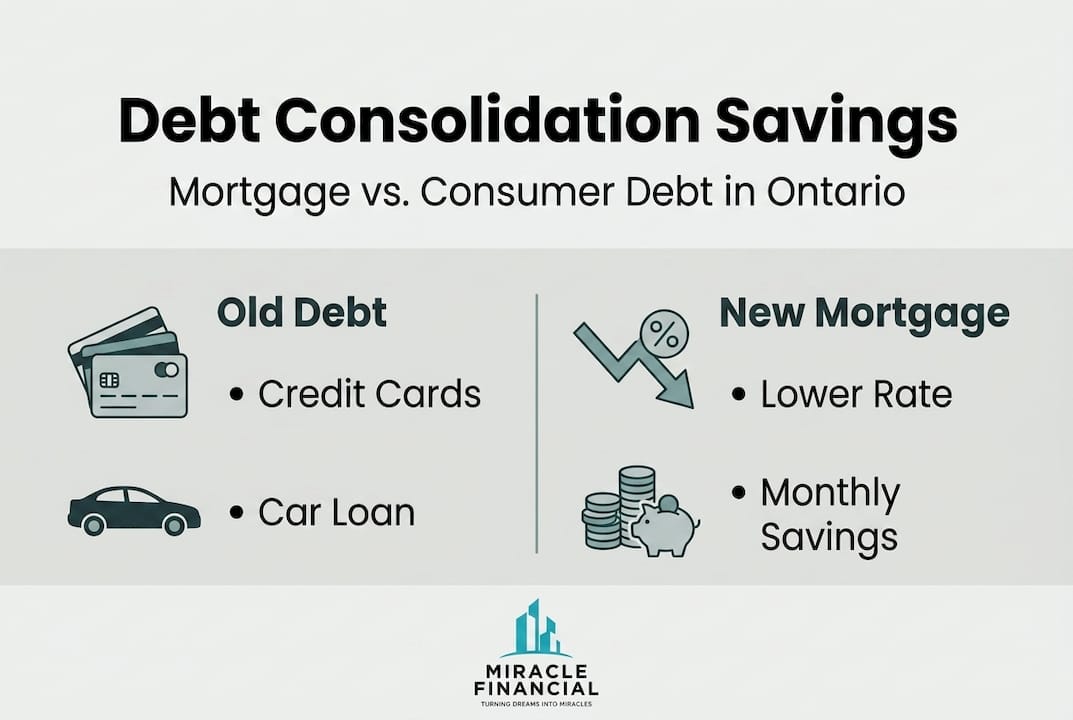
A debt consolidation mortgage is a refinancing strategy where you borrow against your home’s equity to pay off multiple high-interest debts, replacing several payments with a single, lower-rate mortgage payment. In Ontario, this typically involves either refinancing your existing mortgage to a higher balance or taking out a second mortgage or home equity line of credit (HELOC) to access the funds needed.
The core appeal is straightforward. Mortgage interest rates in Canada generally sit well below the rates charged on credit cards and personal loans, so consolidating can reduce your effective interest rate significantly. For example, if you carry $40,000 across credit cards and a personal loan at an average rate of 18%, rolling that into a mortgage at 6% means paying far less interest on the same balance each month.
Who benefits most from this approach?
Ontario homeowners who tend to benefit are those who:
- Hold at least 20% equity in their home after consolidation
- Carry two or more high-interest debts with combined balances above $15,000
- Have a stable income and the discipline to avoid rebuilding consumer debt
- Are struggling with monthly cash flow rather than total debt load
However, the Government of Canada warns that consolidation may extend your repayment period and increase total interest paid over the life of the loan. It also cautions borrowers to shop rates carefully, since poor credit can lead to higher rates than what you currently pay, and that ongoing financial discipline is essential to avoid accumulating new debt.
Benefits and drawbacks at a glance:
- Benefits: Lower monthly payments, simplified single payment, potential interest savings, reduced financial stress
- Drawbacks: Longer repayment timeline, home used as collateral, closing costs and penalties, risk of reaccumulating debt
Our debt consolidation mortgage guide covers these trade-offs in further detail for Ontario homeowners evaluating their options.
Pro Tip: A consolidation mortgage makes the most sense when your existing debts carry rates at least 5 to 8 percentage points above current mortgage rates. If the gap is smaller, the savings may not justify the closing costs and extended amortisation.
What you need before consolidating: Requirements and preparation
With the basics understood, the next step is knowing what you need to qualify and what to gather before approaching a lender or broker.
Essential documents and information:
- Recent mortgage statement showing current balance and rate
- Property valuation or recent appraisal (lenders typically require an independent appraisal)
- Proof of income: T4s, Notice of Assessment, or business financials if self-employed
- Current credit report and score
- Statements for all debts you intend to consolidate
- Government-issued identification
Ontario lenders generally require that your home retain at least 20% equity after the consolidation, meaning the total mortgage cannot exceed 80% of the home’s appraised value. This threshold is known as the loan-to-value (LTV) ratio. If your LTV would exceed 80%, you may still qualify through alternative or private lenders, though at higher rates.
Preparation overview table:
| Requirement | Why it matters |
|---|---|
| Home equity (min. 20%) | Determines how much you can borrow |
| Credit score (620+ preferred) | Affects rate and lender options |
| Proof of stable income | Confirms ability to service new mortgage |
| Debt statements | Confirms amounts being consolidated |
| Property appraisal | Establishes current market value |
| Mortgage penalty estimate | Reveals true cost of breaking existing mortgage |
Credit score plays a significant role in what rate you’ll receive. The Government of Canada notes that poor credit may lead to higher rates than what you currently pay on existing debts. This is a critical point: if your credit is severely bruised, consolidating could actually cost you more unless you work with lenders who specialise in non-prime solutions.
Watch for these red flags before proceeding:
- Your home has depreciated recently, reducing available equity
- You have a large mortgage prepayment penalty that offsets savings
- Your income is unstable or recently changed
- You’ve already consolidated debts once and rebuilt balances
Working with a mortgage broker who has access to banks, credit unions, and alternative lenders gives you a clearer picture of which lenders will consider your profile and at what rate, before you commit to anything.
How to consolidate your debts into your mortgage: Step-by-step process
With your documents ready and eligibility confirmed, here is how the process unfolds from start to finish.
-
Assess your debts and home equity. List every debt you want to consolidate, including balances, rates, and monthly payments. Then calculate your available equity by subtracting your current mortgage balance from 80% of your home’s estimated value. That figure is the maximum you can borrow.
-
Get a professional property appraisal. Most lenders require an independent appraisal to confirm your home’s current market value. Budget $300 to $500 for this step in Ontario.
-
Review your existing mortgage terms. Check whether breaking your mortgage early triggers a prepayment penalty. These penalties can range from three months’ interest to an interest rate differential (IRD) calculation and can easily reach several thousand dollars. Factor this into your total cost.
-
Compare lender options. A mortgage broker will present options from multiple lenders. Compare the annual percentage rate (APR), amortisation period, prepayment privileges, and any fees. Remember that consolidation may extend repayment, increasing total interest paid.
-
Submit your application. Your broker or lender will collect all documentation, run a credit check, and submit the application. Approval timelines vary from a few days with institutional lenders to 24 to 48 hours with private lenders.
-
Review and sign the commitment letter. Read the terms carefully, paying attention to the rate type (fixed vs. variable), amortisation length, and any conditions attached to approval.
-
Work with a real estate lawyer. In Ontario, a lawyer is required to register the new mortgage and disburse funds. Legal fees typically range from $1,000 to $1,500.
-
Confirm debt payouts. Once funds are released, confirm that each debt is paid in full and that accounts are closed as agreed. Request written confirmation from each creditor.
You may want to review comparing consolidation with refinancing to understand whether a full mortgage refinance in Ontario or a second mortgage better suits your situation before completing step four.
Pro Tip: Ask your lawyer or broker to disburse consolidation funds directly to creditors rather than to you. This removes any temptation to redirect the money and ensures debts are actually retired.
How much can you actually save? Comparing the numbers
Once the process is clear, the most important question is what the numbers actually look like. Savings depend on the gap between your existing debt rates and your new mortgage rate, the total balance being consolidated, and the new amortisation period.

Consider a realistic Ontario example. A homeowner carries $50,000 in consumer debt: $25,000 on credit cards at 19.99%, $15,000 on a personal loan at 10.5%, and $10,000 on a line of credit at 9%. Monthly payments total roughly $1,450. Rolling this into a mortgage at 6.5% over 20 years reduces the monthly payment on that $50,000 to approximately $375, a monthly saving of over $1,000.
Before and after consolidation comparison:
| Debt | Balance | Rate | Monthly payment |
|---|---|---|---|
| Credit card | $25,000 | 19.99% | $750 |
| Personal loan | $15,000 | 10.5% | $450 |
| Line of credit | $10,000 | 9.0% | $250 |
| Total before | $50,000 | ~16% | $1,450 |
| Consolidated mortgage | $50,000 | 6.5% | $375 |
| Monthly saving | $1,075 |
The monthly relief is real. However, the total interest paid over 20 years on $50,000 at 6.5% is approximately $37,000. If you had paid off those consumer debts aggressively in three to five years, the total interest would have been considerably less. This is exactly why the Government of Canada cautions that consolidation may extend repayment and increase total interest, and that discipline to avoid new debt is essential.
“Consolidating your debts into your mortgage may extend your repayment period and increase the total amount of interest you pay. You must have the discipline to avoid taking on new debt after consolidating.” — Government of Canada, Financial Consumer Agency
The savings calculation also shifts if your credit is bruised. A homeowner with a credit score below 600 may receive a rate of 9% or higher through a private lender, which narrows the gap significantly. Review debt consolidation best practices and the benefits of refinancing to understand how your credit profile affects the outcome.
Common mistakes and how to avoid them
Now that you understand the savings potential, it’s worth examining the traps that consistently erode those gains for Ontario homeowners.
The most common mistakes include:
-
Extending amortisation without a plan. Choosing a 25-year amortisation on consolidated debt feels comfortable but dramatically increases total interest. Where possible, keep the amortisation on the consolidated portion as short as your cash flow allows.
-
Not shopping multiple lenders. Accepting the first offer, especially with bruised credit, can mean paying 1 to 2 percentage points more than necessary. Even a 1% rate difference on $50,000 over 20 years adds thousands in interest.
-
Spending the monthly savings instead of applying them. The most common pattern after consolidation is that freed-up cash flow gets absorbed into lifestyle spending. The Government of Canada is explicit that discipline to avoid new debt is essential. Redirect savings to mortgage prepayments or an emergency fund instead.
-
Ignoring prepayment penalties. Breaking a closed mortgage early can cost $5,000 to $15,000 or more in Ontario, depending on the lender and the IRD calculation. Always get a penalty estimate in writing before proceeding.
-
Rebuilding consumer debt after consolidation. This is the single most damaging outcome. Homeowners who consolidate and then run credit cards back up within two to three years end up with both a larger mortgage and new consumer debt, in a worse position than before.
Practical strategies to avoid these mistakes include setting up automatic mortgage prepayments equal to at least half of your monthly savings, closing paid-off credit card accounts or reducing their limits, and scheduling a financial review every six months. You can explore how other Ontario homeowners have structured this at consolidate debt with mortgage.
What most guides get wrong about debt consolidation mortgage savings
Most articles on debt consolidation mortgages focus almost entirely on the monthly payment reduction and present it as a straightforward win. The number looks compelling. But the real measure of success is what happens in the 24 months after consolidation, not the day it closes.
The uncomfortable truth is that the financial behaviour that created the debt in the first place doesn’t automatically change when the debts disappear. Without a concrete plan for the freed-up cash flow, the monthly savings become invisible, absorbed into spending rather than wealth-building. This is not a character flaw; it’s a predictable pattern that lenders and brokers see repeatedly.
What genuinely changes outcomes is using any windfall, whether a tax refund, bonus, or inheritance, to make lump-sum mortgage prepayments immediately after consolidating. Most Ontario mortgages allow 10 to 20% annual prepayment privileges. Using them aggressively can shorten a 20-year amortisation by five years or more and save tens of thousands in interest. Our in-depth consolidation guide covers how to structure prepayments effectively alongside your consolidation strategy.
Find your best debt consolidation mortgage strategy today
Understanding the mechanics of a debt consolidation mortgage is the first step. Putting the right strategy in place for your specific situation, your credit profile, your home equity, and your cash flow goals, is where professional guidance makes a measurable difference.

At Miracle Financial, we work with Ontario homeowners across the credit spectrum, including those with bruised credit or urgent financing needs, to structure consolidation solutions through banks, credit unions, alternative lenders, and private lenders. Whether you’re exploring Ontario debt consolidation solutions for the first time or want to compare options side by side, our team provides clear, practical advice without pressure. Start with our debt consolidation mortgage guide or contact us directly to get a personalised assessment of what consolidating could save you.
Frequently asked questions
Will a debt consolidation mortgage lower my monthly payments in Ontario?
Yes, most Ontario homeowners see lower monthly payments when debts are rolled into a mortgage, but total interest paid may increase if you extend your repayment period.
Can I get a debt consolidation mortgage with bruised credit in Ontario?
It is possible, but poor credit leads to higher rates and stricter requirements, so working with a broker who accesses alternative and private lenders is important.
What risks should I consider before consolidating through a mortgage?
Key risks include increased total interest over a longer amortisation, home equity loss if property values drop, and the likelihood of reaccumulating new debt after consolidation.
How do I avoid ending up in more debt after consolidating?
The most effective approach is disciplined budgeting and redirecting all monthly savings to mortgage prepayments, since avoiding new debt requires a concrete plan, not just good intentions.
Is shopping for rates really that important?
Absolutely, because shopping rates carefully can prevent you from paying significantly more interest than necessary, particularly when your credit score limits your lender options.