
Blog
First-time homebuyer programs in Ontario explained


TL;DR:
- First-time homebuyer programmes in Ontario offer significant financial benefits, including tax rebates, savings accounts, and HST relief, which can total over $170,000 when properly coordinated.
- Eligibility depends on precise agreement dates, occupancy timelines, and builder participation, making early planning essential for maximum benefit.
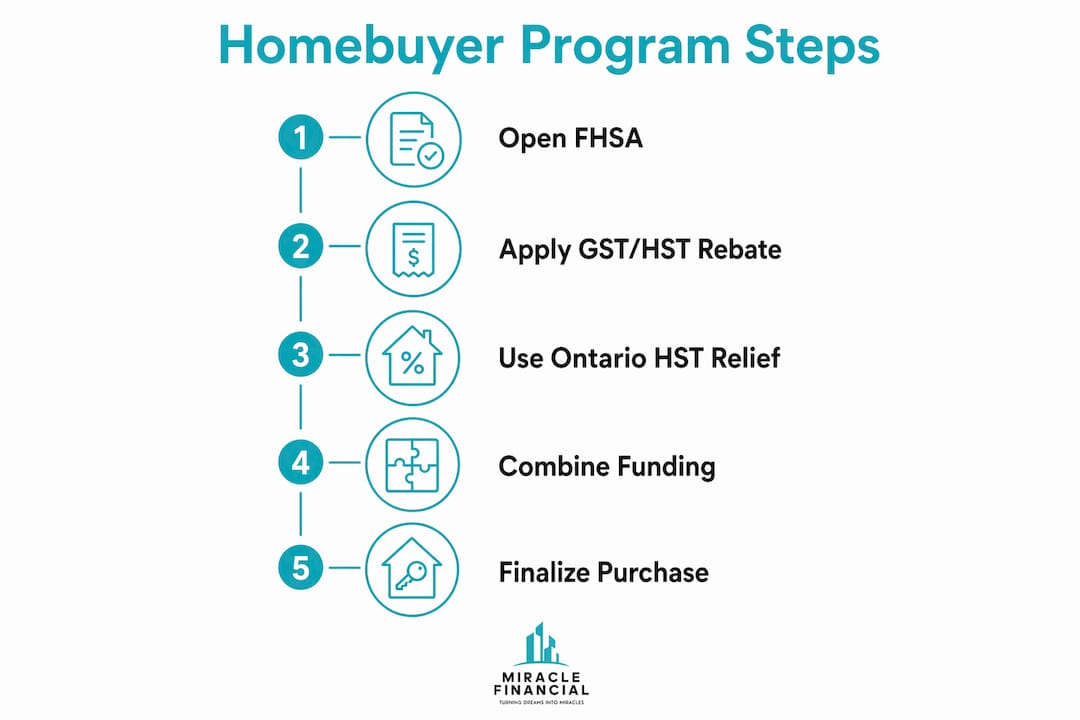
First-time homebuyer programmes are government initiatives that provide financial benefits, including tax rebates, savings accounts, and HST relief, specifically designed to reduce the upfront cost of purchasing a first home in Ontario. In 2026, three programmes stand out as the most significant: the federal GST/HST rebate for new homes, Ontario’s expanded one-year HST relief, and the First Home Savings Account (FHSA). Together, these tools can put tens of thousands of dollars back into a buyer’s pocket, but only if you understand the eligibility rules, application timelines, and how each programme interacts with your mortgage. This guide explains first-time homebuyer programmes in plain language so you can act with confidence before critical deadlines pass.
What are the main first-time homebuyer financial assistance programmes in Ontario?

Three federal and provincial programmes define understanding homebuyer assistance in Ontario right now. Each operates differently, targets different costs, and carries its own eligibility requirements.
Federal GST/HST rebate for new homes
The first-time home buyers’ GST/HST rebate provides up to $50,000 back on newly constructed or substantially renovated homes. The Canada Revenue Agency began accepting applications on March 17, 2026, with eligibility covering purchases from March 20, 2025, through January 1, 2031. That window matters because signing your purchase agreement before March 20, 2025, disqualifies you entirely, regardless of when you close.
The Making Life More Affordable for Canadians Act underpins this rebate, removing up to 5% GST on qualifying new homes priced up to $1 million, with a full rebate at that threshold and a phase-out up to $1.5 million. Homes above $1.5 million receive no rebate. This means a buyer purchasing a $900,000 new build could recover the full GST component, which is a meaningful reduction in closing costs.
Ontario’s expanded HST relief
Ontario and the federal government jointly eliminated the full 13% HST on qualifying new home purchases up to $1 million for one year, running from April 1, 2026, to March 31, 2027. The rebate value caps at $130,000 and phases down for homes priced above $1.5 million. Critically, this relief extends beyond first-time buyers to all purchasers of qualifying new homes, making it the broadest tax relief measure currently available in Ontario.
First Home Savings Account (FHSA)
The FHSA is a registered savings account that lets first-time buyers contribute up to $8,000 per year, with a $40,000 lifetime maximum. Contributions are tax-deductible, and qualifying withdrawals are tax-free. Unused annual contribution room carries forward, meaning a buyer who skipped a year can contribute up to $16,000 in a single calendar year. This carry-forward feature makes the FHSA one of the most flexible tax-advantaged tools available to first-time buyers in Canada.
| Programme | Maximum benefit | Who qualifies | Key deadline |
|---|---|---|---|
| Federal GST/HST rebate | Up to $50,000 | First-time buyers, new builds | Agreements from March 20, 2025 to Jan 1, 2031 |
| Ontario HST relief | Up to $130,000 | All buyers of qualifying new homes | Agreements April 1, 2026 to March 31, 2027 |
| FHSA | Up to $40,000 tax-sheltered | First-time buyers, Canadian residents | Annual contribution by Dec 31 each year |
Pro Tip: Open your FHSA account as early as possible, even if you are not yet ready to buy. Contribution room accumulates from the date the account is opened, not from when you first deposit funds.
How do eligibility criteria and timelines affect qualification?
Qualifying for first-time homebuyer programmes is not simply about whether you have owned a home before. The rules are more precise than most buyers expect, and missing a single deadline can cost you the entire rebate.
-
First-time buyer status. For the federal GST/HST rebate and FHSA, you must not have owned a qualifying home in Canada at any time during the current calendar year or in any of the preceding four calendar years. A spouse or common-law partner who has owned a home during that period can also disqualify you.
-
Purchase agreement dates. The agreement signing date is as important as your buyer status. For the federal rebate, agreements must be dated on or after March 20, 2025. For Ontario’s expanded HST relief, purchase agreements must be signed between April 1, 2026, and March 31, 2027, with construction and completion deadlines that vary by project start date.
-
Occupancy requirements for FHSA withdrawals. FHSA qualifying withdrawals require you to intend to occupy the home as your principal residence within one year of purchase, with actual occupancy required by October 1 of the year following the withdrawal. If you fail to meet this deadline, the withdrawn amount becomes taxable income, eliminating the tax-free benefit entirely.
-
Construction and completion timelines for Ontario HST relief. Two eligibility paths exist under Ontario’s programme, both tied to construction start and completion dates. Buyers purchasing pre-construction condominiums or new builds must confirm with their builder that the project meets these specific timelines before signing.
-
Application deadlines post-closing. The GST/HST rebate application must be submitted within two years of the closing date. Missing this window forfeits the rebate permanently.
Pro Tip: Ask your real estate lawyer to confirm your purchase agreement date and construction timeline in writing before you sign. A one-day error in agreement dating can disqualify you from programmes worth tens of thousands of dollars.
How do these programmes interact with mortgages and down payments?
First-time homebuyer programmes do not operate in isolation. They connect directly to your mortgage qualification, down payment capacity, and long-term debt load. Understanding these interactions is where the real financial benefit is unlocked.
The FHSA and RRSP Home Buyers’ Plan (HBP) can be combined for up to $100,000 in tax-advantaged funds toward a home purchase. The HBP allows a withdrawal of up to $35,000 from an RRSP, tax-free, provided it is repaid over 15 years. The FHSA withdrawal carries no repayment obligation. Using both together gives a buyer a substantial down payment pool that reduces the mortgage principal from day one.
A larger down payment has a compounding effect on mortgage affordability. Reducing the principal lowers your monthly payment, improves your debt-to-income ratio, and can help you qualify for a better rate. For buyers who are borderline on qualification, the FHSA withdrawal applied to the down payment can be the difference between approval and decline.
Consider the following comparison:
| Scenario | Down payment | Mortgage principal | Monthly payment (est. 5%, 25 yr) |
|---|---|---|---|
| Without FHSA/HBP | $60,000 | $740,000 | ~$4,320 |
| With FHSA + HBP ($100,000) | $160,000 | $640,000 | ~$3,737 |
That difference of roughly $583 per month is not trivial. Over five years, it represents nearly $35,000 in cash flow retained by the buyer.
One common pitfall is assuming that rebates eliminate the need for closing cost reserves. GST/HST rebates reduce the tax component of the purchase price, but land transfer tax, legal fees, title insurance, and home inspection costs remain. Ontario buyers should budget 1.5% to 4% of the purchase price for closing costs, separate from any rebate received.
Pro Tip: Work with your mortgage broker before finalising your FHSA withdrawal amount. The timing of the withdrawal relative to your mortgage application can affect how lenders assess your down payment source.
What are the practical steps to access and maximise these programmes?
Knowing the programmes exist is only half the work. Accessing them correctly requires specific steps, documentation, and coordination with your professional team.
-
Open your FHSA immediately. The account must be open before you make contributions, and contribution room only accumulates from the account opening date. If you plan to buy within three to five years, open the account now and contribute the maximum each year.
-
Confirm your purchase agreement date with your lawyer. Before signing any agreement of purchase and sale, have your real estate lawyer verify that the date falls within the eligible window for both the federal GST/HST rebate and Ontario’s HST relief. Review the mortgage application process with your broker at the same time to align timelines.
-
Determine whether your builder will credit the rebate at closing. Builder crediting depends on builder participation and the timing of Royal Assent. If your builder does not participate, you apply directly to the CRA after closing using the appropriate CRA forms. Confirm this arrangement in writing before closing day.
-
Gather your documentation early. Required documents typically include your purchase agreement, proof of Canadian residency, FHSA account statements, CRA tax filings, and confirmation of first-time buyer status. Your real estate lawyer and mortgage broker can provide a closing checklist specific to your transaction.
-
Monitor 2026 legislative updates. Ontario’s expanded HST relief programme has a defined one-year window. Administrative changes, construction deadline extensions, or programme modifications can occur. Subscribe to CRA and Ontario Ministry of Finance updates, or ask your mortgage broker to flag any changes that affect your closing.
Pro Tip: If your builder is not yet confirmed as a participant in the GST/HST rebate crediting process, apply directly to the CRA after closing rather than waiting. The two-year application window gives you time, but earlier applications reduce the risk of missing documentation.
Key takeaways
Ontario first-time buyers who combine the federal GST/HST rebate, Ontario’s expanded HST relief, and the FHSA can access over $170,000 in combined tax savings and sheltered funds, but only by meeting precise agreement dates, occupancy timelines, and application requirements.
| Point | Details |
|---|---|
| Federal GST/HST rebate | Provides up to $50,000 on new homes; agreements must be dated from March 20, 2025 onward. |
| Ontario HST relief | Removes full 13% HST on homes up to $1 million; applies to agreements signed April 1, 2026 to March 31, 2027. |
| FHSA contribution strategy | Contribute up to $8,000 per year; open the account early to maximise carry-forward room. |
| FHSA and HBP combined | Together provide up to $100,000 in tax-advantaged funds, directly reducing mortgage principal. |
| Timing is the critical variable | Agreement dates, occupancy deadlines, and builder participation all determine whether you qualify. |
What I have learned advising Ontario first-time buyers in 2026
The single biggest mistake I see first-time buyers make is treating these programmes as an afterthought. They find a property, fall in love with it, sign the agreement, and then ask whether they qualify for any rebates. By that point, the agreement date may already have disqualified them from Ontario’s HST relief, or their builder has not been confirmed as a rebate participant.
The FHSA is particularly underused. Many buyers open the account the same month they plan to purchase, which means they have contributed only $8,000 rather than the $40,000 lifetime maximum they could have accumulated over five years. That missed contribution represents a significant reduction in tax-sheltered down payment funds, and there is no way to recover it after the purchase is complete.
What actually works is treating these programmes as a planning timeline, not a checklist. Open the FHSA three to five years before you intend to buy. Confirm your purchase agreement date with your lawyer before you sign anything. Ask your mortgage broker how your FHSA withdrawal will be treated by lenders during qualification. And confirm your builder’s participation in the rebate crediting process at least 60 days before closing.
The 2026 legislative changes, particularly Ontario’s one-year HST relief window, have created a genuine opportunity for buyers who act within the defined period. But the window is narrow, and the conditions are specific. Buyers who plan carefully and coordinate their professional team early will capture the full benefit. Those who treat the programmes as paperwork to sort out later will likely leave significant money on the table.
— Miracle
How Miraclefinancial helps first-time buyers in Ontario
Navigating first-time homebuyer programmes alongside a mortgage application is a coordination challenge that most buyers underestimate. Miraclefinancial works with Ontario first-time buyers to structure financing that accounts for FHSA withdrawals, GST/HST rebate timing, and down payment sourcing from the start of the process, not as an afterthought.
Whether you are purchasing a new build, a pre-construction condominium, or a resale property, Miraclefinancial connects you with banks, credit unions, and alternative lenders across Ontario to find a mortgage that fits your actual financial situation. If you want to understand how your rebates and savings interact with your mortgage refinancing options or your first purchase, book a consultation with Miraclefinancial and get a clear plan before you sign anything. You can also review the first-time homebuyer guide for Ontario for a full breakdown of 2026 programme details.
FAQ
What is a first-time homebuyer programme in Ontario?
A first-time homebuyer programme is a government initiative that provides financial assistance, such as tax rebates or savings accounts, to eligible buyers purchasing their first home. In Ontario, the main programmes in 2026 are the federal GST/HST rebate, Ontario’s expanded HST relief, and the First Home Savings Account (FHSA).
How much can I save through Ontario’s HST relief in 2026?
Ontario’s expanded HST relief eliminates the full 13% HST on qualifying new homes up to $1 million, with a maximum rebate of $130,000. Purchase agreements must be signed between April 1, 2026, and March 31, 2027, to qualify.
Can I use both the FHSA and the RRSP Home Buyers’ Plan together?
Yes. The FHSA and RRSP Home Buyers’ Plan can be combined for up to $100,000 in tax-advantaged funds toward a qualifying home purchase, with the FHSA withdrawal carrying no repayment obligation and the HBP requiring repayment over 15 years.
How do I apply for the federal GST/HST rebate?
You can have the rebate credited by your builder at closing if they participate in the programme, or apply directly to the CRA after closing using the designated CRA forms. The application must be submitted within two years of your closing date.
What happens if I withdraw from my FHSA but do not occupy the home on time?
If you fail to occupy the home as your principal residence by October 1 of the year following your FHSA withdrawal, the withdrawn amount becomes taxable income. Meeting the occupancy deadline is a firm condition of the tax-free withdrawal benefit.