
Blog
Fixed vs Variable Mortgage: Ontario Borrower Impact


Choosing between fixed and variable mortgage rates can feel overwhelming for many Vaughan homeowners, especially when rising interest rates add another layer of uncertainty. Understanding the unique features of each option is crucial for shaping a stable financial future in the Canadian housing market. This guide breaks down the real differences between fixed and variable rates, helping you make a confident decision that matches your comfort level and long-term goals.
Table of Contents
- Defining Fixed and Variable Mortgages in Canada
- Differences in Rates, Terms, and Payments
- How Fixed and Variable Rates Are Set
- Impacts of Rate Fluctuations on Borrowers
- Choosing the Right Mortgage for Your Goals
Key Takeaways
| Point | Details |
|---|---|
| Fixed-Rate Mortgages Offer Stability | Fixed-rate mortgages provide consistent monthly payments and predictable budgeting, protecting borrowers from interest rate increases. |
| Variable-Rate Mortgages Allow Flexibility | Variable-rate mortgages have lower initial rates but can lead to fluctuating payments, appealing to risk-tolerant borrowers. |
| Consider Your Financial Situation Before Choosing | Assess your personal financial landscape, risk tolerance, and future income changes to determine the best mortgage type for your needs. |
| Stay Informed About Rate Influences | Monitor economic indicators and Bank of Canada announcements to make informed decisions on mortgage options and potential rate changes. |
Defining Fixed and Variable Mortgages in Canada
In the Canadian mortgage landscape, homebuyers face a critical decision between fixed and variable mortgage rates that can significantly impact their long-term financial strategy. Both mortgage types offer unique advantages and challenges for borrowers across Ontario, with distinct characteristics that influence monthly payments and overall borrowing costs.
A fixed-rate mortgage provides stability and predictability by maintaining the same interest rate throughout the entire mortgage term. Government mortgage guidelines highlight that these mortgages allow homeowners to budget precisely, knowing their interest rate won’t fluctuate regardless of market conditions. Key features include:
- Consistent monthly payment amounts
- Protection against interest rate increases
- Easier financial planning and budgeting
- Typically higher initial interest rates compared to variable options
In contrast, a variable-rate mortgage has an interest rate that adjusts periodically based on the lender’s prime rate. These mortgages introduce more financial flexibility but also carry inherent uncertainty. Variable rates are typically lower initially but can change throughout the mortgage term, meaning your monthly payments might increase or decrease.
Variable mortgages reward risk-tolerant borrowers who can absorb potential payment fluctuations and believe interest rates will remain stable or decline.
The primary differences between fixed and variable mortgages centre on risk tolerance, financial stability, and market predictions. Fixed rates suit conservative borrowers seeking predictability, while variable rates attract those comfortable with potential market shifts and seeking initial cost savings.
Here’s a summary comparing fixed and variable mortgages in key decision areas:
| Decision Factor | Fixed-Rate Mortgage | Variable-Rate Mortgage |
|---|---|---|
| Payment Stability | Always consistent | Can increase or decrease |
| Interest Rate Trend Impact | Unaffected by rising prime rates | Directly affected by prime rate changes |
| Best for Budgeting | Predictable long-term planning | Requires flexibility with monthly cash flow |
| Typical Starting Rate | Higher than variable rates | Lower initial rate |
| Emotional Comfort | Provides peace of mind | May cause payment uncertainty |
Pro tip: Before selecting a mortgage type, carefully assess your personal financial situation, risk tolerance, and potential future income changes to make the most informed decision.
Differences in Rates, Terms, and Payments
Navigating the complexities of fixed and variable mortgages requires a deep understanding of how interest rates, payment structures, and mortgage terms fundamentally differ. These key elements can dramatically impact a borrower’s financial strategy and long-term affordability in the Ontario housing market.
Interest rates represent the most critical distinction between fixed and variable mortgage types. Fixed-rate mortgages lock in a specific interest rate for the entire term, typically ranging from 1-10 years. Borrowers benefit from mortgage terminology guidance that helps them understand these predictable payment structures. Key characteristics of interest rates include:
- Fixed rates remain constant throughout the mortgage term
- Variable rates fluctuate based on the lender’s prime rate
- Fixed rates provide greater predictability and budgeting consistency
- Variable rates often start lower but carry potential future uncertainty
Payment structures differ significantly between these mortgage types. Fixed-rate mortgages offer consistent monthly payments, allowing homeowners to budget with precision. Variable-rate mortgages introduce financial flexibility but also potential payment volatility. When the prime lending rate changes, variable-rate mortgage payments can increase or decrease, creating a more dynamic financial landscape.
Variable-rate mortgages reward financially agile borrowers who can absorb potential payment fluctuations and understand market dynamics.
Mortgage terms also play a crucial role in determining overall borrowing costs. Most Canadian mortgages range from 1-10 years, with each term presenting unique advantages. Fixed-rate terms provide stability and protection against market fluctuations, while variable-rate terms offer potential initial savings and greater adaptability to changing economic conditions.

Pro tip: Carefully assess your risk tolerance and financial stability before selecting a mortgage term, considering potential future income changes and market predictions.
How Fixed and Variable Rates Are Set
Understanding how mortgage rates are determined provides crucial insights for Ontario borrowers navigating the complex financial landscape. Mortgage rates are not arbitrary numbers but carefully calculated financial instruments reflecting broader economic conditions and institutional strategies.
Variable rates demonstrate remarkable sensitivity to economic shifts. Variable rate mechanisms directly track the prime rate, which fluctuates based on central bank monetary policies. These rates change rapidly, responding to key economic indicators such as:
- Bank of Canada overnight lending rate
- Inflation trends
- National economic performance
- Global financial market conditions
- Institutional lending risk assessments
Fixed rates, by contrast, derive from more stable financial instruments. These rates are primarily influenced by government bond yields, representing longer-term market expectations and institutional funding costs. The bond market provides a comprehensive view of anticipated economic conditions, allowing lenders to set fixed rates that reflect predicted medium to long-term financial trends.
Fixed mortgage rates represent a sophisticated financial forecast, capturing broader economic expectations beyond immediate market fluctuations.
The intricate relationship between monetary policy, bond markets, and lending practices creates a complex ecosystem determining mortgage rates. While variable rates offer immediate responsiveness to economic changes, fixed rates provide a more measured, forward-looking approach to pricing financial products.
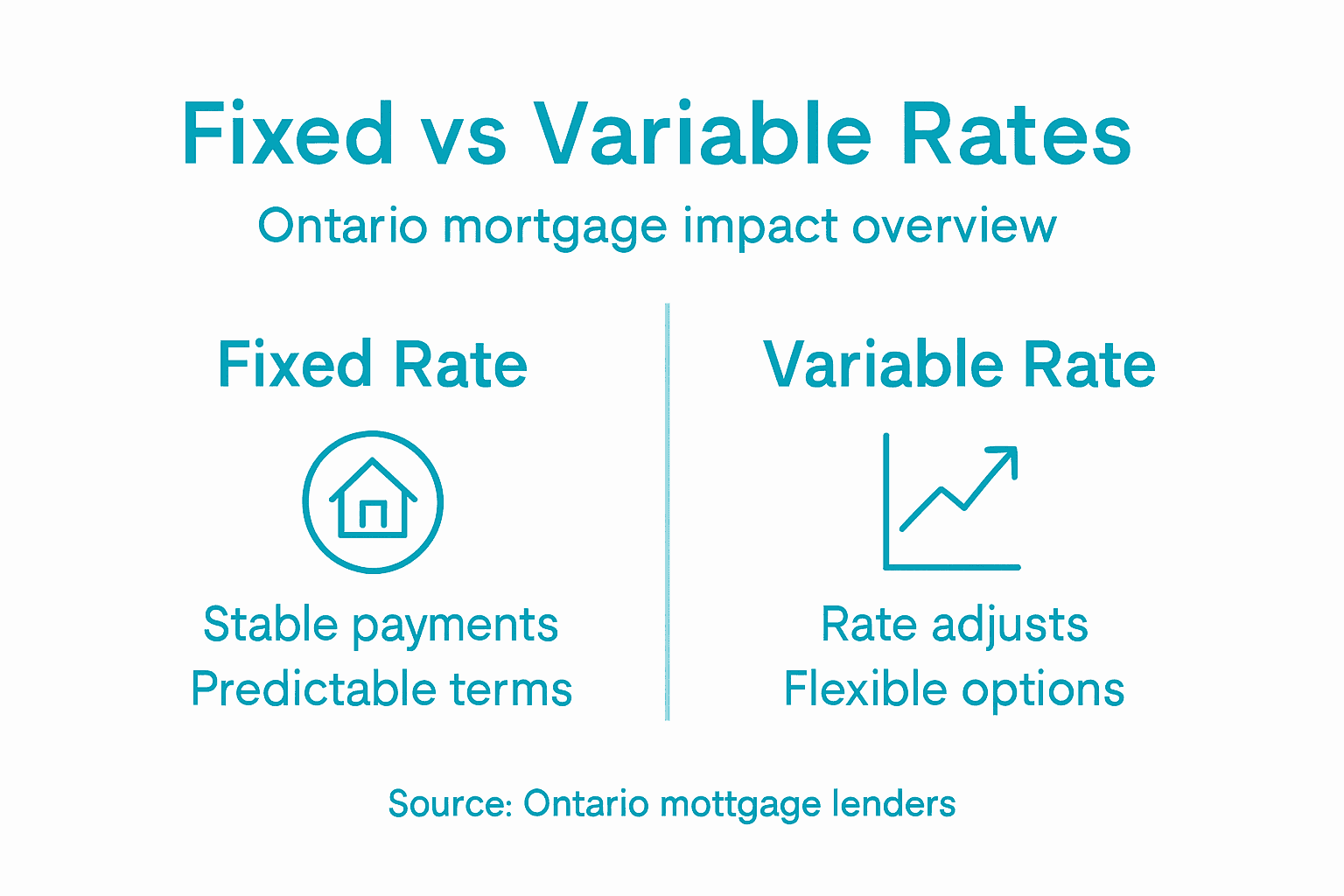
Below is a quick reference on what drives Canadian mortgage rates:
| Rate Type | Main Influences | Adjusts How Often |
|---|---|---|
| Fixed | Government bond yields | Set for entire term |
| Variable | Lender’s prime rate, Bank of Canada policy | Can change multiple times per term |
| Both | Economic indicators, lender risk assessment | Depends on mortgage agreement |
Pro tip: Monitor Bank of Canada announcements and bond market trends to gain insights into potential future mortgage rate movements.
Impacts of Rate Fluctuations on Borrowers
Rate fluctuations can profoundly transform a homeowner’s financial landscape, creating both opportunities and challenges for Ontario mortgage holders. Mortgage rate changes represent more than simple numerical shifts—they directly influence monthly budgets, long-term financial planning, and overall borrowing costs.
For variable-rate mortgage holders, mortgage loan types dramatically impact financial predictability. Rate fluctuations can trigger significant monthly payment variations, creating potential stress for households with tight budgetary constraints. Key potential impacts include:
- Unexpected increases in monthly mortgage payments
- Reduced capacity for additional financial investments
- Potential need to restructure household budgeting
- Increased overall borrowing costs during rate hikes
- Potential challenges in long-term financial planning
Fixed-rate mortgages offer a protective buffer against these economic uncertainties. Borrowers with fixed rates remain insulated from immediate market shifts, maintaining consistent payment structures regardless of broader economic turbulence. This stability provides psychological and financial comfort, allowing more precise long-term financial strategizing.
Rate fluctuations represent a complex financial ecosystem that demands strategic, forward-looking mortgage planning.
The magnitude of rate impacts varies depending on mortgage size, term length, and individual financial resilience. Smaller rate changes might represent minimal disruption for some borrowers, while substantial shifts could necessitate significant financial recalibration, potentially requiring refinancing or alternative debt management strategies.
Pro tip: Maintain a financial buffer of 10-15% beyond your expected mortgage payments to provide flexibility during potential rate fluctuations.
Choosing the Right Mortgage for Your Goals
Selecting the optimal mortgage requires a strategic approach that aligns with your unique financial landscape and personal objectives. Mortgage selection is not a one-size-fits-all decision but a nuanced process demanding careful consideration of individual circumstances and long-term financial aspirations.
Mortgage choice strategies emphasize the critical importance of understanding your personal risk tolerance and financial goals. Potential borrowers must conduct a comprehensive self-assessment across several key dimensions:
- Current income stability
- Future earnings potential
- Short-term and long-term financial objectives
- Comfort level with financial uncertainty
- Potential for lifestyle or career changes
- Overall risk management strategy
Fixed-rate mortgages emerge as the preferred option for borrowers seeking predictability and emotional comfort. These mortgages provide a sense of financial security by maintaining consistent monthly payments, which proves especially valuable for individuals with structured budgets or limited financial flexibility.
Your ideal mortgage should feel like a strategic financial tool, not a financial burden.
Variable-rate mortgages offer an alternative pathway for financially sophisticated borrowers comfortable with potential market fluctuations. These mortgages can provide initial cost savings and greater adaptability, but require a higher tolerance for uncertainty and more active financial management.
Pro tip: Conduct a comprehensive personal financial audit before selecting your mortgage, examining your risk tolerance, income stability, and five-year financial projections.
Find the Right Mortgage Balance with Expert Guidance from Miracle Financial
Choosing between a fixed and variable mortgage can feel overwhelming when your financial future depends on understanding rate fluctuations and payment stability. This article highlights the key challenges Ontario borrowers face, including managing unpredictable variable rates and the desire for consistent fixed payments. At Miracle Financial, we recognize that every borrower has unique risk tolerance and financial goals. Our Vaughan mortgage broker experts offer personalised strategies like refinance mortgage Ontario options and debt consolidation mortgage solutions that help you secure a mortgage tailored to your needs.

Ready to stop worrying about fluctuating payments and start planning with confidence? Connect with Miracle Financial today to explore smart mortgage solutions that align with your personal financial situation. Learn how our Self-Employed Mortgage Broker services or Private Mortgage Lenders Ontario options can give you flexibility while maintaining peace of mind. Visit Miracle Financial now and take the first step toward a mortgage that works with your life.
Frequently Asked Questions
What is the main difference between fixed and variable mortgages?
A fixed mortgage rate remains constant throughout the term, offering payment stability, while a variable mortgage rate fluctuates based on the lender’s prime rate, possibly resulting in varying monthly payments.
What are the advantages of a fixed-rate mortgage?
Fixed-rate mortgages provide predictable monthly payments, protection against interest rate hikes, and ease of budgeting, making them suitable for conservative borrowers seeking stability.
How do interest rates influence fixed and variable mortgages?
Fixed rates are influenced by government bond yields and remain constant throughout the term, whereas variable rates are tied to the lender’s prime rate and can change periodically based on market conditions.
Who should consider a variable-rate mortgage?
A variable-rate mortgage may be ideal for financially agile borrowers who are comfortable with potential fluctuations in monthly payments and anticipate market rates may stabilize or drop over time.
Recommended
- Mortgage renewal checklist for Ontario homeowners
- Understanding mortgage prepayment penalties
- Mortgage porting when you move
- 7 Types of Mortgage Loans Every Ontarian Should Know
- Mortgage Terminology Explained: Complete Ontario Guide – Miracle Financial
- 7 Best Mortgage Options 2025 for Ontario Homebuyers – Miracle Financial
- Best Mortgage Options Ontario – Strategies for First-Time Buyers
- Does A Student Loan Affect Getting A Mortgage – Mortgage Managers