
Blog
Home equity vs. refinance: Best options for Ontario homeowners


Most Ontario homeowners know their home has value, but fewer realise just how much financial power sits inside those walls. You can access up to 80% of your home’s appraised value through the right borrowing strategy, yet the choice between a home equity line of credit and refinancing can mean the difference between building wealth and quietly eroding it. These two tools look similar on the surface but behave very differently when interest rates shift, life changes, or investment opportunities appear. Understanding which one fits your situation is not just useful, it is one of the most important financial decisions you will make as an Ontario homeowner.
Table of Contents
- How home equity access and refinancing work in Ontario
- Pros and cons: Home equity line of credit versus refinancing
- When to use home equity vs. refinance: Real Ontario scenarios
- Key risks and how to avoid common pitfalls
- Our perspective: The hidden opportunity (and risk) most Ontario homeowners ignore
- Ready to make your equity work smarter? We can help
- Frequently asked questions
Key Takeaways
| Point | Details |
|---|---|
| 80% equity access limit | Ontario homeowners can generally access up to 80% of their property’s value via mortgage or combined HELOC. |
| HELOC vs. refinance | HELOCs offer flexible credit but risk ‘debt creep’, while refinancing can lower payments with more predictable terms. |
| Interest savings potential | Refinancing for debt consolidation in Ontario may save 15-25% on interest compared to unsecured loans. |
| Smart strategy matters | The right choice depends on your financial goals, risk comfort, and long-term plans. |
How home equity access and refinancing work in Ontario
Home equity is the portion of your home you actually own. If your home is worth $800,000 and your remaining mortgage balance is $400,000, your equity is $400,000. Lenders allow you to borrow against this equity, but not all of it. Ontario homeowners primarily access equity through two routes: a Home Equity Line of Credit (HELOC) or a full mortgage refinance.
A HELOC works like a revolving credit line secured against your home. You draw funds as needed, repay them, and draw again. According to Canadian government guidelines, a standalone HELOC is capped at 65% loan-to-value (LTV), meaning you can borrow up to 65% of your home’s appraised value. When combined with your existing mortgage, the total borrowing cannot exceed 80% LTV. So on that $800,000 home, the ceiling is $640,000 total.
Refinancing works differently. You replace your existing mortgage with a new one, typically at a higher principal to pull out equity. Most lenders allow refinancing up to 80% LTV. This is a one-time lump sum, not a revolving credit line. Many homeowners use refinancing to access different types of home equity loans or to consolidate high-interest debts into a single, lower-rate payment.
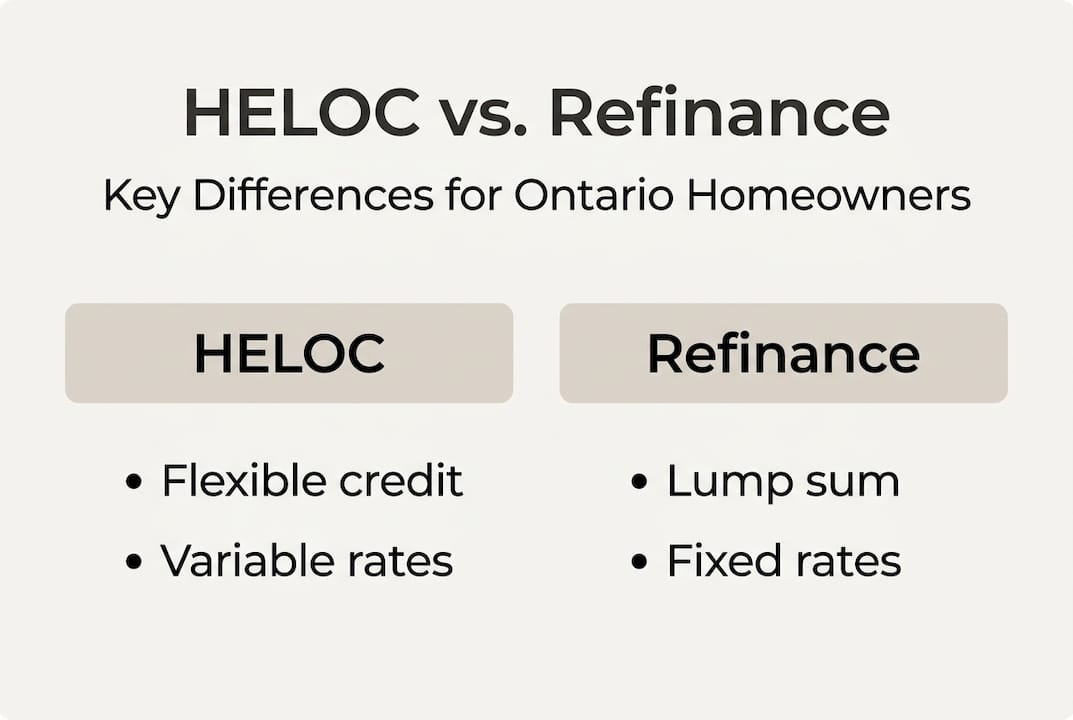
Here is a quick comparison of the two structures:
| Feature | HELOC | Refinance |
|---|---|---|
| Borrowing limit | Up to 65% LTV standalone / 80% combined | Up to 80% LTV |
| Payment structure | Flexible, interest-only option | Fixed monthly payments |
| Access to funds | Revolving, draw as needed | Lump sum |
| Interest rate type | Variable | Fixed or variable |
| Best for | Ongoing or uncertain expenses | Debt consolidation, large one-time needs |
Both options are subject to Ontario’s mortgage stress test, which requires you to qualify at the higher of the Bank of Canada’s qualifying rate or your contract rate plus 2%. Brokers operating in Ontario are regulated by the Financial Services Regulatory Authority of Ontario (FSRA), which sets conduct standards for how these products are presented and sold. Learning more about home equity loans in Ontario can help you understand which product aligns with your goals before you speak to a lender.
Key factors to weigh before choosing:
- Current mortgage balance and remaining term
- Your credit score and income documentation
- Whether you need funds all at once or over time
- Your tolerance for variable versus fixed interest rates
- Short-term cash flow needs versus long-term equity goals
Pros and cons: Home equity line of credit versus refinancing
Now that you understand the mechanics, let’s see how these tools stack up in real life.
The biggest advantage of a HELOC is flexibility. You borrow only what you need, when you need it, and you only pay interest on the outstanding balance. For a homeowner managing a renovation in stages or an investor bridging a purchase, this flexibility has real value. However, that same flexibility carries a serious risk. The Canadian government warns that HELOC debt creep quietly erodes equity and savings over time. Because minimum payments are often interest-only, the principal balance can sit unchanged for years.
Refinancing, by contrast, builds in discipline. You receive a lump sum, your payments are fixed, and you are on a clear amortisation schedule. For debt consolidation specifically, refinancing can reduce your effective interest rate by 15 to 25% compared to unsecured loans or credit cards. That is a meaningful saving that compounds over time.

| Scenario | Better option | Reason |
|---|---|---|
| Consolidating credit card debt | Refinance | Lower fixed rate, structured payoff |
| Funding phased home renovations | HELOC | Draw only what you spend |
| Buying an investment property | Either, depending on timing | Refinance for lump sum, HELOC for flexibility |
| Covering irregular business expenses | HELOC | Revolving access suits variable needs |
| Lowering monthly mortgage payments | Refinance | Rate reduction and term restructuring |
Understanding Ontario mortgage regulations helps you see why lenders structure these products the way they do. Regulation exists to protect you, but it also shapes what is available and at what cost. Reviewing the difference between a refinance versus second mortgage is also worth your time if you want to keep all your options visible.
Pro Tip: If you are considering a HELOC, set your own repayment target above the minimum payment. Treating it like a structured loan, not a credit card, is the single best habit to prevent debt creep.
When to use home equity vs. refinance: Real Ontario scenarios
A side-by-side comparison is useful, but real situations make these choices clearer.
Consider four common Ontario scenarios:
- Consolidating high-interest debt: A homeowner carrying $40,000 in credit card balances at 19.99% could refinance their mortgage and absorb that debt at a much lower rate. The monthly savings are immediate and the payoff timeline is clear.
- Financing a rental property: An investor who needs a down payment for a second property might use a HELOC on their primary home. This keeps the investment financing separate and preserves the primary mortgage structure.
- Home renovations: A phased renovation, such as a kitchen this year and a basement suite next year, suits a HELOC perfectly. You draw funds as each phase begins rather than paying interest on a lump sum you have not yet spent.
- Bridging an investment purchase: When timing is tight, a HELOC can serve as a short-term bridge while longer-term financing is arranged through a mortgage refinance in Ontario.
To decide which path fits, work through these steps:
- List all your current debts, their interest rates, and monthly payments.
- Calculate your home’s current market value and subtract your mortgage balance.
- Identify whether your need is a one-time lump sum or ongoing access.
- Consider your income stability and how a rate increase would affect your payments.
- Speak with an FSRA-regulated broker to confirm what you qualify for under the stress test.
Important: HELOCs are the largest source of non-mortgage household debt in Canada. Before 2012, annual HELOC balances grew by more than 20% nationally, signalling how quickly this product can outpace a homeowner’s ability to manage it.
For older homeowners with significant equity and no desire to increase monthly payments, reverse mortgages represent a third option worth exploring. Not every situation calls for a HELOC or a refinance.
Key risks and how to avoid common pitfalls
With your preferred strategy in mind, let’s ensure you avoid the top traps that catch Ontario homeowners by surprise.
HELOCs carry variable interest rates, which means your payment can increase with little warning. In a rising rate environment, a borrower with a $150,000 HELOC balance could see their monthly interest cost climb by hundreds of dollars within a single year. That is not a hypothetical. It happened to many Canadian borrowers between 2022 and 2024.
Refinancing carries its own set of risks. Breaking your existing mortgage before the term ends triggers an early payout penalty, which can range from three months’ interest to an Interest Rate Differential (IRD) calculation that costs thousands. Resetting your amortisation to 25 or 30 years also means paying more total interest, even if your monthly payment drops.
“Consumers who use their home as an ATM risk finding themselves house-rich and cash-poor when property values soften or rates rise.” This caution from Canada’s Financial Consumer Agency reflects a pattern seen repeatedly in Ontario’s housing market.
Key risks to watch for:
- Variable rate exposure on a HELOC in a rising rate cycle
- Debt creep from making only minimum interest payments
- Early payout penalties when breaking a fixed-rate mortgage
- Amortisation reset extending your debt repayment by years
- Overestimating home value, leading to less equity than expected
The HELOC government guidance recommends treating your home equity as a long-term asset, not a spending account. Our Ontario refinancing guide walks through how to calculate penalties and compare true costs before you commit.
Pro Tip: Always request a full mortgage statement showing your prepayment penalty before signing anything. Lenders are required to provide this, and the number will often change your decision entirely.
Our perspective: The hidden opportunity (and risk) most Ontario homeowners ignore
Most homeowners we speak with compare rates. They want the lowest number on the page. That instinct is understandable, but it misses the bigger picture entirely.
A HELOC with a slightly higher rate but flexible access can outperform a refinance for an investor who moves quickly on opportunities. A refinance with a slightly higher rate but a 5-year fixed term can save a household from financial stress if rates spike. The right answer is not about the rate today. It is about your life over the next three to five years.
HELOCs reward disciplined borrowers and punish impulsive ones. Refinancing rewards planners and punishes those who change their minds. Neither product is inherently better. Both are tools, and tools work when matched to the job.
We have seen homeowners choose a HELOC because it felt less committal, only to find themselves carrying a balance they never paid down. We have also seen homeowners refinance into a long amortisation and feel immediate relief, not realising they added years of interest to their total cost. The refinancing benefits are real, but only when the strategy fits the person, not just the numbers.
Ready to make your equity work smarter? We can help
Choosing between a HELOC and refinancing is not a spreadsheet decision. It involves your income, your goals, your risk tolerance, and the specific rules that apply to Ontario borrowers in 2026. Getting it right the first time saves money and stress.

At Miracle Financial, our mortgage refinance experts work with Ontario homeowners every day to build strategies that match real life, not just ideal scenarios. Whether you are looking to consolidate debt, fund a renovation, or grow your investment portfolio, our debt consolidation specialists can map out your options clearly and honestly. Book a free consultation and find out exactly what your equity can do for you.
Frequently asked questions
What is the maximum I can borrow from my home equity in Ontario?
You can access up to 80% of your home’s value through a combination of your mortgage and a HELOC, with a standalone HELOC capped at 65% loan-to-value.
How does refinancing affect my mortgage payments?
Refinancing can lower your monthly payments by securing a better rate or consolidating debts, though extending your amortisation period may increase total interest paid over the life of the loan.
What are the main risks of using a HELOC?
The primary risks include variable interest rate increases, gradual debt creep eroding equity, and the possibility of foreclosure if payments become unmanageable.
Is a HELOC better than refinancing for debt consolidation?
Refinancing typically delivers greater interest savings of 15 to 25% compared to unsecured debt, while a HELOC offers more flexibility for expenses that are ongoing or unpredictable.