
Blog
How bridge loans work for Ontario homeowners


TL;DR:
- A bridge loan is a short-term, asset-backed loan used to cover financing gaps when purchasing new property before selling or refinancing an existing one. Lenders focus on property value and a clear exit strategy rather than borrower income, offering fast closings within 10 to 21 days, with interest-only payments for 6 to 36 months. Because of high costs and risks, successful use requires a detailed plan, sufficient cash reserves, and realistic timing, making it ideal for time-sensitive real estate transactions.
A bridge loan is a short-term, asset-backed loan designed to cover the financing gap between purchasing a new property and the sale of an existing one or securing permanent financing. Understanding how bridge loans work is critical for Ontario homeowners and real estate investors who need to act quickly in a competitive market without waiting for a buyer to close on their current home. Lenders like Miraclefinancial, TD Canada Trust, and RBC Royal Bank each offer variations of this product, but the core mechanics remain consistent: fast access to capital, interest-only payments, and repayment tied to a clearly defined exit strategy.
How bridge loans work: structure, terms, and underwriting
Bridge financing, as it is formally known in the lending industry, operates on a fundamentally different logic than a conventional mortgage. Where a traditional mortgage evaluates your income, employment history, and credit score over weeks of underwriting, a bridge loan focuses primarily on the value of the property being used as collateral and the credibility of your exit plan.

Bridge loans typically close in 10 to 21 days, compared to 45 to 90 days for traditional loans. That speed is not incidental. It is the entire point. When a seller accepts your offer conditional on a quick close, or when a distressed property comes to market and requires fast action, a bridge loan is often the only tool that fits the timeline.
Loan terms and payment structure
The standard term for a bridge loan runs from 6 to 36 months. During that period, you make interest-only monthly payments with the full principal due as a balloon payment at maturity. This structure keeps your monthly obligations manageable while the underlying property is being sold or refinanced.
Key structural features include:
- Term length: 6 to 36 months, depending on the lender and deal complexity
- Payment type: Interest-only monthly payments throughout the term
- Repayment: Full principal balloon payment at maturity
- Loan-to-value (LTV): Typically 65% to 75% of the property’s appraised value
- Down payment: Approximately 35% required from the borrower
What lenders actually underwrite
Lenders focus on property collateral and a clear exit strategy rather than borrower income or credit scores. This is the single most important distinction between bridge financing and conventional mortgage underwriting. If you are self-employed, have irregular income, or have been declined by a bank, a bridge loan may still be accessible to you provided the property value supports the loan and your exit plan is credible.
The exit strategy is the central underwriting factor. Lenders demand detailed plans on refinance or sale timelines supported by market data. Vague exits lead to loan denial. You need to demonstrate either that the property will sell within the term at a price sufficient to repay the loan, or that you will qualify for permanent financing before maturity.
Pro Tip: Prepare a written exit strategy before approaching any lender. Include comparable sales data, a realistic sale timeline, or a pre-approval letter for the refinancing you plan to use. Lenders who see a documented plan respond faster and offer better terms.
| Feature | Bridge loan details |
|---|---|
| Typical term | 6 to 36 months |
| Closing speed | 10 to 21 days |
| LTV ratio | 65% to 75% |
| Payment structure | Interest-only, balloon at maturity |
| Underwriting focus | Property value and exit strategy |
What does a bridge loan cost, and what are the risks?
Bridge loans are among the most expensive financing forms available to real estate borrowers. That cost reflects the speed, flexibility, and risk the lender absorbs. Understanding the full cost picture before you commit is not optional. It is the difference between a strategic tool and a financial problem.
Typical costs include:
- Interest rate: Approximately 12% per annum, though rates vary by lender and deal risk
- Lender fees (points): 1.5 to 3 points charged at closing (each point equals 1% of the loan amount)
- Appraisal fees: Required for most bridge loans to establish current property value
- Legal and closing costs: Standard in Ontario, typically ranging from $1,500 to $3,000 or more
On a $500,000 bridge loan at 12% interest with 2 points, you are paying $10,000 in upfront fees plus roughly $5,000 per month in interest. Over a six-month term, the total financing cost approaches $40,000 before closing costs. That is a significant number, and it needs to be weighed against the strategic value of the deal you are securing.
The risks you need to plan for
Poor exit strategies often lead to default and increased expenses. The balloon payment at maturity is not negotiable. If your property has not sold or your refinancing has not closed by the time the loan matures, you face either a costly extension, a forced sale, or default. Each of those outcomes is worse than the original problem you were trying to solve.
Cash reserves are not optional. Lenders often require cash reserves equal to 6 to 12 months of principal, interest, taxes, and insurance (PITI) payments. Carrying two properties simultaneously, one with a conventional mortgage and one with a bridge loan, creates real cash flow pressure that you need to model before signing.
“A bridge loan used without a credible exit strategy is not short-term financing. It is a deferred problem with a higher price tag.”
Pro Tip: Before committing to a bridge loan, calculate your total carrying costs for both properties across the full loan term. If those costs consume more than 40% of your monthly income, the deal warrants serious reconsideration.
Bridge loans vs. other financing options
Choosing the right short-term financing product requires understanding how each option is structured and what it costs. The table below compares bridge loans against the most common alternatives available to Ontario homeowners and investors.
| Financing type | Purpose | Approval speed | Cost | Underwriting focus |
|---|---|---|---|---|
| Bridge loan | Short-term gap financing | 10 to 21 days | High (12%+ rate, 1.5 to 3 points) | Property value and exit strategy |
| HELOC | Ongoing equity access | 2 to 4 weeks | Moderate (prime + 0.5% to 1%) | Income and equity |
| Conventional mortgage | Long-term purchase financing | 45 to 90 days | Low (current posted rates) | Income, credit, and property |
| Private/hard money loan | Asset-based short-term lending | 5 to 15 days | Very high (12% to 18%+) | Property value only |
Bridge loans differ from HELOCs in a fundamental way: a HELOC draws on existing equity over a longer, revolving term, while a bridge loan is a single-draw, time-limited product with a defined repayment event. HELOCs are better suited to homeowners who need flexible, ongoing access to equity. Bridge loans are better suited to investors or homeowners who need a specific sum for a specific transaction within a defined window.
Private or hard money loans are the closest cousin to bridge financing. Both are asset-based and fast. The difference is that private lenders often require even less documentation but charge higher rates, sometimes reaching 15% to 18% annually. For Ontario borrowers, understanding the types of mortgage lenders available, including banks, credit unions, alternative lenders, and private lenders, helps you match the product to the situation rather than defaulting to the most familiar option.
A conventional mortgage from TD Canada Trust or RBC Royal Bank remains the lowest-cost option when timing allows. The problem is that timing rarely allows it in competitive Ontario real estate. When a seller wants a 30-day close and your current home has not yet sold, a conventional mortgage simply cannot move fast enough.
How to secure a bridge loan in Ontario
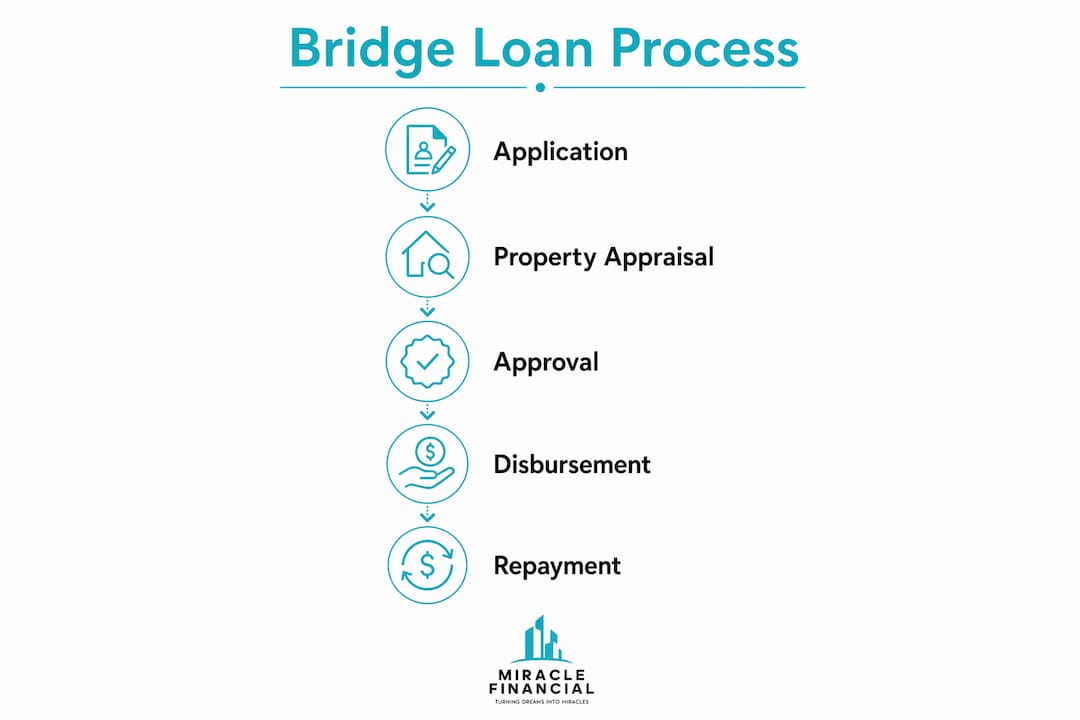
The application process for a bridge loan is faster than a conventional mortgage, but it requires preparation. The process involves deal submissions, term sheets within 24 to 48 hours, underwriting, appraisal, and closing typically within 10 to 21 days if documents are ready. That final clause matters. Delays in documentation are the most common reason bridge loan closings slip past the agreed timeline.
Follow these steps to give your application the strongest possible start:
- Prepare your deal submission. Include the property address, purchase price, current appraised value or recent comparable sales, your requested loan amount, and a written exit strategy with a realistic timeline.
- Gather your financial documents. Lenders will want personal financial statements, proof of ownership of any existing properties, and a summary of current mortgage obligations.
- Order a property appraisal early. Most bridge lenders require an independent appraisal. Ordering it at the same time as your application saves three to five business days.
- Confirm clean title. Title issues, including liens, encumbrances, or unresolved disputes, are the most common cause of funding delays. Have your solicitor confirm title status before submission.
- Align your exit strategy with the lender’s expectations. If your exit is a sale, provide a listing agreement or comparable sales data. If your exit is a refinance, provide a pre-approval letter or evidence of qualifying income.
Pro Tip: Work with a mortgage broker who has direct relationships with private and alternative lenders in Ontario. Brokers like Miraclefinancial can submit your deal to multiple lenders simultaneously, which compresses the timeline and often produces better terms than approaching a single lender directly.
Miraclefinancial works with banks, credit unions, alternative lenders, and private lenders across Ontario to structure bridge financing solutions for homeowners and investors who need fast, flexible funding. The brokerage specialises in situations where traditional lenders are too slow or have declined the application outright.
Key takeaways
Bridge loans are most effective when the exit strategy is specific, documented, and realistic, making the property’s value and repayment plan the foundation of every successful application.
| Point | Details |
|---|---|
| Speed is the core advantage | Bridge loans close in 10 to 21 days, far faster than conventional mortgages at 45 to 90 days. |
| Exit strategy drives approval | Lenders prioritise a credible sale or refinance plan over income or credit score. |
| Costs are significant | Expect approximately 12% interest plus 1.5 to 3 points in fees on top of standard closing costs. |
| Cash reserves are required | Maintain 6 to 12 months of PITI payments in reserve to manage balloon payment risk. |
| Alternatives exist | HELOCs, private loans, and conventional mortgages each suit different timing and cost profiles. |
What I’ve learned about using bridge loans strategically
After working with Ontario homeowners and investors across a wide range of financial situations, one pattern stands out clearly. The borrowers who use bridge financing well are the ones who treat it as a precision instrument, not a fallback. They know their exit date before they sign the term sheet. They have modelled their carrying costs. They have a Plan B if the sale takes longer than expected.
The borrowers who run into trouble are the ones who use a bridge loan to buy time without a clear plan for how that time will be used. A property that is not selling in month two of a six-month bridge term is a serious problem, not a minor inconvenience. The balloon payment does not care about market conditions.
What I find most underappreciated about bridge financing is how well it works for renovation-to-sell projects. An investor purchases a distressed property, uses the bridge term to complete renovations, lists the property at a higher value, and repays the loan from the sale proceeds. The math works when the renovation budget is controlled and the after-repair value is conservative. It fails when either of those assumptions is optimistic.
My advice to any Ontario homeowner or investor considering this product: run the numbers at 12 months, not six. If the deal still makes sense assuming your exit takes twice as long as planned, proceed. If it does not, reconsider the structure before you commit.
— Miracle
How Miraclefinancial can help with bridge financing in Ontario

Miraclefinancial is a Vaughan-based mortgage brokerage that specialises in fast, flexible financing for Ontario homeowners and investors who need solutions that banks cannot provide on their timeline. Whether you are purchasing a new property before your current home sells, funding a renovation project, or securing a time-sensitive investment deal, Miraclefinancial structures bridge loan applications around your specific situation and connects you with the right lender from its network of banks, credit unions, alternative lenders, and private lenders.
Once your bridge term ends, Miraclefinancial can also help you transition into a long-term mortgage refinance to reduce your carrying costs and stabilise your payments. Contact Miraclefinancial today to discuss your financing needs and get a clear picture of your options.
FAQ
What is a bridge loan in simple terms?
A bridge loan is a short-term loan secured against property that provides immediate funds to purchase a new property before an existing one sells or before permanent financing is arranged. It is repaid through the sale proceeds or a refinance at the end of the term.
How long does a bridge loan last?
Bridge loan terms typically range from 6 to 36 months, with most residential transactions structured at 6 to 12 months. The term is chosen based on how long the borrower realistically needs to complete their exit strategy.
Who qualifies for a bridge loan in Ontario?
Bridge loan qualification is primarily based on the value of the property being used as collateral and the strength of the exit strategy, not the borrower’s income or credit score. This makes bridge financing accessible to self-employed borrowers, investors, and homeowners who have been declined by traditional lenders.
What are the main risks of bridge financing?
The primary risks are the balloon payment at maturity, high carrying costs if the exit is delayed, and the potential for default if the property does not sell or the refinance does not close in time. Maintaining adequate cash reserves and having a documented exit plan significantly reduces these risks.
How is a bridge loan different from a HELOC?
A bridge loan is a single-draw, short-term product repaid through a specific transaction such as a sale or refinance, while a HELOC provides revolving access to equity over a longer period. Bridge loans close faster and carry higher costs, making them suited to time-sensitive transactions rather than ongoing equity access.