
Blog
How to Improve Mortgage Approval 2025 in Ontario


Many self employed professionals in Vaughan face tight hurdles when banks scrutinize credit scores and income history for mortgage approval. For those with unconventional earnings or past credit challenges, finding the right financing path becomes crucial. This guide uncovers practical steps such as reviewing your credit report under the Consumer Reporting Act and exploring alternative lenders beyond major Canadian banks, offering strategies to help you secure a mortgage despite tough requirements.
Table of Contents
- Step 1: Assess Your Current Finances And Credit Report
- Step 2: Gather Essential Income And Employment Documents
- Step 3: Explore Alternative Mortgage Solutions And Lenders
- Step 4: Strengthen Your Application With Expert Advice
- Step 5: Verify Your Mortgage Approval And Finalize Next Steps
Quick Summary
| Key Point | Explanation |
|---|---|
| 1. Review Your Credit Report | Obtain a free credit report and check for errors to avoid negative impacts on your mortgage application. |
| 2. Compile Necessary Documents | Gather income verification documents and organize them for employed or self-employed statuses to streamline your application. |
| 3. Explore Alternative Lenders | Consider credit unions and private lenders for more flexible mortgage options beyond traditional banks, potentially improving approval chances. |
| 4. Seek Professional Guidance | Consult with licensed mortgage experts for tailored advice on enhancing your application and understanding lender requirements. |
| 5. Verify Approval Conditions | Carefully check all terms of the mortgage agreement and maintain communication with your lender during the final approval process. |
Step 1: Assess your current finances and credit report
Preparing for mortgage approval in 2025 begins with a comprehensive review of your financial health and credit profile. Understanding your current financial standing helps you identify potential roadblocks and create a strategic plan for mortgage success.
Start by obtaining a free copy of your credit report from credit bureaus like Equifax and TransUnion. The Consumer Reporting Act in Ontario provides you with the right to review your credit information thoroughly. Carefully examine your report for accuracy, looking for any errors in personal information, account details, payment history, or outstanding debts that could negatively impact your mortgage application. If you discover any discrepancies, file a correction request immediately with the credit bureau.
Next, conduct a detailed analysis of your financial metrics that lenders will scrutinize. Canadian mortgage guidelines require assessing your gross debt service ratio (GDS) and total debt service ratio (TDS). Calculate your monthly income, track all existing debts, and determine your debt-to-income ratio. Aim to keep your total monthly debt payments under 42% of your gross monthly income to improve your mortgage approval chances.
Pro tip: Request your credit reports from both major bureaus and cross-reference them to ensure comprehensive accuracy of your financial profile.
Step 2: Gather essential income and employment documents
Compiling a comprehensive collection of income and employment documents is crucial for a smooth mortgage application process. This step requires careful preparation to demonstrate your financial stability and earning potential to potential lenders.
For employed individuals, you will need to gather key income verification documents that prove your consistent earnings. These typically include recent pay stubs from the past two to three months, a current employment letter stating your job title, salary, and length of employment, and your most recent T4 slip. If you have additional income sources like bonuses or commissions, include documentation that verifies these earnings.

Self employed applicants face a more complex documentation process. You will need to provide comprehensive financial records including two years of personal and business tax returns, notice of assessment forms, financial statements, and proof of business registration. Licensed mortgage brokers in Ontario recommend having these documents organised and readily available to streamline your mortgage application. Include corporate tax returns, business bank statements, and any contracts or invoices that demonstrate your consistent income stream.
Pro tip: Create a dedicated digital folder with all required documents scanned and organised to simplify the mortgage application process and enable quick submission.
Here is a quick comparison of typical documentation requirements for employed versus self employed mortgage applicants in Ontario:
| Documentation Type | Employed Applicants | Self Employed Applicants |
|---|---|---|
| Income Verification | Recent pay stubs, T4 slip, job letter | Two years of personal and business tax returns |
| Proof of Employment | Current employer letter | Business registration documents |
| Additional Income Evidence | Bonus or commission statements | Contracts, invoices, business bank statements |
| Tax Information | Most recent T4 | Notice of assessment, corporate tax returns |
Step 3: Explore alternative mortgage solutions and lenders
Expanding your mortgage options beyond traditional bank offerings can significantly improve your approval chances and potentially secure more favourable terms. Understanding the diverse landscape of mortgage lenders will help you navigate the complex financing environment.
Alternative mortgage solutions in Ontario include credit unions, caisses populaires, insurance companies, and private lenders. Each of these institutions offers unique products tailored to different financial profiles. Credit unions often provide more flexible lending criteria compared to major banks, making them an excellent option for self-employed individuals or those with non-traditional income streams. Insurance companies might offer specialized mortgage products with competitive rates, while private lenders can be particularly helpful for borrowers who do not meet standard bank requirements.
To maximize your mortgage approval potential, work with a mortgage broker who can compare multiple lender offerings. These professionals have access to a wide range of products and can match your specific financial situation with lenders most likely to approve your application. Consider exploring options like variable-rate mortgages, hybrid products, or insured mortgages that might provide more flexibility based on your credit and income profile.
Pro tip: Request detailed product comparisons from at least three different lender types to understand the full range of mortgage options available to you.
The table below summarizes the lender types and their distinctive mortgage solution features in Ontario:
| Lender Type | Key Features | Best Suited For |
|---|---|---|
| Big Banks | Strict guidelines, standard rates | Salaried with strong credit profile |
| Credit Unions | Flexible criteria, local focus | Self employed or non-traditional income |
| Insurance Companies | Special mortgage products, competitive rates | Borrowers seeking unique options |
| Private Lenders | Fast approvals, higher flexibility | Challenging credit or complex cases |
Step 4: Strengthen your application with expert advice
Navigating the complex mortgage approval landscape requires strategic guidance and professional insights. Working with qualified experts can transform your mortgage application from potentially challenging to highly competitive.
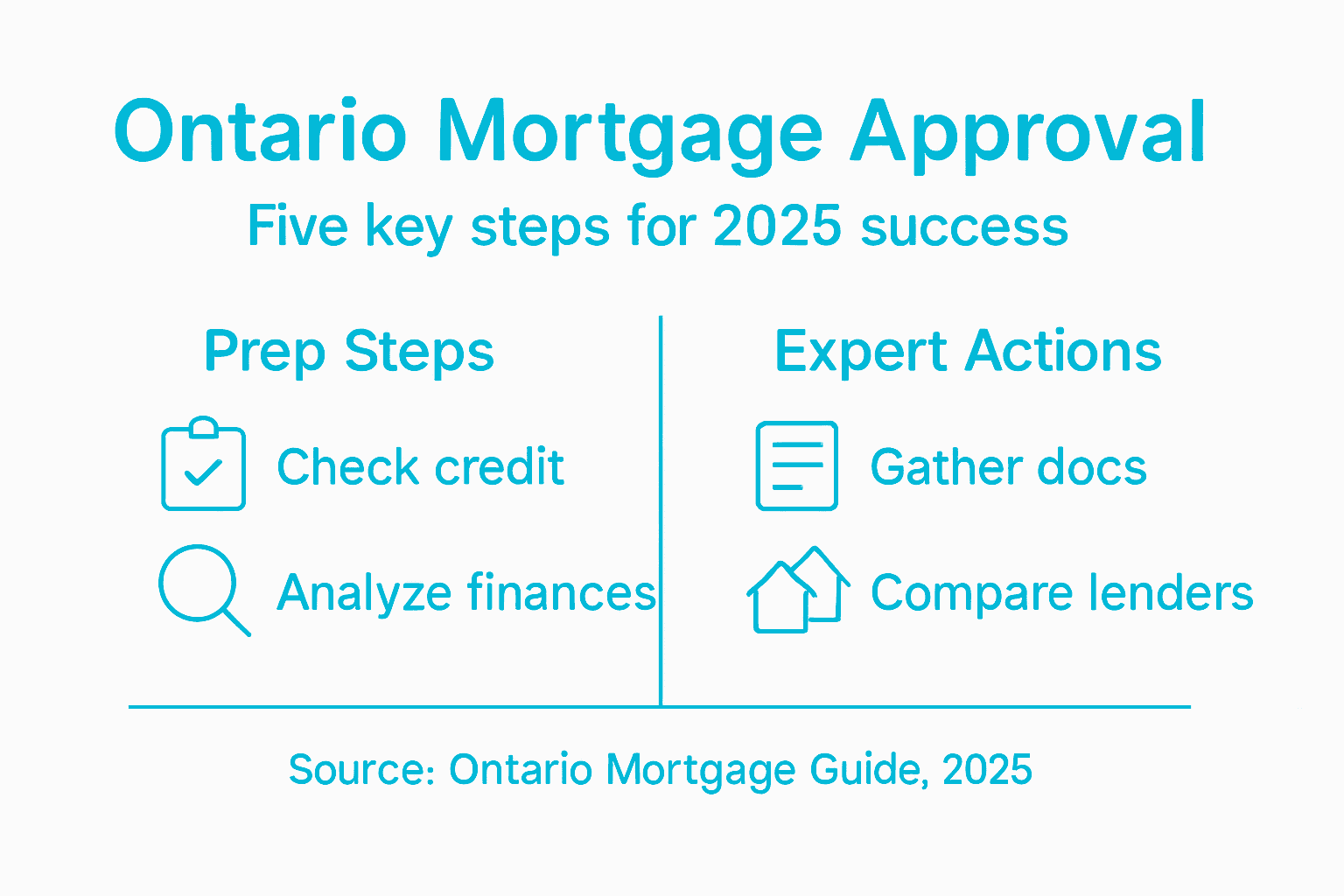
Licensed mortgage professionals provide critical support in understanding and improving your mortgage approval prospects. These experts offer comprehensive guidance on credit enhancement, document preparation, and lender selection. They can help you identify potential weaknesses in your application and develop targeted strategies to address them. For instance, they might suggest specific steps to improve your credit score, recommend ways to restructure existing debt, or guide you towards lenders more likely to approve your specific financial profile.
Professional mortgage advisors also excel at mortgage preapproval preparation. They understand the nuanced stress test requirements and can help you organize financial documentation to present the most compelling case to potential lenders. This might include exploring alternative options like co-signers, understanding complex income verification processes for self employed applicants, or identifying specialized lending programs that match your unique financial circumstances.
Pro tip: Schedule consultations with multiple mortgage professionals to gain diverse perspectives and comprehensive insights into improving your mortgage application.
Step 5: Verify your mortgage approval and finalize next steps
Reaching mortgage approval is an exciting milestone that requires careful attention to details and strategic follow through. Your final steps will transform your mortgage from an approved concept into a tangible financial agreement.
Mortgage preapproval terms demand thorough verification of all conditions and requirements. Carefully review the entire mortgage contract, paying special attention to the interest rate, repayment schedule, and any specific contingencies. Confirm that you understand every clause and requirement, and ensure all documentation is complete and accurate. This includes verifying your personal information, employment details, income documentation, and any additional supporting materials the lender may require.
Working closely with your lender and legal professionals is crucial during the final stages. This involves scheduling property appraisals, completing final underwriting processes, and confirming funding dates. Mortgage finalization steps require proactive communication and prompt response to any additional requests. Maintain open lines of communication with your mortgage advisor, promptly submit any requested documents, and stay informed about each stage of the closing process.
Pro tip: Create a dedicated email folder and document tracking system to ensure you can quickly locate and submit any additional paperwork required during the final mortgage approval stages.
Take Control of Your Mortgage Approval Journey with Expert Support
Improving your mortgage approval chances in Ontario begins with a clear understanding of your financial picture and access to the right lending partners. The article highlights key challenges such as managing your credit report accuracy, organising income documentation, and exploring alternative mortgage solutions. At Miracle Financial, we specialise in helping Canadians overcome these exact hurdles by providing tailored strategies like debt consolidation mortgage options and private mortgage lenders Ontario access that align with your unique financial goals.

Don’t let complexities slow down your path to homeownership or refinancing. Connect today with a trusted Ontario mortgage broker and self-employed mortgage broker who understands your distinct needs. With fast approvals and personalised guidance from Miracle Financial, you can navigate mortgage planning with confidence and secure the best terms available. Visit https://www.miraclefinancial.ca/ now to start improving your mortgage approval prospects and take the next step toward financial freedom.
Frequently Asked Questions
How can I check my credit report for mortgage approval?
To check your credit report for mortgage approval, obtain a free copy from the main credit bureaus. Review it closely for accuracy and dispute any errors immediately to improve your chances of approval.
What documents do I need to prepare for my mortgage application?
Gather essential income and employment documents, such as recent pay stubs, a job letter, and your most recent tax returns. Organize these documents in a dedicated digital folder to streamline the application process.
How can I improve my gross debt service ratio for mortgage approval?
You can improve your gross debt service ratio by reducing your existing debts or increasing your monthly income. Aim to keep your total monthly debt payments below 42% of your gross monthly income to enhance your approval potential.
What alternative lenders should I consider for mortgage approval?
Consider exploring credit unions, insurance companies, and private lenders for mortgage approval. Working with a mortgage broker can help you compare offers from these providers and find the best fit for your financial situation.
How can a mortgage professional help me with my application?
A mortgage professional can provide expert guidance on enhancing your application by reviewing your financial profile and suggesting improvement strategies. Schedule a consultation to receive personalized advice tailored to your specific circumstances.
What are the final steps to complete after mortgage approval?
After obtaining mortgage approval, carefully review the mortgage contract for accuracy and confirm all required documentation is in order. Maintain open communication with your lender and promptly address any additional requests to finalise the process.