
Blog
Low Credit Score Mortgage Options: Complete Guide Ontario


Securing a mortgage with a low credit score can seem nearly impossible for many canadian homebuyers. Traditional lenders in Canada often require a minimum credit score of 680, leaving those below this threshold facing strict barriers. With more than one in five Canadians carrying a subprime credit score, knowing your financing options is crucial. This guide gives clear, practical strategies and insights into the best mortgage solutions for low credit borrowers, helping you move closer to homeownership even in a challenging market.
Table of Contents
- Defining Low Credit Score Mortgage Options
- Types of Mortgages for Low Credit Borrowers
- How Private and Alternative Lending Works in Ontario
- Qualifying Criteria and Documentation Needs
- Risks, Costs, and Common Pitfalls to Avoid
Key Takeaways
| Point | Details |
|---|---|
| Low Credit Options | Borrowers with a credit score below 600 face challenges in securing traditional mortgages, but alternative pathways exist. |
| Types of Lenders | Options include A-Lenders (traditional banks), B-Lenders (alternative providers), and private mortgage lenders, with varying criteria and rates. |
| Documentation Requirements | Comprehensive documentation is essential, including personal identification, income verification, and property details, to support the mortgage application. |
| Risks and Strategies | Higher interest rates and potential pitfalls necessitate careful research and strategic financial planning to mitigate risks associated with alternative lending. |
Defining Low Credit Score Mortgage Options
A low credit score in the Canadian mortgage market can significantly impact your ability to secure traditional home financing. According to Wowa, a credit score below 600 is generally considered challenging, potentially limiting your mortgage options and increasing borrowing costs.
In the Ontario mortgage landscape, lenders categorise credit scores into distinct tiers that directly influence lending decisions. Traditional mortgage providers typically require a minimum credit score of 680, which means borrowers with scores between 500 and 679 are considered higher-risk applicants. NerdWallet confirms that while these borrowers might face more stringent approval processes, alternative mortgage solutions do exist.
Navigating low credit score mortgage options requires understanding several key strategies:
- Alternative Lending Pathways: Private mortgage lenders and credit unions often have more flexible credit requirements
- Higher Interest Compensation: Expect to pay slightly elevated interest rates to offset perceived lending risk
- Secured Mortgage Options: Providing additional collateral can help mitigate lender concerns
- Credit Improvement Programs: Some lenders offer mortgage products designed to help borrowers rebuild credit
By working with experienced mortgage professionals who understand the nuanced Ontario lending environment, borrowers with lower credit scores can still achieve their homeownership goals. Alternative Mortgages in Ontario: Complete Expert Guide provides further insights into navigating these specialized mortgage solutions.
Types of Mortgages for Low Credit Borrowers
Navigating mortgage options with a low credit score requires understanding the diverse lending landscape in Ontario. Wowa outlines three primary mortgage categories that cater to borrowers with challenging credit profiles: A-Lenders, B-Lenders, and private mortgage providers.
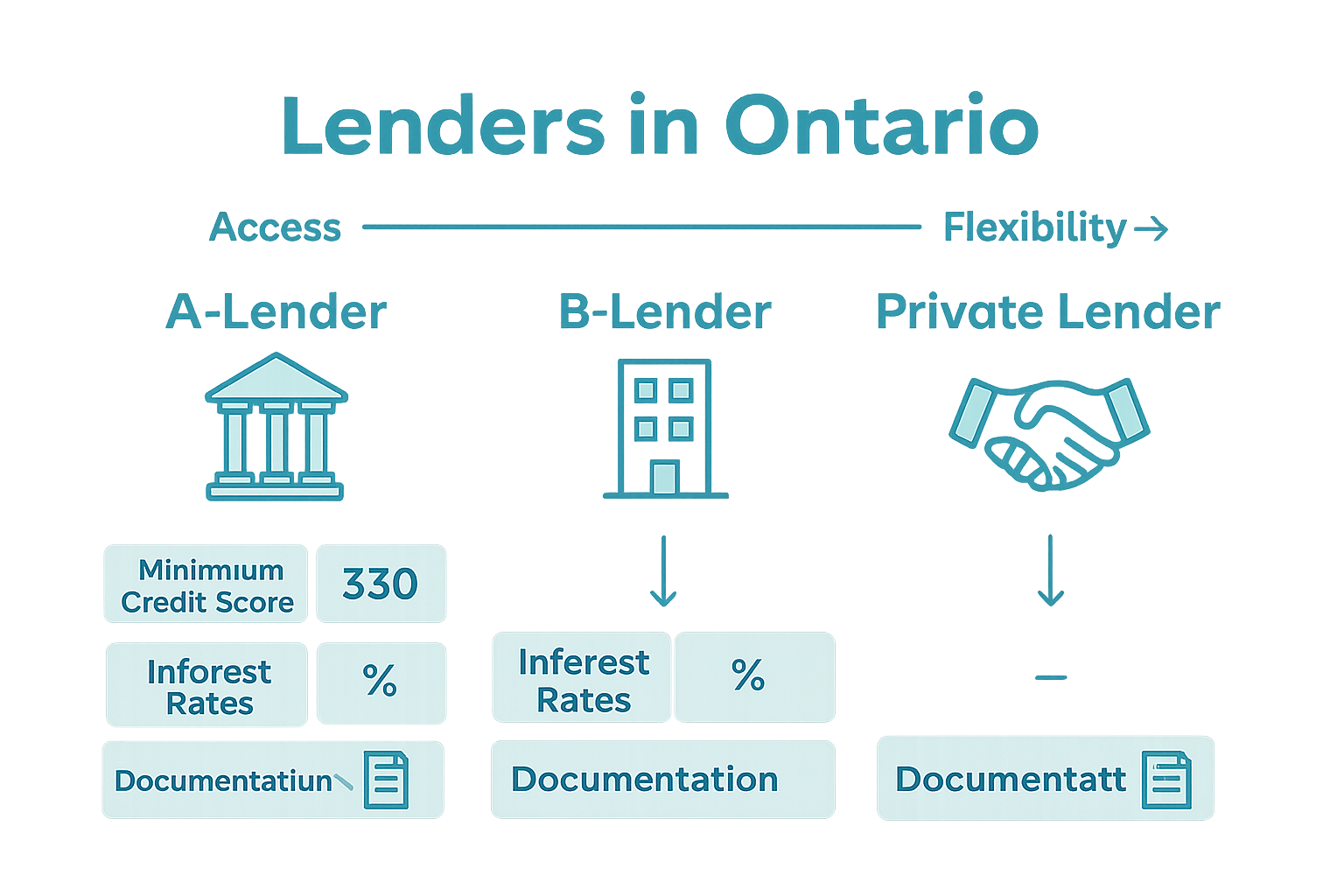
A-Lenders (Traditional Banks) represent the most stringent lending category, typically requiring credit scores of 680 or higher. These institutional lenders like major Canadian banks have the most conservative approval criteria, making them challenging for low credit borrowers. Applicants with scores below 680 will likely need to explore alternative financing strategies.
B-Lenders and Alternative Mortgage Providers offer more flexible lending standards. These financial institutions can accommodate credit scores as low as 600, providing opportunities for borrowers who might be rejected by traditional banks. Key characteristics of B-Lender mortgages include:
- Higher interest rates compared to traditional bank offerings
- More lenient credit score requirements
- Willingness to consider non-traditional income sources
- Faster approval processes
Private Mortgage Lenders represent the most flexible option for low credit borrowers. These lenders often have no minimum credit score requirement, focusing instead on property value and potential equity. While their interest rates are typically higher, they provide crucial financing opportunities for individuals struggling to secure traditional mortgages.
 Private Mortgage Lending Explained: Ontario Guide offers comprehensive insights into navigating these specialized lending solutions.
Understanding these mortgage types empowers low credit borrowers to make informed financing decisions, recognizing that alternative pathways exist beyond conventional lending standards.
How Private and Alternative Lending Works in Ontario
Private and alternative lending represents a critical financial pathway for borrowers who cannot secure traditional mortgage financing in Ontario. Wowa highlights that alternative lenders provide unique mortgage solutions, particularly for individuals with challenging credit profiles, by offering more flexible approval criteria compared to conventional banking institutions.
Risk-Based Lending Model characterizes how alternative and private lenders evaluate mortgage applications. Unlike traditional banks that prioritize credit scores, these specialized lenders focus on broader financial indicators such as property value, potential equity, income stability, and overall repayment capacity. This approach allows borrowers with non-traditional financial backgrounds to access mortgage opportunities that would otherwise be unavailable.
Key characteristics of alternative lending in Ontario include:
- Higher interest rates reflecting increased lending risk
- More substantial down payment requirements
- Shorter loan terms compared to conventional mortgages
- Greater emphasis on property valuation
- Faster approval processes
- Flexibility with credit history and income verification
Navigating private lending requires understanding the nuanced landscape of mortgage financing. Step-by-Step Guide to Private Mortgage Lenders in Ontario can provide borrowers with comprehensive insights into selecting the right alternative lending solution. By working with experienced mortgage professionals, borrowers can strategically leverage these specialized lending options to achieve their homeownership goals, even when traditional pathways seem closed.
Qualifying Criteria and Documentation Needs
Qualifying for a low credit score mortgage in Ontario requires a comprehensive documentation approach that goes beyond traditional lending standards. Mortgage documentation serves as the financial fingerprint that alternative and private lenders use to assess borrower reliability and potential lending risk.
The core documentation package typically includes several critical financial records that demonstrate your economic stability and repayment capacity. Lenders will meticulously review these documents to construct a holistic view of your financial profile:
- Personal Identification: Government-issued photo identification
- Income Verification: Recent pay stubs, tax returns, notice of assessments
- Employment Confirmation: Employment letter, contract details, work history
- Credit History: Detailed credit report, explanation of past credit challenges
- Property Details: Purchase agreement, property appraisal, current market valuation
- Bank Statements: Comprehensive 3-6 months of personal and business banking records
For self-employed borrowers or those with non-traditional income streams, documentation requirements become even more nuanced. Alternative lenders often require additional proof of income stability, such as:
- Comprehensive business financial statements
- Contracts and invoices demonstrating consistent revenue
- Accountant-prepared income verification
- Proof of existing business operations
Step-by-Step Guide to Private Mortgage Lenders in Ontario offers borrowers strategic insights into preparing a robust mortgage application package that addresses potential lender concerns. Understanding and meticulously preparing these documentation requirements can significantly improve your chances of securing a mortgage, even with challenging credit history.

Risks, Costs, and Common Pitfalls to Avoid
Navigating low credit score mortgages in Ontario demands a strategic approach that balances opportunity with potential financial risks. Alternative lending presents unique challenges that require careful consideration and proactive financial management to mitigate potential negative outcomes.
The most significant risks associated with alternative and private mortgage lending include substantially higher borrowing costs. Interest rates for low credit score mortgages can range from 2-4 percentage points higher than traditional mortgage rates, translating into thousands of additional dollars over the loan’s lifetime. Borrowers must carefully calculate long-term financial implications, understanding that these elevated rates compensate lenders for increased perceived risk.
Common pitfalls borrowers should vigilantly avoid include:
- Insufficient Research: Failing to compare multiple alternative lending options
- Overlooking Fine Print: Skipping detailed review of mortgage terms and conditions
- Ignoring Prepayment Penalties: Not understanding potential additional fees
- Neglecting Credit Repair: Missing opportunities to improve credit score
- Overextending Financial Capacity: Accepting mortgage terms beyond sustainable budget
Strategic mitigation strategies can help borrowers navigate these potential challenges:
- Maintain transparent communication with lenders
- Build a comprehensive financial improvement plan
- Consistently monitor and improve credit score
- Establish emergency financial reserves
- Consider working with mortgage professionals specializing in alternative lending
How to Choose Private Mortgage Lender in Ontario: Step-by-Step provides invaluable guidance for borrowers seeking to make informed decisions in the complex landscape of alternative mortgage financing. Understanding these risks empowers borrowers to approach low credit score mortgages with confidence and strategic insight.
Overcome Low Credit Score Challenges with Expert Ontario Mortgage Support
Struggling to find mortgage options with a low credit score can feel overwhelming. The article highlights the costly risks and restricted choices many face in Ontario’s mortgage market. At Miracle Financial, we understand these hurdles and are here to guide you through alternative lending, private mortgage solutions, and strategic refinancing tailored to your unique financial reality. Whether you are self-employed, rebuilding credit, or seeking flexible terms, our experienced Vaughan mortgage broker team provides clarity and confidence.
Take control of your financial future by trusting professionals who prioritize your goals. We combine industry expertise with fast approvals and transparent communication to match you with the best solutions like private mortgage lenders Ontario trusts and debt consolidation mortgage options that ease your burden.
Ready to explore customized mortgage plans designed specifically for low credit score borrowers? Visit Miracle Financial now. Discover how our Ontario mortgage broker experts can help you unlock homeownership and financial stability despite past credit challenges. Your smarter mortgage journey starts today.
Frequently Asked Questions
What are the mortgage options available for borrowers with low credit scores?
Borrowers with low credit scores can consider several options including A-Lenders (traditional banks), B-Lenders (alternative mortgage providers), and private mortgage lenders. A-Lenders typically require scores of 680 or higher, while B-Lenders can accommodate scores as low as 600. Private lenders often have flexible criteria with no minimum credit score requirement.
How do private mortgage lenders evaluate borrowers?
Private mortgage lenders use a risk-based lending model, focusing more on property value and equity rather than solely on credit scores. They evaluate the borrower’s overall financial profile, including income stability and repayment capacity, which allows individuals with less traditional financial backgrounds to secure mortgages.
What documentation is needed to qualify for a low credit score mortgage?
To qualify for a low credit score mortgage, borrowers typically need to provide personal identification, income verification (such as pay stubs and tax returns), employment confirmation, a detailed credit report, property details, and bank statements. Self-employed individuals may need additional documentation to confirm income stability.
What are the risks associated with mortgages for borrowers with low credit scores?
The primary risks include significantly higher borrowing costs, as interest rates can be 2-4 percentage points higher than traditional mortgages. Borrowers should be aware of potential pitfalls such as skipping thorough research, overlooking fine print in the mortgage terms, and accepting terms that exceed their financial capacity.
Recommended
- Step-by-Step Guide to Private Mortgage Lenders in Ontario – Miracle Financial
- How to Choose Private Mortgage Lender in Ontario: Step-by-Step – Miracle Financial
- Alternative Mortgages in Ontario: Complete Expert Guide – Miracle Financial
- Private Mortgage Lending Explained: Ontario Guide – Miracle Financial