
Blog
Missed a mortgage payment in Ontario? Steps and solutions


TL;DR:
- Missing one mortgage payment in Ontario does not mean losing your home if prompt action is taken.
- Early communication with your lender and exploring relief options can prevent foreclosure and protect your credit.
- There are various solutions like deferrals, refinancing, and debt consolidation to help homeowners recover.
Missing a mortgage payment is one of the most stressful financial events a homeowner can face. The fear of losing your home, the uncertainty about what happens next, and the shame that can come with financial difficulty are all very real. But here is the truth: missing one payment does not mean you will lose your home. Ontario homeowners have more options than most realise, and the single most important factor in how this situation unfolds is how quickly you take action. This guide walks you through exactly what happens after a missed payment, what the legal process looks like, and the concrete steps and solutions available to you right now.
Table of Contents
- How missed mortgage payments are handled in Ontario
- Short- and long-term consequences of missed payments
- Your immediate action plan: Steps to protect your home
- Exploring your options: Relief, refinancing, and debt consolidation
- What most guides miss: The emotional and strategic side of mortgage recovery
- How we can help you regain control of your mortgage
- Frequently asked questions
Key Takeaways
| Point | Details |
|---|---|
| Early action is vital | Contacting your lender after a missed payment lets you access relief options and prevents escalation. |
| Serious consequences possible | If not resolved, missed payments can lead to legal action and potential loss of your home. |
| Multiple options exist | Relief, refinancing, or debt consolidation can help you recover, even if your credit has taken a hit. |
| Ontario rates rising | Mortgage payment troubles are becoming more common, especially in Toronto, but help is available. |
How missed mortgage payments are handled in Ontario
Understanding the process is the first step to regaining control. When you miss a mortgage payment, your account enters what lenders call arrears, meaning the outstanding amount owed has fallen behind the agreed schedule. If arrears continue without resolution, your mortgage moves into default, which is a formal legal status that triggers more serious lender action. These are not the same thing, and knowing the difference matters.
Here is a general timeline of what to expect:
| Timeframe | What happens |
|---|---|
| Day 1 to 15 | Payment missed; lender may charge a late fee and attempt contact |
| Day 15 to 30 | Account flagged as in arrears; credit bureau notification may begin |
| 30 to 90 days | Formal demand letter issued; lender escalates to collections or legal team |
| 90+ days | Notice of Sale issued; 35-day statutory redemption period begins |
| After redemption period | Lender may proceed with power of sale if arrears are not cleared |
The power of sale is the most common enforcement remedy used by Ontario lenders. After a Notice of Sale is issued, you have a 35-day statutory redemption period to pay all outstanding arrears and costs to stop the process. This is not the end of the road. It is a formal warning with a clear window for action.
Lenders do not want to sell your home. It is costly, time-consuming, and uncertain for them. As a result, lenders prefer early resolution and may offer payment plans, deferrals, re-amortisation, or temporary forbearance before pursuing legal remedies. Knowing about Ontario mortgage solutions available through brokers and alternative lenders expands your choices further.
Here are the immediate options lenders may offer:
- Payment deferral: One or more payments are postponed and added to the end of your mortgage term.
- Repayment plan: Arrears are spread across future payments so you gradually catch up.
- Re-amortisation: Your mortgage is extended over a longer period to reduce monthly payments.
- Temporary forbearance: The lender agrees to pause or reduce payments for a set period.
Pro Tip: Contact your lender the moment you realise you will miss or have missed a payment. Early communication protects your credit and keeps more options on the table.
Short- and long-term consequences of missed payments
Now that you understand the process, it is important to know what is truly at stake if missed payments continue.
Short-term effects:
- Late fees added to your mortgage balance
- Credit score drop of 50 to 100 points or more after bureau reporting
- Increased lender contact and formal written notices
- Stress and uncertainty about your housing situation
Long-term effects:
- Formal default status on your mortgage
- Legal action and power of sale proceedings
- Potential loss of your home if arrears are not resolved
- Lasting damage to your credit profile, affecting future borrowing for years
- Difficulty qualifying for new financing at competitive rates
| Consequence | Short-term (0 to 90 days) | Long-term (90+ days) |
|---|---|---|
| Credit impact | Moderate score drop | Severe, lasting damage |
| Financial cost | Late fees | Legal fees, sale costs |
| Housing risk | Low to moderate | High if unaddressed |
| Lender relationship | Manageable with contact | Strained; legal escalation |
| Solution availability | Many options open | Fewer, more complex options |
Ontario’s mortgage arrears rate has climbed to approximately 0.25 to 0.29% in 2025 to 2026, the highest level since 2020. Toronto has been hit particularly hard, with missed payments quadrupling in just three years, reflecting the real affordability pressure many Ontario families are under.
The longer arrears go unaddressed, the narrower your options become and the higher the costs grow. Legal fees, property management costs, and accrued interest can add tens of thousands of dollars to what you owe. Understanding mortgage rate trends in Ontario also helps you anticipate whether your payments may increase further at renewal, which is critical context for planning ahead.

Your immediate action plan: Steps to protect your home
Knowing the risks, it is crucial to act quickly and methodically to protect your financial future. Here is a clear, step-by-step action plan to follow starting today.
- Contact your lender immediately. Call the number on your mortgage statement and explain your situation honestly. Ask specifically about payment relief options such as deferral, repayment plans, or re-amortisation. You do not need to have all the answers. You just need to start the conversation.
- Gather your mortgage documents. Collect your most recent mortgage statement, your original mortgage agreement, any notices you have received, and your payment history. Having these ready speeds up every conversation you will have.
- Review your full financial picture. List all your monthly income, expenses, and debts. This helps you understand what repayment amount is realistic and gives you credibility when negotiating with your lender.
- Document every interaction. Write down the date, time, name of the person you spoke with, and what was agreed. Follow up phone calls with a written email summarising what was discussed.
- Consult a licensed mortgage broker. If your lender’s options are not workable, a broker who specialises in improving mortgage approval outcomes can connect you with alternative and private lenders. A private mortgage lender guide can help you understand how these solutions work.
When you first call your lender, keep your tone calm and factual. Something like: “I am calling because I have missed my most recent payment and I want to work with you to resolve this as quickly as possible. Can you walk me through the options available to me?” This approach signals good faith and opens the door to solutions.
Pro Tip: Keep a written log of every call, letter, and email you receive from your lender. This record protects you legally and helps your mortgage broker or adviser understand the full picture.
Exploring your options: Relief, refinancing, and debt consolidation
Once you have reached out to your lender, understanding the wider set of options helps you choose the right path.
Lender-offered relief options:
- Payment deferral: Useful for short-term cash flow problems. Interest still accrues.
- Re-amortisation: Extends your mortgage term to lower monthly payments. You pay more interest over time.
- Repayment plan: Structured catch-up over several months. Requires stable income to sustain.
Refinancing:
- Replaces your existing mortgage with a new one, often at a lower payment or better rate.
- Pros: Can clear arrears, lower monthly costs, and reset your mortgage terms.
- Cons: Requires sufficient home equity and at least some qualifying income. May involve penalties for breaking your current mortgage.
Second mortgage:
- A loan secured against your home equity, separate from your first mortgage.
- Pros: Accessible even with damaged credit if equity exists. Can be used to clear arrears quickly.
- Cons: Higher interest rates than first mortgages. Adds a second payment obligation.
Debt consolidation options:
- HELOC or second mortgage to consolidate high-interest debts into one lower-rate payment.
- Consumer proposal: A formal agreement to repay a portion of unsecured debt. Stops collection proceedings and protects your assets, but affects your credit for several years.
- Debt management plan (DMP): Negotiated through a non-profit credit counselling agency. Reduces interest but does not reduce principal.
Be cautious of any company offering a “quick fix” to your mortgage problem in exchange for upfront fees or equity transfer arrangements. These schemes can put your home at greater risk, not less. Always verify that any adviser you work with is licensed in Ontario.
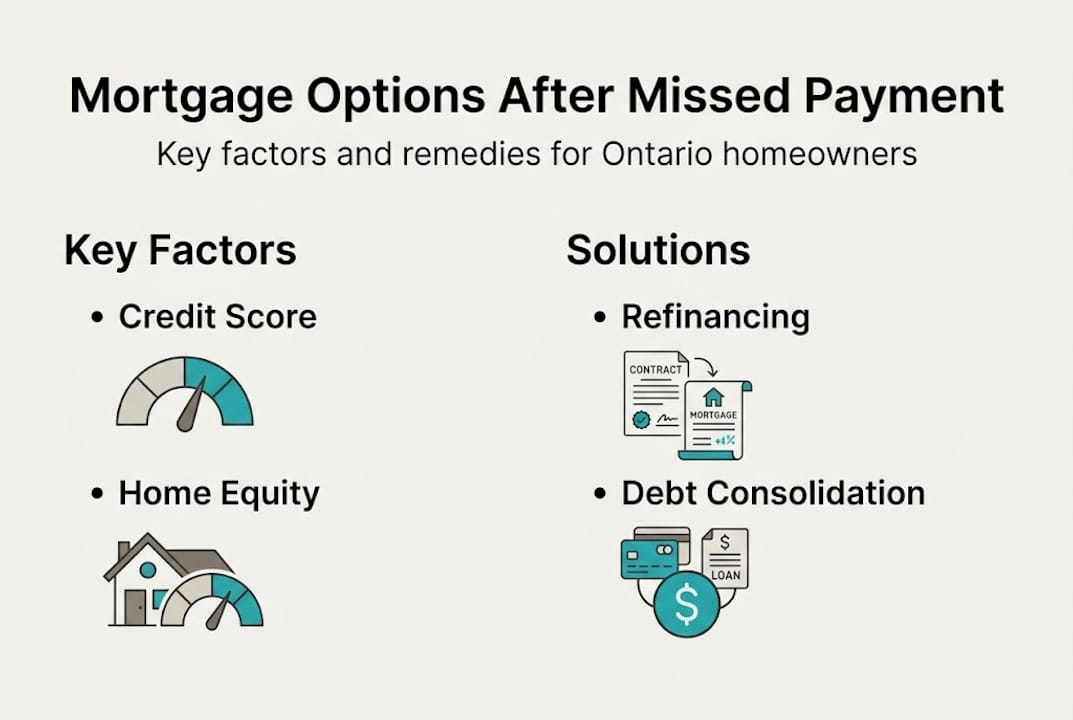
Your credit score, income stability, and available home equity are the three factors that most shape which options are realistic for you. Even with bruised credit, equity in your home opens doors that many homeowners do not realise exist.
What most guides miss: The emotional and strategic side of mortgage recovery
Most practical guides focus entirely on timelines and paperwork, but there is a human side to this experience that deserves acknowledgement. Many Ontario homeowners delay contacting their lender not because they lack information, but because shame and anxiety make it feel easier to wait. That silence is almost always the most costly decision.
It is worth reframing how you think about this situation. A missed mortgage payment is a financial problem, not a moral failing. Life events like job loss, illness, separation, or rising costs can affect anyone, and Ontario’s regulatory environment means that more structured options exist than most people realise. Lenders are required to engage with you in good faith before pursuing legal action.
Homeownership is not lost after one missed payment. What restores choice is information and early action. Exploring options for a low credit score shows just how many pathways remain open even when your financial situation feels compromised. The homeowners who recover fastest are rarely the ones with the most money. They are the ones who asked for help the soonest.
How we can help you regain control of your mortgage
If you are facing missed payments or mounting debt, Miracle Financial has helped hundreds of Ontario homeowners avoid power of sale and return to stable, manageable payments.

We specialise in refinancing your mortgage when traditional lenders have said no, and in structuring debt consolidation solutions that reflect your real financial situation, whether you are self-employed, carrying multiple debts, or dealing with credit challenges. Every case is different, and we take the time to understand yours before recommending a path forward. To get a confidential, no-pressure assessment of your options, speak to a specialist at Miracle Financial today.
Frequently asked questions
How many mortgage payments can I miss before losing my house in Ontario?
Generally, legal action can begin after two or more missed payments, but the 35-day redemption period after a Notice of Sale gives you a formal window to pay all arrears and stop the power of sale process.
How do missed payments affect my credit score?
Late mortgage payments are reported to credit bureaus and can significantly lower your score, making future borrowing more difficult and more expensive.
What is the power of sale process?
Power of sale allows a lender to sell your home after default; you receive a Notice of Sale and have a statutory period to clear arrears before the sale proceeds.
Can I refinance my mortgage after missing payments?
Refinancing may still be possible, particularly if you have sufficient home equity, though available refinancing options narrow as credit damage increases.
Are missed mortgage payments common in Ontario?
Arrears remain historically low overall, but Ontario arrears are rising to their highest levels since 2020, with thousands of homeowners across the province experiencing payment difficulty each year.