
Blog
Mortgage Affordability – How It Impacts Vaughan Homebuyers


Finding the right home in Vaughan often comes with the question of how much mortgage you can truly afford. With rising property prices and changing costs, understanding mortgage affordability is more important than ever for first-time buyers. This article breaks down what lenders look at, the tools available to calculate your own affordability, and the key financial factors you should consider when planning your purchase in Ontario.
Table of Contents
- Defining Mortgage Affordability In Ontario
- Key Factors That Influence Affordability
- Calculating Your Qualifying Mortgage Amount
- Common Misconceptions Among First-Time Buyers
- Improving Affordability With Mortgage Strategies
Key Takeaways
| Point | Details |
|---|---|
| Understanding Mortgage Affordability | Mortgage affordability in Ontario is based on income, expenses, and lending criteria, primarily measured through GDS and TDS ratios. |
| Key Financial Factors | Important elements include income stability, credit score, debt levels, and down payment. Assessing these helps buyers understand their purchasing power. |
| Common Misconceptions | First-time homebuyers often hold misconceptions about down payments and credit requirements, which can hinder their mortgage journey. |
| Strategies for Improvement | Homebuyers can enhance affordability by extending amortization periods, improving credit scores, and exploring various mortgage products. |
Defining Mortgage Affordability in Ontario
Mortgage affordability represents the financial capacity of potential homebuyers to secure and sustain a mortgage in Ontario. It’s a critical concept that determines how much housing you can realistically purchase based on your income, expenses, and lending criteria. Mortgage affordability calculations involve complex financial assessments that help lenders evaluate a borrower’s ability to manage monthly mortgage payments.
Lenders in Ontario typically use specific metrics to determine mortgage affordability, with two primary measurements being key:
- Gross Debt Service (GDS) Ratio: Maximum of 32% of gross household income allocated to housing expenses
- Total Debt Service (TDS) Ratio: Maximum of 40% of gross household income covering all debt obligations
The mortgage affordability process considers multiple financial factors beyond just income. Mortgage loan assessments involve comprehensive evaluations including:
- Credit history and credit score
- Annual income and employment stability
- Existing debt levels
- Down payment amount
- Current interest rates
- Potential property taxes and insurance costs
Understanding these factors helps Ontario homebuyers prepare financially and set realistic expectations about their home purchasing power. Lenders use stress tests and detailed financial models to ensure borrowers can sustainably manage their mortgage payments, protecting both the financial institution and the homeowner.
Pro tip: Get pre-approved for a mortgage before house hunting to understand your precise affordability range and strengthen your negotiating position.
Key Factors That Influence Affordability
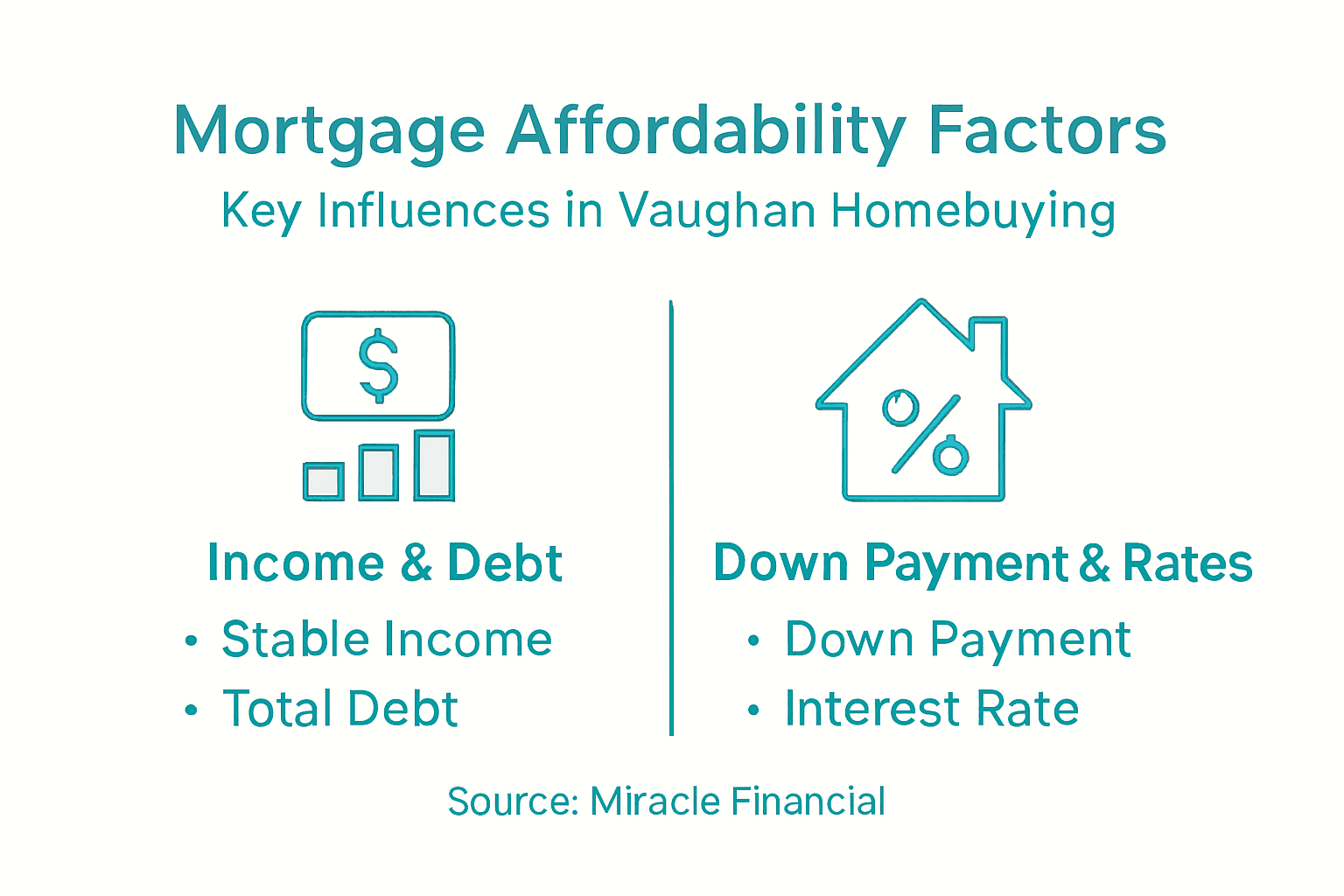
Mortgage affordability in Ontario is a complex interplay of multiple financial and personal factors that can significantly impact a homebuyer’s purchasing power. Housing affordability challenges stem from intricate economic dynamics that extend beyond simple income calculations.
The primary factors influencing mortgage affordability include:
- Income Stability: Consistent employment and predictable earnings
- Credit Score: Higher scores typically translate to better mortgage terms
- Debt Levels: Existing financial obligations impact borrowing capacity
- Down Payment: Larger down payments reduce overall mortgage requirements
- Interest Rates: Current market rates directly affect monthly payments
Regional economic conditions play a crucial role in determining mortgage affordability. Urban centres like Vaughan experience unique market pressures that can dramatically influence housing costs. Factors such as local employment rates, economic growth, and housing supply significantly impact how much home a buyer can realistically afford.

Financial experts recommend a comprehensive approach to evaluating mortgage affordability. This means looking beyond base income and considering potential future financial changes, emergency funds, and long-term financial goals. Understanding these nuanced factors helps Ontario homebuyers make more informed decisions about their home purchasing potential.
Pro tip: Consult a mortgage professional to perform a detailed affordability assessment that accounts for your unique financial situation and future goals.
Calculating Your Qualifying Mortgage Amount
Calculating your qualifying mortgage amount requires a comprehensive understanding of your financial profile and current lending standards. Mortgage qualification tools help homebuyers precisely estimate their borrowing potential by analyzing multiple financial variables.
The primary components used to determine your qualifying mortgage amount include:
- Gross Annual Income: Total earnings before taxes
- Credit Score: Demonstrates financial reliability
- Existing Debt Obligations: Monthly payments for loans and credit
- Down Payment: Amount of upfront capital available
- Current Interest Rates: Market-driven lending costs
Lenders typically apply two critical calculation methods to assess mortgage qualification: the Gross Debt Service (GDS) Ratio and the Total Debt Service (TDS) Ratio. These formulas ensure that your proposed mortgage payments remain within acceptable financial limits, typically restricting housing costs to 32% of your gross income and total debt payments to 40% of your gross income.
Mortgage qualification is not just about how much you want to borrow, but how much you can sustainably manage within your overall financial ecosystem.
Advanced mortgage calculators provide detailed insights by incorporating factors like property taxes, heating costs, and potential mortgage insurance requirements. These tools help Vaughan homebuyers develop a realistic understanding of their borrowing capacity before entering formal mortgage negotiations.
Pro tip: Gather all financial documentation beforehand and consider getting pre-approved to understand your exact mortgage qualification range.
Common Misconceptions Among First-Time Buyers
First-time homebuyers in Vaughan often enter the housing market with well-intentioned but misguided assumptions that can significantly impact their mortgage journey. First-time buyer misconceptions can lead to financial challenges and unexpected complications throughout the home purchasing process.
The most prevalent misconceptions include:
- Down Payment Myths: Believing a 20% down payment is always required
- Credit Score Misunderstandings: Thinking any credit score will qualify for a mortgage
- Pre-Approval Misconception: Assuming pre-approval is unnecessary or optional
- Hidden Cost Ignorance: Overlooking additional expenses beyond the mortgage
- Interest Rate Assumptions: Misunderstanding fixed versus variable rate implications
Many first-time buyers mistakenly believe that mortgage qualification is solely based on income. In reality, lenders conduct comprehensive assessments that examine multiple financial factors. Mortgage affordability insights reveal that credit history, existing debt, and potential future financial changes play crucial roles in determining mortgage eligibility.
Not all mortgage information found online applies universally – each buyer’s financial situation is unique and requires personalized evaluation.
Understanding these misconceptions can help Vaughan homebuyers approach their mortgage journey with greater confidence and financial preparedness. By dispelling myths and seeking professional guidance, first-time buyers can make more informed decisions that align with their long-term financial goals.
Pro tip: Consult a mortgage professional who can provide personalized insights tailored to your specific financial circumstances.
Improving Affordability With Mortgage Strategies
Homebuyers in Vaughan can strategically improve their mortgage affordability by understanding and implementing sophisticated financial approaches. Mortgage affordability insights reveal multiple techniques for managing mortgage expenses and expanding purchasing potential.
Key strategies for enhancing mortgage affordability include:
- Extend Amortization Period: Reduce monthly payment burdens
- Optimize Down Payment: Minimize mortgage insurance requirements
- Improve Credit Score: Qualify for better interest rates
- Consolidate Existing Debt: Improve overall financial profile
- Consider Alternative Lenders: Explore diverse financing options
Carefully selecting mortgage products can significantly impact long-term financial outcomes. Fixed-rate mortgages provide stability by locking in consistent payments, while variable-rate mortgages might offer initial cost advantages depending on market conditions. Understanding the nuanced trade-offs between these options helps buyers make informed decisions aligned with their financial goals.
Here’s a comparison of fixed-rate and variable-rate mortgages to help buyers choose the best fit for their situation:
| Mortgage Type | Payment Stability | Interest Rate Risks | Typical Suitability |
|---|---|---|---|
| Fixed-Rate | Predictable payments | Insulated from hikes | Long-term financial planners |
| Variable-Rate | Payments may fluctuate | Sensitive to market | Flexible or risk-tolerant |
Strategic mortgage planning is about balancing short-term affordability with long-term financial health.
Additional affordability enhancement techniques involve exploring government-supported programs, negotiating competitive rates, and maintaining a robust financial profile that demonstrates reliability to potential lenders.
Here is a summary of strategies to improve mortgage affordability in Vaughan:
| Strategy | Core Benefit | Potential Drawback |
|---|---|---|
| Extend Amortization Period | Lower monthly payments | Higher total interest over the term |
| Improve Credit Score | Access better rates | May take substantial time |
| Consolidate Debt | Increased borrowing capacity | May incur new fees or conditions |
Pro tip: Consult a mortgage professional to develop a personalized strategy that maximizes your unique financial opportunities.
Take Control of Your Mortgage Affordability with Expert Guidance
Understanding mortgage affordability and navigating the complex factors like credit scores, debt levels, and income stability can feel overwhelming for Vaughan homebuyers. Whether you are a first-time buyer or looking to refinance, the challenge lies in finding a mortgage solution that fits your unique financial situation while keeping your long-term goals in sight. Terms like Gross Debt Service and Total Debt Service ratios define your purchasing power but also highlight the need for personalized strategies.

At Miracle Financial, we specialize as a trusted Vaughan mortgage broker committed to helping you turn these affordability challenges into strategic opportunities. Our team offers tailored solutions including refinance mortgage options in Ontario, debt consolidation mortgages, and private mortgage lending to address low credit score mortgages or unconventional income situations. Don’t let misconceptions or hidden costs derail your homeownership dreams. Start your journey today by consulting with experienced professionals who understand the market and your unique needs. Visit Miracle Financial now to explore how we can improve your mortgage affordability and set you on a confident path to homeownership.
Frequently Asked Questions
What is mortgage affordability?
Mortgage affordability refers to a potential homebuyer’s financial capacity to secure and maintain a mortgage, taking into account income, expenses, and lending criteria.
How do lenders in Vaughan calculate mortgage affordability?
Lenders typically use the Gross Debt Service (GDS) Ratio and Total Debt Service (TDS) Ratio, which consider a maximum of 32% and 40% of gross household income allocated to housing expenses and total debt obligations, respectively.
What factors affect mortgage affordability for homebuyers?
Key factors include income stability, credit score, existing debt levels, down payment amounts, and current interest rates, along with regional economic conditions.
How can first-time homebuyers improve their mortgage affordability?
First-time homebuyers can improve affordability by extending the amortization period, optimizing the down payment, improving their credit score, consolidating existing debt, and considering different mortgage products.