
Blog
Mortgage Approval Workflow Markham: Step-by-Step Guide


Facing mortgage approval in Markham can feel daunting when your credit score is low or your income varies year to year. Lenders rely on your credit report and financial documents to judge if you are ready for homeownership, making this process especially important for self-employed buyers. This guide shows how to build a strong application and highlights tailored financing solutions that can help you secure your dream home, even with a less-than-perfect credit profile.
Table of Contents
- Step 1: Assess Credit Profile And Financial Documents
- Step 2: Select Tailored Mortgage Options With Miracle Financial
- Step 3: Submit Application And Supporting Materials
- Step 4: Verify Approval Status And Finalize Mortgage
Quick Summary
| Key Insight | Explanation |
|---|---|
| 1. Assess Your Credit Profile First | Obtain your credit report and carefully review your score. Address any errors ahead of time to strengthen your application before submitting it to lenders. |
| 2. Gather Comprehensive Financial Documents | Collect essential documents including tax returns and bank statements, as self-employed applicants typically need more documentation to demonstrate income stability. |
| 3. Choose Mortgage Options Wisely | Work with a broker to find mortgage products tailored to your profile, especially if you have lower credit scores or are self-employed, to ensure suitable terms. |
| 4. Submit a Thorough Application | Ensure all application materials are accurate and complete. This thoroughness can significantly expedite the approval process and reduce delays caused by missing information. |
| 5. Stay Engaged During Approval Process | Regularly check your application status with your broker and respond promptly to any lender requests to maintain your closing timeline and avoid further delays. |
Step 1: Assess credit profile and financial documents
Your credit profile and financial documents form the foundation of your mortgage application. Lenders in Markham use these to evaluate your ability to repay, so reviewing them before applying helps you understand your position and address any issues upfront.
Start by obtaining your credit report from either Equifax or TransUnion. You can request a free copy online to verify accuracy and check for errors. Review your credit score carefully—this number signals your payment history and debt management to lenders.
What to look for in your credit report:
- Payment history: Are bills marked as paid on time or late?
- Credit card balances: How much of your available credit are you using?
- Outstanding debts: What loans or lines of credit are currently open?
- Errors or discrepancies: Are there accounts you don’t recognise?
- Hard inquiries: Have other lenders recently checked your credit?
If you spot errors, contact the credit bureau immediately. Correcting inaccuracies can improve your score before lender review. For self-employed individuals with inconsistent income, credit repair strategies may help strengthen your profile during underwriting.
Next, gather your financial documents. OSFI guidelines require lenders to assess your overall financial health, not just your credit score. Self-employed applicants typically need more documentation than salaried employees.
Essential documents to collect:
- Last 2 years of personal tax returns
- Last 2 years of business tax returns and financial statements
- Recent pay stubs or income statements
- Bank statements covering the last 3 to 6 months
- Investment account statements
- List of debts with current balances
Organise these documents in one folder before your lender meeting. Clear, complete paperwork speeds up the approval process and shows you’re serious about the mortgage.
Understanding your credit profile and gathering complete financial documents before application significantly improves your chances of approval, especially with a lower credit score.
Pro tip: If your credit score is below 650, focus on reducing credit card balances before applying—even a 10-15% reduction in utilisation can boost your score by 20-30 points within weeks.
Step 2: Select tailored mortgage options with Miracle Financial
With your financial documents and credit profile assessed, you’re ready to explore mortgage options designed specifically for your situation. A mortgage broker specialising in self-employed borrowers and lower credit scores can match you with products that fit your needs and budget.

Miracle Financial works with homebuyers in Markham to evaluate your complete financial picture. Rather than fitting you into a generic mortgage, the team reviews your income stability, debt obligations, and long-term goals to recommend the best fit.
Share your financial story clearly:
- Explain any credit challenges and what caused them
- Detail your self-employed income patterns and business stability
- Discuss your down payment amount and savings capacity
- Mention your timeline for purchasing and long-term plans
- Be honest about monthly affordability limits
Your broker will then present mortgage options tailored to your profile. This might include fixed vs. variable rate mortgages, different amortisation periods, and mortgage insurance considerations based on your down payment.
For self-employed individuals or those with lower credit scores, alternative mortgages in Ontario may offer solutions that traditional lenders won’t provide. These options expand your possibilities beyond conventional financing.
Key decisions to make:
- Rate type: Fixed provides payment stability; variable offers lower initial rates
- Amortisation length: Longer periods lower monthly payments; shorter periods build equity faster
- Insurance: Mortgage default insurance protects the lender if you default
- Prepayment options: Can you pay extra to accelerate your mortgage paydown?
Don’t rush this step. Compare offers carefully and ask your broker to explain how each option affects your long-term finances. The cheapest rate isn’t always the best choice if the terms don’t match your situation.
Here’s a quick guide to how different mortgage rate types affect your long-term finances:
| Mortgage Feature | Fixed Rate | Variable Rate |
|---|---|---|
| Payment Predictability | Consistent monthly payment | Payments vary with rates |
| Initial Cost | Often higher than variable | Typically lower initial rate |
| Interest Savings | May pay more if rates fall | Could save if rates drop |
| Best For | Stable budgeting needs | Tolerance for rate changes |
Selecting the right mortgage product requires matching the terms to your income stability, credit profile, and financial goals, not just chasing the lowest rate.
Pro tip: Request a personalised amortisation schedule showing how your payments build equity over time—this helps you understand the true cost and benefits of each option before committing.
Step 3: Submit application and supporting materials
You’ve selected your mortgage product and organised your documents. Now comes the critical step of submitting your application with complete, accurate supporting materials. This is where clarity and thoroughness directly impact approval speed.
Your broker will guide you through the application form, but you’re responsible for ensuring every detail is correct. Even small errors can trigger delays or requests for clarification, so take time to review before submitting.
Core documents your lender needs:
- Government-issued photo identification
- Proof of current address (utility bill, lease, or property tax statement)
- Last 2 years of tax returns (personal and business for self-employed)
- Recent pay stubs or income statements
- Last 3 to 6 months of bank statements
- Employment contact information and verification
- Complete list of existing debts with balances
- Down payment proof (savings statements or gift letters)
Before submitting, ensure all documents are legible and organised chronologically. Providing detailed supporting documents accelerates processing and reduces back-and-forth requests.
Once you submit, your lender will perform underwriting checks. This includes verifying your income, reviewing credit reports, and conducting a mortgage stress test to confirm you can afford payments at qualifying interest rates. Self-employed applicants often face extra scrutiny here, so ensure your financial documents clearly demonstrate income stability.
Honesty is non-negotiable. Providing false information can result in application rejection, fraud investigations, or even legal consequences. If something in your financial picture is complex or unfavourable, discuss it with your broker beforehand—they can frame it appropriately for lenders.
Submitting complete, accurate documents upfront eliminates delays and demonstrates you’re serious and organised, which matters to underwriters reviewing lower credit scores.
Pro tip: Keep a checklist of submitted documents and confirm receipt from your lender—this creates a paper trail and prevents “lost document” delays that can push back your closing date.
Step 4: Verify approval status and finalize mortgage
Your application is submitted and undergoing review. Now you wait for approval confirmation, but this doesn’t mean sitting passively. Staying informed and responding quickly to lender requests ensures your closing date stays on track.
Contact your broker regularly to check on your application status. Lenders typically provide updates within 5 to 10 business days, but timelines vary depending on application complexity. Self-employed borrowers and those with lower credit scores may experience longer reviews as underwriters conduct more thorough assessments.
Expect the lender to request:
- Updated bank statements showing down payment funds
- Explanation letters for any credit issues or income gaps
- Proof of employment or business stability verification
- Property appraisal (arranged and paid for by the lender)
- Title search and insurance quote
- Final verification that your financial situation hasn’t changed
Respond to all lender requests within 24 to 48 hours. Delays in providing documents can push back your closing date significantly. Keep your broker informed of any major financial changes, such as job loss, new debt, or large withdrawals from savings.
Once the lender confirms your application meets all underwriting guidelines, you’ll receive a formal approval letter. This outlines your mortgage amount, interest rate, term, and any conditions that must be met before funding. Review this document carefully with your broker to confirm everything matches your expectations.
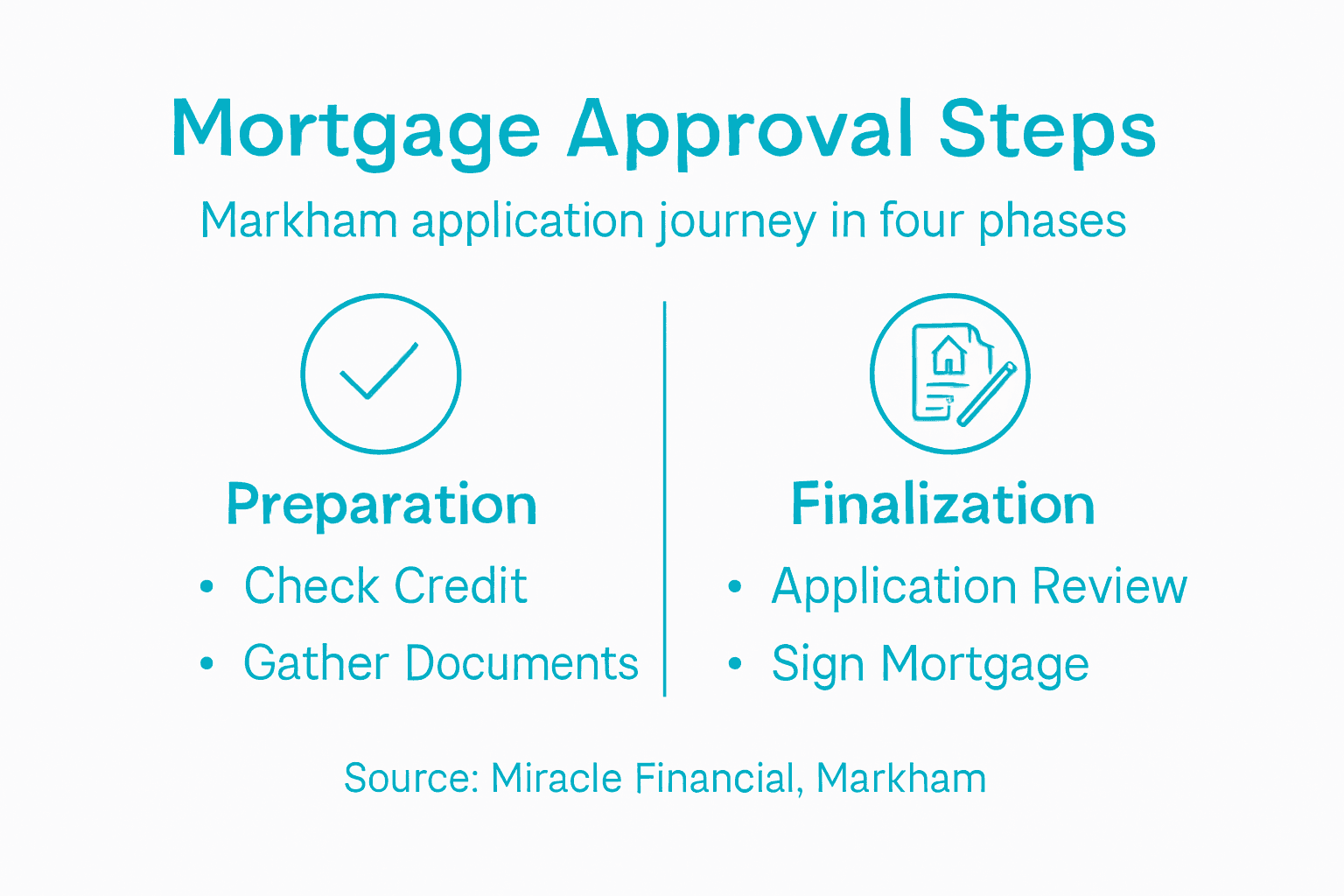
Finalising your mortgage involves signing documents and completing insurance requirements, including mortgage default insurance if your down payment is less than 20 percent. Your lawyer or notary public will handle legal paperwork and title registration.
The final step is scheduling your closing appointment. This is when you sign the mortgage agreement, receive the keys, and officially become the homeowner.
Key steps for finalising your mortgage and how they impact your closing process:
| Step | Purpose | Impact on Approval Timeline |
|---|---|---|
| Respond to lender requests | Provide additional information | Timely replies prevent delays |
| Review approval letter | Confirm loan details | Avoids last-minute surprises |
| Complete insurance requirements | Satisfy lender’s risk criteria | Required before funding |
| Attend closing appointment | Finalise all documents | Officially complete purchase |
Approval confirmation marks a significant milestone, but finalisation requires attention to detail and quick responses to ensure your closing date doesn’t slip.
Pro tip: Set phone reminders for document deadlines and confirm receipt of submitted materials with your lender in writing—this prevents miscommunications that could delay your approval or closing by weeks.
Simplify Your Mortgage Approval Journey with Miracle Financial
Navigating the detailed steps of mortgage approval in Markham can feel overwhelming, especially when managing financial documents and credit challenges on your own. Whether you are self-employed, rebuilding your credit, or seeking alternative mortgage options, the process requires expert guidance to avoid delays and boost your approval chances. From assessing your credit profile to finalizing mortgage details, every stage benefits from tailored advice that understands your unique financial story.

Take control of your home financing with an experienced Ontario Mortgage Broker who specialises in helping clients with lower credit scores and self-employed income. Miracle Financial offers personalised mortgage solutions including debt consolidation mortgage and private lending options to fit your needs. Don’t wait until the last minute – connect with a trusted Self-Employed Mortgage Broker today to speed up approvals and secure your ideal mortgage terms. Visit Miracle Financial now to start your stress-free mortgage journey.
Frequently Asked Questions
What documents do I need to prepare for mortgage approval in Markham?
To get approved for a mortgage, you need to gather several key documents, including your last two years of personal and business tax returns, recent pay stubs, and bank statements. Organise these documents in one folder before your lender meeting to speed up the approval process.
How can I improve my credit score before applying for a mortgage in Markham?
To enhance your credit score, focus on reducing credit card balances. A reduction of 10-15% in your credit utilisation can boost your score by 20-30 points within weeks, improving your chances of approval.
What should I expect during the mortgage application process in Markham?
After submitting your application, you can expect your lender to conduct underwriting checks, including verifying income and performing a mortgage stress test. Stay proactive by checking in with your broker regularly for status updates, as this process typically takes 5 to 10 business days.
How can I select the right mortgage option for my needs in Markham?
To choose the best mortgage option, clearly discuss your financial situation, down payment amount, and monthly affordability limits with your mortgage broker. They will present tailored products that fit your needs instead of generic options.
What happens after I receive mortgage approval in Markham?
Once you receive mortgage approval, you must finalise your mortgage by signing documents and meeting any insurance requirements. Respond to lender requests promptly to ensure your closing date stays on track.
How long does the entire mortgage approval workflow take in Markham?
The mortgage approval workflow can vary in duration but typically averages 30-60 days from application submission to closing. Staying organised and responsive throughout the process will help expedite this timeline.