
Blog
Mortgage prepayment penalties: Ontario homeowner guide


TL;DR:
- Mortgage prepayment penalties in Ontario are fees charged when homeowners pay off or refinance their mortgages early, often calculated as either three months’ interest or the interest rate differential (IRD), whichever is higher. These penalties vary based on mortgage type, remaining term, and rate calculation method, with fixed-rate mortgages typically incurring higher costs due to IRD calculations. Understanding and requesting a written payout quote helps homeowners strategize, potentially reducing penalties through timing, porting, or using prepayment privileges.
Mortgage prepayment penalties are fees charged by lenders when you pay off your mortgage early, refinance before your term ends, or exceed the prepayment limits written into your contract. In Ontario, these fees can range from a few thousand to tens of thousands of dollars, depending on your mortgage type, the interest rates involved, and how much time remains on your term. The two primary calculation methods are the Interest Rate Differential (IRD) and three months’ interest. Understanding which method applies to your mortgage, and how your lender applies it, is the difference between a refinancing decision that saves you money and one that costs you far more than expected.
How are mortgage prepayment penalties calculated in Ontario?
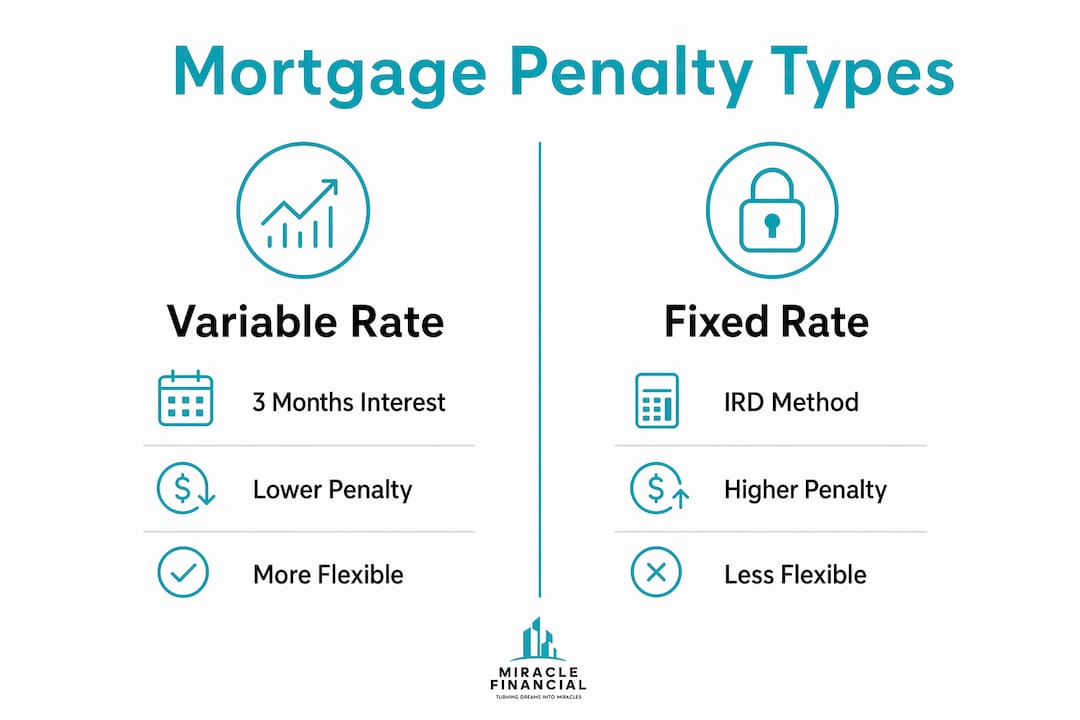
Prepayment penalties in Canada are typically calculated as either three months’ interest or the IRD, whichever is higher. The method that applies depends on your mortgage type. Variable-rate mortgages almost always use three months’ interest, which is straightforward to calculate. Fixed-rate mortgages use the higher of the two methods, which means the IRD frequently applies and produces a much larger number.
The IRD measures the difference between your original contract rate and the rate your lender can charge today for a term similar to your remaining term. If you locked in at 5.5% and current rates for a comparable term are 4.0%, the lender calculates the cost of that 1.5% gap across your remaining balance and remaining months. That gap, multiplied across a large mortgage balance, produces a penalty that surprises most homeowners.
The most significant variable in IRD calculations is whether your lender uses your discounted rate or their posted rate. Posted-rate IRD formulas are described by brokers as the most expensive calculation method, and they are used by most major Canadian banks. Because posted rates are typically higher than the discounted rate you actually received, the difference between the posted rate and the current comparison rate appears smaller, which paradoxically inflates the penalty. This is the calculation detail that catches most Ontario homeowners off guard.
Pro Tip: Never estimate your penalty using an online calculator alone. Request a written payout statement directly from your lender, which shows the exact rates and formula used. Lenders must provide this quote in writing, and it is binding if accepted.
The table below compares the two main penalty methods side by side:
| Feature | Three months’ interest | IRD penalty |
|---|---|---|
| Applies to | Variable-rate mortgages | Fixed-rate mortgages (if higher) |
| Calculation basis | Outstanding balance × rate × 3 months | Rate gap × balance × remaining term |
| Typical cost | Lower, more predictable | Higher, especially early in term |
| Rate formula used | Contract rate | Posted or discounted rate (lender-specific) |
| Predictability | High | Low without written quote |
The remaining term on your mortgage also directly affects penalty size. IRD penalties are dominant cost drivers early in a term, when more months remain and the rate gap has more time to compound. Breaking a five-year fixed mortgage in year two produces a far larger penalty than breaking it in year four.
What situations trigger mortgage prepayment penalties?
Several common actions trigger mortgage prepayment penalties for Ontario homeowners. Each of the following typically results in either a three-month interest charge or an IRD penalty:
- Selling your home before the term ends. When you sell and the buyer does not assume your mortgage, the full outstanding balance is repaid, triggering the penalty.
- Refinancing mid-term. Accessing equity, consolidating debt, or securing a lower rate before your renewal date all constitute breaking your existing contract.
- Switching lenders before renewal. Moving to a different lender, even for a better rate, requires discharging your current mortgage and paying the associated penalty.
- Exceeding your annual prepayment limit. Most closed mortgages allow lump-sum payments of 10% to 20% of the original principal per year. Payments above that threshold trigger a penalty on the excess amount.
- Blending and extending with a different lender. Blending your current rate with a new rate at the same lender avoids a penalty, but moving to a new lender to do the same does not.
Two additional concepts matter here. First, porting your mortgage when you move to a new property transfers your existing balance and rate to the new home, avoiding the penalty entirely. Not all lenders allow porting, and conditions apply, but it is worth exploring before listing your property. Second, the distinction between hard and soft penalties matters for planning. A hard prepayment penalty applies regardless of circumstances, while a soft penalty may be waived or reduced in specific situations such as a sale. Reviewing your mortgage contract or speaking with your lender clarifies which type you hold.
Understanding your fixed vs variable mortgage structure is the starting point for knowing which penalty scenario applies to you.
How to avoid or reduce mortgage prepayment penalties
Avoiding or reducing prepayment penalties requires deliberate planning, ideally before you sign your mortgage contract and throughout your term.
-
Choose an open mortgage if flexibility is a priority. Open mortgages permit prepayment at any time without penalty. The trade-off is a higher interest rate, typically 1% or more above a comparable closed mortgage rate. For homeowners who expect to sell or refinance within one to two years, the rate premium is often less costly than a closed mortgage penalty.
-
Maximise your annual prepayment privileges. Most closed mortgages include the right to make lump-sum payments of 10% to 20% of the original principal each year, plus the option to increase regular payment amounts. Using these privileges reduces your outstanding balance before any refinancing, which directly lowers the penalty amount since penalties are calculated on the balance owed.
-
Time your break close to renewal. Breaking a mortgage closer to renewal significantly reduces the IRD penalty because fewer months remain. If your renewal is six months away, the cost of waiting is often far less than the penalty you would pay today. Review your renewal date before making any refinancing decision.
-
Port your mortgage when moving. If you are selling your current home and purchasing another, ask your lender whether porting is available. Porting transfers your existing mortgage to the new property, preserving your rate and avoiding the penalty. Some lenders also allow you to blend a top-up amount at current rates.
-
Request a written payout quote before committing. Online penalty calculators are estimates. A written payout statement from your lender shows the exact formula, rates, and penalty amount. This document is binding if accepted, giving you a firm number to include in your break-even analysis.
-
Negotiate or ask about blending. Lenders rarely waive IRD penalties outright, but blending your current rate with a new rate at the same lender can soften the financial impact. This approach is not available at all lenders, but it is worth asking about before assuming a full penalty is unavoidable.
-
Consult a mortgage broker before acting. A broker with access to multiple lenders can model the full cost of breaking your mortgage against the benefit of a new rate or product, helping you determine whether the move makes financial sense.
Pro Tip: Paying down your mortgage balance using your annual lump-sum privilege before refinancing reduces the principal on which the penalty is calculated. Even a $20,000 prepayment before breaking a fixed-rate mortgage can meaningfully lower the IRD amount.
How do penalties affect refinancing and debt consolidation?

Mortgage prepayment penalties directly affect whether refinancing or debt consolidation makes financial sense. The core question is whether the savings from a new mortgage rate or consolidated debt payment exceed the cost of breaking the current contract. This is the break-even analysis every Ontario homeowner should complete before proceeding.
Consider a homeowner carrying $30,000 in credit card and line-of-credit debt at 19% to 22% interest. Consolidating that debt into a refinanced mortgage at 5% to 6% produces significant monthly savings. If the prepayment penalty is $8,000, the break-even point is the number of months required for the interest savings to recover that $8,000. In many cases, the math still favours refinancing, particularly when the penalty can be rolled into the new mortgage balance.
| Scenario | Penalty cost | Potential saving | Break-even period |
|---|---|---|---|
| Refinance to lower rate (0.75% drop) | $6,000 to $12,000 | $200 to $400/month | 18 to 36 months |
| Debt consolidation (high-interest debt) | $5,000 to $10,000 | $500 to $900/month | 8 to 16 months |
| Selling home mid-term | $4,000 to $15,000 | N/A (sale proceeds cover it) | Not applicable |
For homeowners exploring a debt consolidation mortgage, the penalty is a one-time cost weighed against ongoing monthly relief. When high-interest debt is consuming $800 to $1,200 per month in interest alone, a $7,000 penalty paid once is recovered within months. The calculation changes if the penalty is very large relative to the savings, which is why getting the written payout figure first is non-negotiable.
Second mortgages and private mortgage options offer an alternative path for homeowners who want to access equity without breaking their first mortgage. These products carry higher rates but avoid the prepayment penalty entirely, which can make them the lower-cost option when the IRD on a first mortgage is substantial. A mortgage broker can model both scenarios side by side.
For rental or investment properties, prepayment penalties may be tax-deductible as a financing cost. Personal residences do not qualify for this treatment. Confirming the tax treatment with an accountant before breaking a mortgage on an investment property can change the net cost of the decision.
Key takeaways
Mortgage prepayment penalties are a calculable cost, not an unavoidable surprise, and understanding the IRD formula, your lender’s rate method, and your remaining term gives you the information needed to make a sound financial decision.
| Point | Details |
|---|---|
| Two penalty methods | Variable mortgages use three months’ interest; fixed mortgages pay the higher of IRD or three months’ interest. |
| Posted-rate IRD inflates costs | Lenders using posted-rate formulas produce significantly higher penalties than discounted-rate calculations. |
| Timing reduces penalties | Breaking a mortgage close to renewal lowers the IRD because fewer months remain in the term. |
| Written quote is binding | Always request a written payout statement before refinancing; online calculators are estimates only. |
| Break-even analysis is required | Compare the full penalty cost against monthly savings to determine whether refinancing or consolidation makes financial sense. |
What most homeowners get wrong about prepayment penalties
The single most common misunderstanding I see is homeowners calculating their own IRD using the rate on their mortgage statement, then being shocked when the lender’s actual figure is two or three times higher. The reason is almost always the posted-rate formula. Your lender’s posted rate at the time you signed was likely 1.5% to 2% above your discounted contract rate. When the lender calculates the IRD, they compare their current posted rate for the remaining term against their original posted rate, not your actual rate. The gap looks smaller, but the penalty is larger. It is a counterintuitive calculation that requires a written quote to understand fully.
The second mistake is waiting too long to ask the question. Many homeowners only request a payout statement after they have already accepted an offer on their home or committed to a new lender. At that point, the penalty is a fixed cost with no room to plan around it. Requesting the quote six to twelve months before any anticipated change gives you time to use prepayment privileges, time the break strategically, or explore porting.
The third pitfall is assuming that a lower rate always justifies breaking a mortgage. Rate is only one variable. The penalty, the legal and appraisal costs of refinancing, and the remaining term all factor into whether the move generates a net benefit. I have seen homeowners break a mortgage to save 0.5% on their rate, pay a $14,000 IRD penalty, and end up worse off over the remaining amortisation period. The mortgage break costs must be modelled in full before any decision is made.
Working with a mortgage broker who has access to multiple lenders and understands how each calculates penalties gives you a material advantage. The right broker does not just find you a rate. They model the full cost of your current contract against the benefit of moving, and they tell you the truth about whether the numbers work.
— Miracle
How Miraclefinancial helps Ontario homeowners manage mortgage penalties
Dealing with a prepayment penalty is rarely straightforward, and the stakes are high when refinancing, consolidating debt, or adjusting your mortgage terms. Miraclefinancial works with Ontario homeowners to model the full cost of breaking a mortgage and identify the most practical path forward, whether that means refinancing your mortgage in Ontario, structuring a debt consolidation solution, or exploring second mortgage and private lending options that avoid triggering a penalty on your first mortgage entirely.

Miraclefinancial works with banks, credit unions, alternative lenders, and private lenders across Ontario, which means more options and more flexibility when your situation does not fit a standard bank approval. If you are weighing the cost of breaking your mortgage against the benefit of lower payments or consolidated debt, book a consultation and get a clear, numbers-based answer before you commit.
FAQ
What is a mortgage prepayment penalty?
A mortgage prepayment penalty is a fee charged by your lender when you pay off your mortgage early, refinance before your term ends, or exceed your annual prepayment limits. The fee compensates the lender for the interest income lost when the contract is broken ahead of schedule.
How is the IRD penalty calculated in Canada?
The IRD is calculated as the difference between your contract rate and the lender’s current rate for a comparable remaining term, multiplied by your outstanding balance and the number of months left. Lenders using posted-rate formulas typically produce higher penalties than those using discounted rates.
Can I avoid a prepayment penalty when refinancing?
You can reduce or avoid penalties by timing your refinance close to your renewal date, using your annual prepayment privileges to lower the balance first, porting your mortgage to a new property, or choosing an open mortgage term from the outset. Waiting until renewal eliminates the penalty entirely.
Is a prepayment penalty worth paying for debt consolidation?
For homeowners carrying high-interest debt at 19% or more, paying a prepayment penalty to consolidate into a mortgage at 5% to 6% is often worthwhile. The break-even period is typically eight to sixteen months, after which the monthly savings exceed the one-time penalty cost.
Do variable-rate mortgages have lower prepayment penalties?
Variable-rate mortgages use the three months’ interest method, which is generally lower and more predictable than the IRD applied to fixed-rate mortgages. For homeowners who anticipate breaking their mortgage early, a variable-rate product often carries a lower early repayment cost.