
Blog
Mortgage refinance Vaughan: options for equity homeowners


TL;DR:
- Many Vaughan homeowners have built significant equity but often do not utilize it due to potential penalties and costs. Refinancing options like rate-and-term, cash-out, HELOCs, and second mortgages can help lower payments or access funds, but require careful planning to avoid costly mistakes. The best time to refinance is typically at renewal, with thorough calculations of penalties and benefits to ensure a sound financial decision.
If you own a home in Vaughan and have been paying your mortgage for several years, there is a good chance you have built up meaningful equity, and you may not be using it to your advantage. Mortgage refinance Vaughan options for homeowners with equity have expanded considerably, giving you real paths to lower your interest rate, reduce monthly payments, or access funds for renovations and debt consolidation. This guide walks through what refinancing involves, which options suit different goals, what it actually costs, and how to avoid the mistakes that turn a sound financial move into an expensive one.
Table of Contents
- Key takeaways
- What you need before refinancing in Vaughan
- Refinance options available to Vaughan homeowners
- Refinancing costs and prepayment penalties in Ontario
- Step-by-step: how to refinance your Vaughan mortgage
- Common refinancing mistakes to avoid
- My perspective on refinancing in Vaughan
- How Miraclefinancial helps Vaughan homeowners refinance
- FAQ
Key takeaways
| Point | Details |
|---|---|
| Equity threshold matters | Most lenders require you to retain at least 20% equity in your home after refinancing. |
| Penalties can erase savings | Breaking your mortgage mid-term triggers prepayment penalties that may offset any interest savings. |
| Multiple refinance routes exist | Rate-and-term, cash-out, HELOC, and second mortgage options each serve different financial goals. |
| Renewal timing is optimal | Refinancing at renewal avoids penalties and offers the cleanest break-even calculation. |
| Broker access broadens options | Working with a mortgage broker gives you access to bank, credit union, and private lender rates in one place. |
What you need before refinancing in Vaughan
Before approaching any lender, you need a clear picture of your financial standing. Three figures matter most: your credit score, your debt-to-income ratio, and your loan-to-value (LTV) ratio.
Most lenders want an LTV below 80% when refinancing or accessing equity, meaning you need to own at least 20% of your home’s current appraised value. If your home is worth $900,000 and you owe $650,000, your LTV is roughly 72%, which puts you in a workable position. Your loan-to-value ratio is the single most important qualifier for most refinance products.
Beyond LTV, lenders will also review:
- Credit score: A score above 680 opens most conventional refinance options. Scores below that may require alternative or private lenders.
- Debt-to-income (DTI) ratio: Most federally regulated lenders cap total debt obligations at 44% of gross monthly income.
- Employment and income documentation: T4s or Notices of Assessment for the past two years, recent pay stubs, and bank statements are standard.
- Mortgage status: Whether your mortgage is open or closed, and how far you are from renewal, changes the cost equation significantly.
Understanding whether you are mid-term or approaching renewal is particularly important. Refinancing at renewal avoids prepayment penalties entirely and gives you much cleaner savings calculations. If you are mid-term, you need to model the penalty before proceeding.
Pro Tip: Request a mortgage statement from your current lender showing your outstanding balance, interest rate, and renewal date before speaking to any new lender. This gives you precise numbers to work with and prevents surprises during the application process.
Refinance options available to Vaughan homeowners
Not all refinancing looks the same. The right refinance type depends on your goal: adjusting affordability versus accessing cash. Here is how the main options compare.
| Refinance type | Best for | Key benefit | Main risk |
|---|---|---|---|
| Rate-and-term refinance | Lowering monthly payments | Reduces interest cost without increasing debt | Penalty if mid-term |
| Cash-out refinance | Accessing equity for renovations or debt consolidation | Converts equity into usable funds | Increases total mortgage balance |
| HELOC | Flexible, ongoing access to equity | Borrow only what you need, when you need it | Variable rate exposure |
| Second mortgage | Urgent equity access when refinancing is costly | No need to break existing mortgage | Higher interest rate than first mortgage |
Rate-and-term refinance is the most straightforward option. You keep the same principal balance but negotiate a lower interest rate, a different amortisation period, or both. Refinancing lets you reset your rate and term, which directly affects monthly payment size. If rates have dropped since you signed your original mortgage, this option can produce meaningful monthly savings.
Cash-out refinance allows you to borrow more than your current outstanding balance and receive the difference as a lump sum. For example, if you owe $500,000 and your home is worth $850,000, you might refinance to $650,000 and use the extra $150,000 to pay off high-interest debt or fund a major renovation. Cash-out refinance is frequently used for debt consolidation because mortgage rates are significantly lower than credit card or personal loan rates.
A HELOC (Home Equity Line of Credit) functions differently. Rather than a lump sum, it gives you a revolving credit line you draw on as needed. HELOCs allow borrowing up to approximately 80% of your home’s value minus your outstanding mortgage balance. The rate is typically variable and tied to prime, making it less predictable than a fixed-rate refinance but useful for homeowners who want flexible, staged access to their equity.

A second mortgage sits behind your first mortgage and lets you access equity without disturbing your existing mortgage contract. This is worth considering when breaking your first mortgage would trigger a penalty large enough to cancel out the benefit of a lower rate. For a detailed comparison, the refinance versus second mortgage breakdown from Miracle Financial is worth reviewing before making a decision.
Pro Tip: If you plan to consolidate high-interest debt using your home equity, calculate your total interest cost under both a cash-out refinance and a HELOC before committing. The lower rate on the cash-out option is not always the cheaper choice once penalty costs are included.
Refinancing costs and prepayment penalties in Ontario
This is where many Vaughan homeowners get caught off guard. Refinancing mid-term almost always triggers a prepayment penalty because you are breaking a closed mortgage contract before its end date. The size of that penalty depends on your lender type and mortgage terms.
For fixed-rate mortgages, lenders use the higher of three months’ interest or the Interest Rate Differential (IRD). The IRD compares your contract rate against the lender’s current rate for a term similar to what remains, and in a declining rate environment, the IRD calculation can produce penalties in the range of $10,000 to $25,000 or more for a typical Vaughan-sized mortgage.
For variable-rate mortgages, penalties are generally capped at three months’ interest, which is considerably more predictable.
Here is a simplified illustration of how penalty size affects the break-even calculation:
| Scenario | Monthly savings | Penalty cost | Months to break even |
|---|---|---|---|
| No penalty (renewal) | $300 | $0 | 0 months |
| Small penalty | $300 | $3,600 | 12 months |
| Large IRD penalty | $300 | $15,000 | 50 months |
If you would not remain in the property or keep the mortgage long enough to recover the penalty through lower payments, the refinance does not make financial sense right now.
There are legitimate ways to reduce penalty exposure. You can use your prepayment privileges (most closed mortgages allow lump sum payments of 10 to 20% annually) to reduce the outstanding balance before refinancing, which lowers the penalty base. Prepayment privileges can meaningfully reduce what you owe before triggering a break. Timing your refinance within 30 to 90 days of your renewal date is the cleanest approach, as many lenders allow early renewal without a full penalty. Understanding mortgage break costs in detail before proceeding is not optional. It is the difference between a smart financial move and a costly one.
Pro Tip: Ask your lender for a written penalty quote before signing anything with a new lender. Verbal estimates are not binding, and the actual figure can be substantially different.
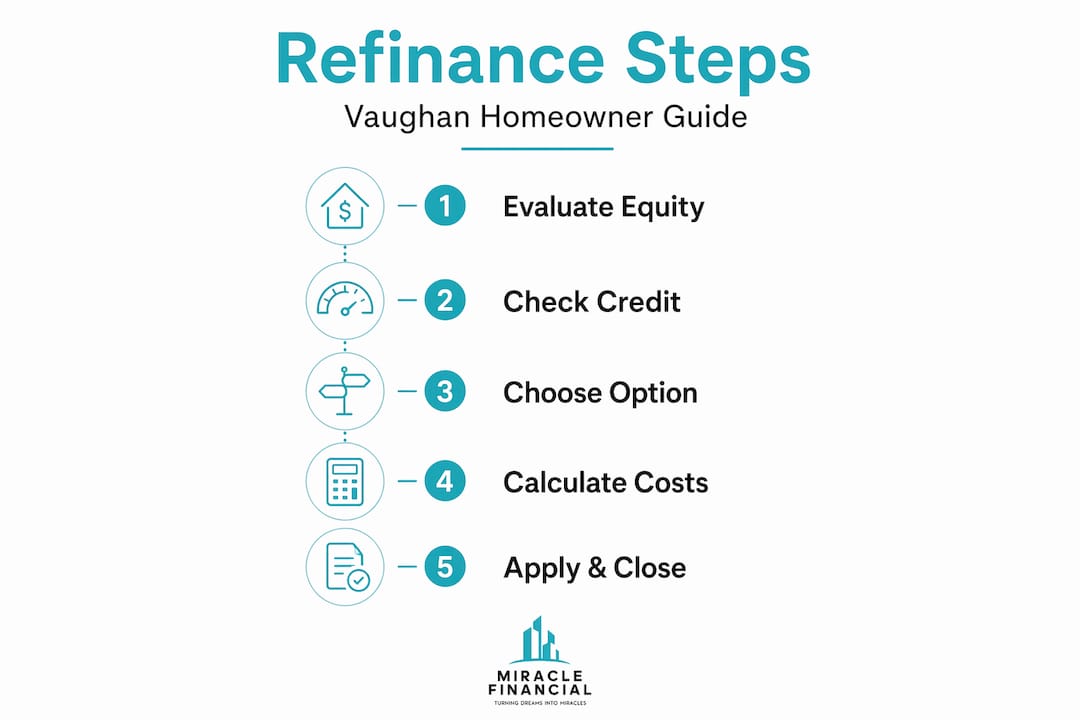
Step-by-step: how to refinance your Vaughan mortgage
Having the right sequence matters as much as having the right goal. Here is the order that produces the best results.
- Define your financial objective. Are you trying to lower monthly payments, access equity for a specific purpose, or consolidate debt? Your goal determines which refinance product fits.
- Pull your current mortgage details. Request a mortgage statement showing your balance, interest rate, renewal date, and prepayment privileges from your current lender.
- Get a home appraisal estimate. Use recent sales in your neighbourhood to estimate your current home value, then calculate your approximate LTV. A formal appraisal will be required later, but this gives you an early read on your equity position.
- Calculate the break-even point. Divide the total cost of refinancing (penalty plus legal fees plus appraisal) by your projected monthly savings to determine how many months it takes to come out ahead. If the number exceeds how long you plan to stay in the home, revisit the timing.
- Compare lenders. Work with a mortgage broker who has access to banks, credit unions, and alternative lenders. Getting multiple rate quotes simultaneously does not damage your credit score the way multiple direct applications do.
- Submit your application and complete the appraisal. Once you select a lender, the formal appraisal confirms your home’s value. The lender will also verify your income, credit, and property details.
- Review the new mortgage terms carefully. Before signing, confirm the rate type (fixed or variable), amortisation period, prepayment privileges, and any conditions attached to the new product.
Pro Tip: When comparing refinancing home loans in Vaughan, do not evaluate rate alone. Two lenders offering identical rates can have very different prepayment penalty structures, which will matter if you ever need to refinance again before the new term ends.
Common refinancing mistakes to avoid
Even well-prepared homeowners make errors that cost them money or delay approval. The most frequent ones are straightforward to avoid once you know what to watch for.
- Underestimating the penalty. This is the most expensive mistake. Thorough penalty modelling before proceeding is non-negotiable, yet many homeowners skip it and are blindsided at closing.
- Focusing only on the interest rate. The best refinancing rates in Vaughan on paper may come attached to restrictive prepayment terms that cost you more over time. Total cost of ownership over the new term is what matters.
- Not checking eligibility before applying. Applying with a lender whose criteria you do not meet generates a hard credit inquiry and does nothing useful. Confirm the lender’s LTV, credit, and income requirements first.
- Ignoring your credit score. Even a modest improvement in your score before applying, paying down a credit card or correcting a reporting error, can move you into a better rate tier.
- Over-borrowing on a cash-out refinance. Accessing equity for renovations is reasonable. Using a cash-out refinance to fund discretionary spending increases your mortgage balance without improving your net financial position. Borrow for things that add value or reduce higher-cost debt.
- Misunderstanding the amortisation impact. Resetting to a 25 or 30 year amortisation lowers monthly payments but significantly increases total interest paid over the life of the mortgage. Model the long-term cost, not just the monthly relief.
My perspective on refinancing in Vaughan
I’ve seen hundreds of Vaughan homeowners approach refinancing with the best of intentions and still end up in worse financial positions than when they started, not because they made reckless decisions, but because they did not run the full numbers before committing.
The most consistent lesson I’ve taken from working with Ontario homeowners is this: the single best time to refinance is at renewal. That may sound obvious, but many people accept whatever rate their current lender offers at renewal without shopping it, and that habit costs them thousands. Mortgage renewal timing is where the cleanest savings live, with no penalties, no legal fees in many cases, and full flexibility to switch lenders.
What I’ve also learned is that prepayment penalties are frequently a deal-breaker that advisors gloss over too quickly. A $300 monthly saving sounds attractive. A $18,000 IRD penalty does not. I always tell homeowners to get the penalty figure in writing and then sit with it before deciding.
The other thing I would push back on is the idea that a lower rate is always the goal. Sometimes, a cash-out refinance at a slightly higher rate that eliminates $40,000 in credit card debt makes far more financial sense than a rate-and-term refinance that saves $150 per month. You need to understand home equity vs refinance as separate tools for separate problems, not a single lever to pull whenever rates drop.
— Miracle
How Miraclefinancial helps Vaughan homeowners refinance
Miraclefinancial works specifically with Vaughan and Ontario homeowners to find refinancing solutions that match your real financial situation, not just a standard application template.
Whether you want to reduce your monthly payments through a rate-and-term refinance, access equity for debt consolidation through a cash-out refinance, or explore a second mortgage to avoid breaking a favourable existing contract, Miraclefinancial connects you with banks, credit unions, and alternative lenders across Ontario to find what fits. For homeowners who have been declined by traditional banks, Miraclefinancial’s private lending access often opens doors that stay closed elsewhere.
The process starts with a full cost-benefit assessment, including penalty calculations, before any application is submitted. To explore your mortgage refinance options with an advisor who knows the Vaughan market, book a consultation with Miraclefinancial and get a clear picture of what is actually available to you.
FAQ
What equity do I need to refinance my Vaughan home?
Most lenders require you to retain at least 20% equity after refinancing, meaning your LTV must stay below 80%. Some alternative and private lenders will go higher, but at a higher rate.
Will I pay a penalty to refinance before my mortgage term ends?
Yes, in almost all cases. Breaking a closed mortgage mid-term triggers a prepayment penalty, calculated as either three months’ interest or the Interest Rate Differential, whichever is greater for fixed-rate mortgages.
What is the difference between a cash-out refinance and a HELOC?
A cash-out refinance gives you a lump sum by increasing your mortgage balance, while a HELOC provides a revolving credit line you draw on as needed. The right choice depends on whether you need funds all at once or in stages.
Can I refinance if I have bad credit or have been declined by a bank?
Yes. Alternative lenders and private lenders assess applications based more heavily on your equity position and property value than your credit score alone. Mortgage brokers with access to these lender types can often structure a solution when banks say no.
Is a second mortgage better than refinancing to access equity?
A second mortgage makes sense when breaking your existing mortgage would trigger a penalty large enough to cancel out the benefit. It leaves your first mortgage intact and provides equity access at a higher rate, making it a short-term tool rather than a long-term solution. Review the debt consolidation vs refinancing comparison to understand which approach fits your situation.