
Blog
How mortgage refinancing affects your credit score in Ontario


TL;DR:
- Refinancing in Ontario typically causes only a temporary, minor drop in credit scores when managed responsibly.
- Shopping within a 14-45 day window groups multiple inquiries, minimizing long-term credit impact and enabling better loan options.
- Strategic refinancing can improve financial health by reducing debt, lowering payments, and fostering long-term credit recovery.
Many Ontario homeowners hesitate to refinance because they assume it will damage their credit score beyond repair. In reality, the situation is far more nuanced, and often more favourable, than most people expect. Multiple mortgage inquiries within a 14-45 day rate-shopping window are treated as one inquiry by Equifax and TransUnion, meaning shopping around carries far less risk than you might think. When refinancing is approached with a clear plan, it can actually become a tool for strengthening your credit profile and reducing the financial pressure of high-interest debt over the long term.
Table of Contents
- Understanding mortgage refinancing and your credit in Ontario
- The real effect of credit inquiries when rate shopping
- Account changes: Why replacing your old mortgage can temporarily lower your score
- Long-term outlook: How refinancing can help you rebuild or raise your score
- Why short-term score drops are worth the long-term gain
- Next steps: Leverage refinancing for your financial health
- Frequently asked questions
Key Takeaways
| Point | Details |
|---|---|
| Rate shopping impacts are minimal | Credit bureaus count multiple mortgage inquiries in a short period as a single event. |
| Expect a small early score drop | Replacing your old mortgage with a new one may slightly reduce your score but this is usually short-lived. |
| Long-term benefits outweigh short-term loss | Lower payments and consolidated debts from refinancing often help boost your credit over time. |
| Proper management is key | Making timely payments on your new mortgage is the most important factor for future credit health. |
Understanding mortgage refinancing and your credit in Ontario
Now that we’ve teased some common misconceptions, let’s clarify what actually happens to your credit score when you refinance.
Mortgage refinancing means replacing your existing mortgage with a new one, typically to access better interest rates, lower monthly payments, or consolidate high-interest debts like credit cards and personal loans into a single, more manageable payment. Your credit score is a three-digit number between 300 and 900 that lenders use to assess your reliability as a borrower, drawing on your payment history, credit usage, account age, and the types of credit you carry.
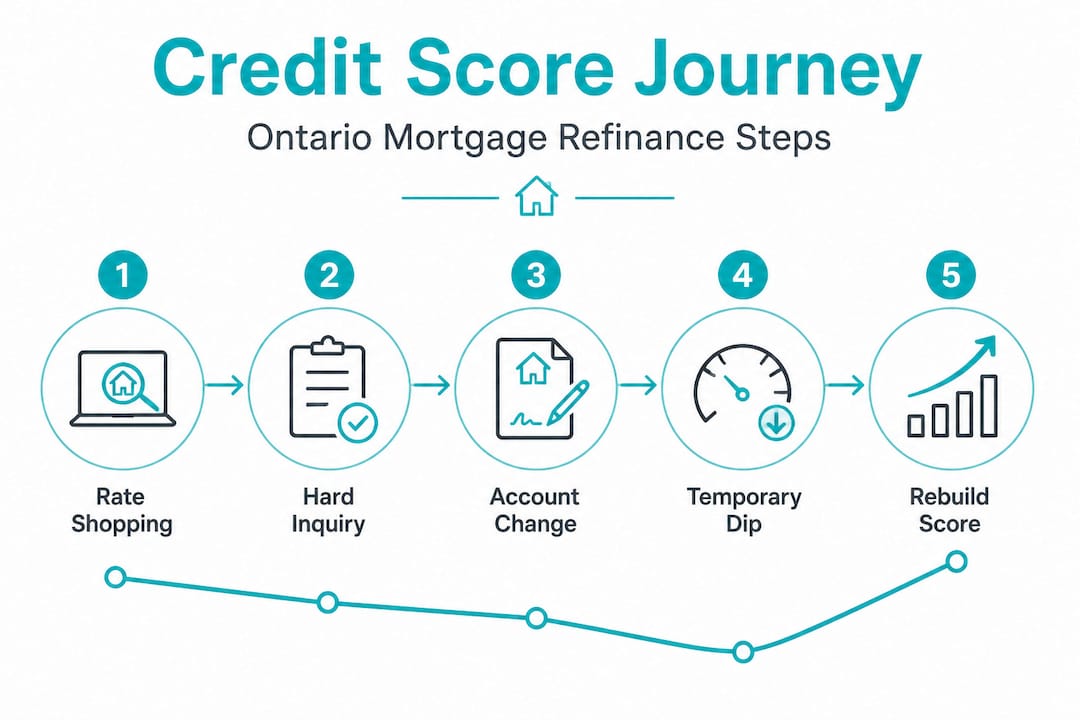
For Ontario homeowners, the refinancing process generally follows these steps:
- You apply with a new lender or negotiate new terms with your current one
- The lender pulls a hard credit inquiry (also called a hard pull) to assess your file
- Your old mortgage is paid out and closed
- A new mortgage is registered and begins reporting to the credit bureaus
- Your credit profile is updated to reflect the new account
Each of these steps has the potential to affect your score, and it’s worth understanding exactly how. The immediate impacts include a modest score drop from the hard inquiry and the closing of your existing mortgage account. However, these are typically short-lived effects. The more meaningful long-term impact depends on whether you manage the new loan responsibly.
Reviewing a dedicated Ontario mortgage refinancing guide can help you understand what to expect before you start the process. It’s also worth comparing your options, since the difference between refinancing versus a second mortgage can affect not just your payments but also how your credit profile is structured going forward.
Pro Tip: If you’re worried about the impact of a hard inquiry, ask your mortgage broker to confirm the timing before authorising any credit checks. A well-organised broker will coordinate all necessary pulls within the same window to minimise score impact.
The real effect of credit inquiries when rate shopping
With a clear process in mind, let’s address the biggest worry: do multiple mortgage inquiries destroy your score?
The short answer is no, provided you shop within a specific timeframe. Both Equifax and TransUnion in Canada recognise that responsible borrowers compare mortgage rates before committing, and their scoring models account for this. Multiple mortgage inquiries within a 14-45 day window are treated as a single inquiry for scoring purposes, which means gathering quotes from several lenders carries minimal risk if done in a concentrated period.
Here’s how the two common scenarios compare:
| Scenario | Number of hard inquiries logged | Estimated score impact | Rate options explored |
|---|---|---|---|
| Single inquiry, one lender | 1 | Minimal (2-5 points) | Limited |
| Multiple inquiries within 14-45 days | 1 (grouped) | Minimal (2-5 points) | Broad, competitive |
| Multiple inquiries spread over 90+ days | Multiple | Moderate (5-15+ points) | Broad but costly |
The data in this table makes the case clearly: spacing your rate shopping out over months is the one scenario that genuinely hurts your score. Keeping all inquiries within the rate-shopping window is the most practical strategy.
Understanding how your credit score affects mortgage eligibility helps you approach rate shopping strategically rather than reactively. If you want to take a proactive stance, reviewing resources on improving your mortgage credit score before you start shopping gives you a stronger starting position.
Pro Tip: Set a firm two-week window for collecting all your mortgage quotes. Start on a Monday, reach out to all lenders and brokers by the following week, and have all applications submitted before day 14. This approach keeps your inquiries grouped and your score protected while giving you enough data to make a genuinely informed decision.
It’s worth noting that the precise number of points lost to a hard inquiry varies by individual file. Someone with a strong, lengthy credit history will see far less impact from one or two pulls than someone with a thin or newer credit profile. The key takeaway is that inquiry damage is temporary and predictable, not catastrophic.
Account changes: Why replacing your old mortgage can temporarily lower your score
Once your rate-shopping is done and you decide to refinance, another immediate question is what happens to your credit age and accounts.
Credit age, sometimes called the average age of accounts, refers to how long your credit accounts have been open. Credit bureaus favour longer, well-managed credit histories because they provide more data about your reliability. When you refinance, you close your old mortgage and open a new one, which can reduce the average age of your credit profile, particularly if your mortgage was your oldest or longest-standing account.
As Equifax explains, closing the old mortgage and opening a new one resets the average age of accounts and can temporarily lower your score. This is a factual and predictable outcome, not a reason to avoid refinancing altogether.
“While the reset of your credit age may cause a short-term dip, how you manage your new loan over time carries far more weight with lenders than the age of your existing accounts.” Equifax Canada
Here’s a straightforward comparison of the two situations:
| Scenario | Credit age effect | Short-term score impact | Long-term outlook |
|---|---|---|---|
| No refinancing, keep old mortgage | Credit age preserved | No immediate impact | Stable, assuming on-time payments |
| Refinancing, close old/open new | Average age resets | Modest temporary dip | Strong recovery with consistent payments |
What can you do to support your credit through this transition? Several practical steps make a meaningful difference:
- Avoid opening new credit accounts in the 3-6 months surrounding your refinance, as each new account further reduces your average credit age
- Keep older, non-mortgage accounts open such as credit cards you’ve held for years, even if you rarely use them
- Make your first new mortgage payment on time, as payment history carries the most weight in your credit score calculation
- Monitor your credit report in the 60-90 days after refinancing to confirm the old account is properly marked as closed and the new one is reporting accurately
- Avoid any missed payments on other accounts during this period, as even a single late payment can amplify the short-term dip
For homeowners who are concerned about their current score standing, exploring refinancing with bad credit is a viable path. Alternative lenders and private lenders in Ontario can structure deals even when your credit file is less than ideal, helping you access equity and begin rebuilding your score through consistent payments.
Long-term outlook: How refinancing can help you rebuild or raise your score
All of this begs the big question: is refinancing worth it for your credit score in the end? Let’s look to the future.
The initial score dip from refinancing is real but temporary. What matters far more is the trajectory your credit takes in the months and years following the refinance. When done correctly, refinancing can produce meaningful, measurable improvements to your overall credit health.

Consider a common Ontario homeowner scenario: you carry $40,000 in credit card debt at an average interest rate of 19.99%, spread across three cards, each carrying balances close to their limits. Your credit utilisation ratio (the percentage of your available credit that you’re using) is sitting at or above 80%, which is a major negative factor in your credit score. By consolidating that debt into your mortgage at a rate of 5-6%, you clear those balances, drop your utilisation ratio to near zero, and free up hundreds of dollars per month in cash flow. The long-term gain from lower payments and a better debt mix far outweighs the temporary score adjustment that comes with the refinance itself.
Here’s a step-by-step approach to managing your new mortgage for the best possible credit outcome:
- Set up automatic payments for your new mortgage the moment the loan is activated, ensuring you never miss a due date
- Pay down any remaining credit card balances with the cash freed up from lower monthly mortgage payments, targeting the cards with the highest utilisation first
- Resist new debt for at least six months post-refinance, giving your score time to stabilise and recover before taking on new obligations
- Review your credit report at the three-month and six-month marks to verify accuracy and track your recovery progress
- Keep older credit accounts active by making small, regular purchases and paying them off in full each month, preserving your credit history length
- Document your payment history by keeping records of each mortgage payment, which becomes useful evidence if you need to demonstrate creditworthiness to a future lender
A well-executed refinance for debt consolidation can lower your overall debt load, reduce your monthly obligations, and create the stable payment environment that credit bureaus reward over time. Using a refinance mortgage checklist before you begin ensures you’re prepared for each step, reducing errors that could complicate the process.
Pro Tip: Commit to a 12-month “credit quiet period” after refinancing. This means no new credit cards, no car loans, and no additional lines of credit. Give your new mortgage payment history time to build and let your credit score reflect the improved debt management you’ve put in place. The discipline required during this period is what separates borrowers who see genuine, lasting credit improvement from those who refinance and then immediately return to old habits.
Why short-term score drops are worth the long-term gain
Most articles about refinancing and credit scores focus heavily on the negative: the hard inquiry, the account age reset, the temporary dip. What gets far less attention is the bigger picture, and that’s where the real insight lies.
Here is a perspective we share with clients regularly: a 5 to 15-point temporary decline in your credit score is almost entirely irrelevant if the refinance solves a debt problem that’s been compounding for years. Homeowners who avoid refinancing out of fear of a score drop often end up carrying high-interest debt for years longer than necessary, watching their financial flexibility erode month after month while protecting a credit number that doesn’t truly reflect their financial stress.
The most financially successful borrowers we work with don’t obsess over short-term score fluctuations. They focus on payment reliability and debt reduction. And that’s exactly what Equifax supports: the handling of a new loan over time carries more long-term weight than the initial account age disruption.
There’s also a practical point that often gets overlooked: if your goal is to qualify for better financing in the future, a clean payment record on a well-structured mortgage is a far more powerful credential than a slightly higher score built on unmanaged, high-utilisation debt. Lenders look at the full picture, not just the number.
Understanding when refinancing is truly worthwhile means asking the right questions before you start. The credit score impact is rarely the deciding factor. The real question is whether the new mortgage structure improves your financial position over time, and for most Ontario homeowners carrying high-interest debt, the honest answer is yes.
Next steps: Leverage refinancing for your financial health
With a clear understanding and strategy, you’re ready to turn knowledge into results.
At Miracle Financial, we work with Ontario homeowners at every stage of the credit spectrum, from those with strong scores looking to optimise their financial position, to those navigating past challenges who need a lender that looks beyond the number. Our team structures mortgage refinance options around your real financial situation, connecting you with banks, credit unions, alternative lenders, and private lenders across Ontario to find the solution that genuinely fits.

Whether your priority is reducing monthly payments, clearing high-interest debt, or beginning a credit recovery journey, our Ontario debt consolidation solutions are built to deliver practical results. Book a consultation with our team today and find out exactly what your refinancing options look like based on your current equity, income, and credit profile. There’s no obligation, and the clarity alone is worth the conversation.
Frequently asked questions
How long does it take for my credit score to recover after refinancing in Ontario?
Your score often recovers within a few months if you consistently make on-time payments on your new mortgage, since new loan management is weighted more heavily than the initial account age disruption.
Will checking multiple mortgage rates hurt my score if I use different lenders?
If you check rates with multiple lenders within 14-45 days, multiple inquiries are grouped as one by Equifax and TransUnion and won’t seriously affect your score.
Is mortgage refinancing the best way to pay off credit card debt?
Refinancing can be a strong choice if your new payment is meaningfully lower than your combined current obligations and you avoid accumulating new high-interest debt after consolidating.
Can refinancing help if I have bad credit in Ontario?
Yes, options exist through alternative and private lenders for homeowners with lower scores, and an experienced broker can match you with products specifically structured for credit recovery.
Does refinancing affect my ability to get other loans?
A small, temporary score drop is possible, but your payment history on the new mortgage carries the most weight for future loan approvals, meaning responsible management quickly rebuilds your standing.