
Blog
Mortgage trends in 2025: what Ontario homeowners must know


TL;DR:
- The 2025 Canadian mortgage market was driven by a peak renewal wave, increased refinancing, and borrower preference for variable rates and shorter terms. Ontario experienced rising delinquencies and affordability pressures, prompting proactive renewal strategies and full cost analysis before refinancing. Federal rule changes expanded insured mortgage access but required careful modeling to weigh benefits against long-term costs.
Mortgage trends in 2025 were defined by one dominant force: a peak renewal wave that pushed hundreds of thousands of Canadian homeowners into renegotiation simultaneously, while rising refinancing activity and a clear borrower shift toward variable rates and shorter terms reshaped the lending market. The impact of inflation on mortgages continued to weigh on affordability, and federal rule changes introduced new pathways for first-time buyers and high-value property owners alike. For Ontario homeowners, understanding these shifts is not optional. It is the difference between renewing on unfavourable terms and structuring a mortgage that actually fits your financial reality in 2026 and beyond.
What drove mortgage trends in 2025 across Canada and Ontario?
The 2025 mortgage market was shaped by three converging forces: interest rate movement, a historic renewal volume peak, and borrower behaviour adapting in real time to financial pressure.
Bond yields and the Bank of Canada’s rate decisions set the floor for fixed mortgage pricing throughout the year. As rate expectations shifted, borrowers increasingly selected shorter mortgage terms and variable rates rather than locking into longer fixed commitments. This was a market response to uncertainty, not a policy directive. Homeowners were hedging against the possibility of further rate decreases by avoiding long-term fixed commitments at rates that might look expensive in two years.
The renewal wave was the single largest structural force in the market. Renewal mortgages dominated residential mortgage activity in Canada in 2025, with volumes peaking before an expected easing in 2026. This created real operational pressure across lenders and brokers. When a large portion of the mortgage market renews within the same window, processing times slow, pricing windows close faster, and borrowers who wait too long lose negotiating leverage.
Ontario felt this pressure acutely. The national 90-plus day delinquency rate rose from 0.21% to 0.24%, but Ontario’s increase was sharper at 35%, and the Toronto CMA saw a 45% rise in delinquencies. These numbers remain low in absolute terms, but the directional trend signals genuine financial stress in pockets of the province, particularly among borrowers who purchased at peak prices and are now renewing at materially higher rates.
Key drivers of 2025 mortgage market behaviour in Ontario included:
- Rate sensitivity: Borrowers avoided long fixed terms as rate forecasts remained uncertain, favouring flexibility over predictability.
- Renewal volume pressure: High simultaneous renewal volumes created underwriting bottlenecks and compressed lender response times.
- Affordability stress: Rising monthly payments at renewal pushed some borrowers toward refinancing or debt consolidation to manage cash flow.
- Federal policy changes: New insured mortgage rules expanded eligibility for certain buyers, increasing insured lending volumes.
- Regional delinquency risk: Toronto and surrounding areas showed above-average financial stress, requiring Ontario-specific mortgage strategies.
“The renewal wave peaks but still dominates the mortgage market, with easing expected in 2026.” — CMHC-cited market analysis, 2025
How did mortgage refinancing behaviour change in 2025?
Refinance lending volume grew to 29% of total lending in 2025, up from 22% in 2024. This shift reflects borrowers responding to rate signals rather than a broad recovery in home purchase demand. More homeowners chose to restructure existing debt than to enter new purchase transactions, which tells you something important: affordability constraints were limiting new buying activity even as refinancing picked up.

The composition of refinancing also changed. Cash-out refinance share declined to 34.8% in December 2025, after peaking above 80% in prior years. This means the majority of refinancing activity in 2025 was rate-and-term focused, with borrowers prioritising lower payments or better terms over extracting equity. For Ontario homeowners, this distinction matters when deciding which type of refinance makes sense for your situation.
| Refinance type | Primary motivation | Best suited for |
|---|---|---|
| Rate-and-term refinance | Lower interest rate or change term length | Borrowers with stable equity seeking payment reduction |
| Cash-out refinance | Access home equity as lump sum | Borrowers needing funds for debt consolidation or renovation |
| Debt consolidation refinance | Roll high-interest debt into mortgage | Homeowners with credit card or line-of-credit debt at high rates |
The Ontario context adds another layer. Homeowners facing payment increases at renewal often turn to refinancing as a way to extend amortisation, reduce monthly obligations, or consolidate high-interest debt into a single lower-rate payment. This is not always the cheapest long-term option, but it can be the most manageable short-term solution when cash flow is the primary concern.
Pro Tip: Before committing to a refinance, model the break-even point. Divide your closing costs by your monthly savings to determine how many months it takes to recover the cost of refinancing. If you plan to sell or renew again before that point, the refinance may not be worth the fees.
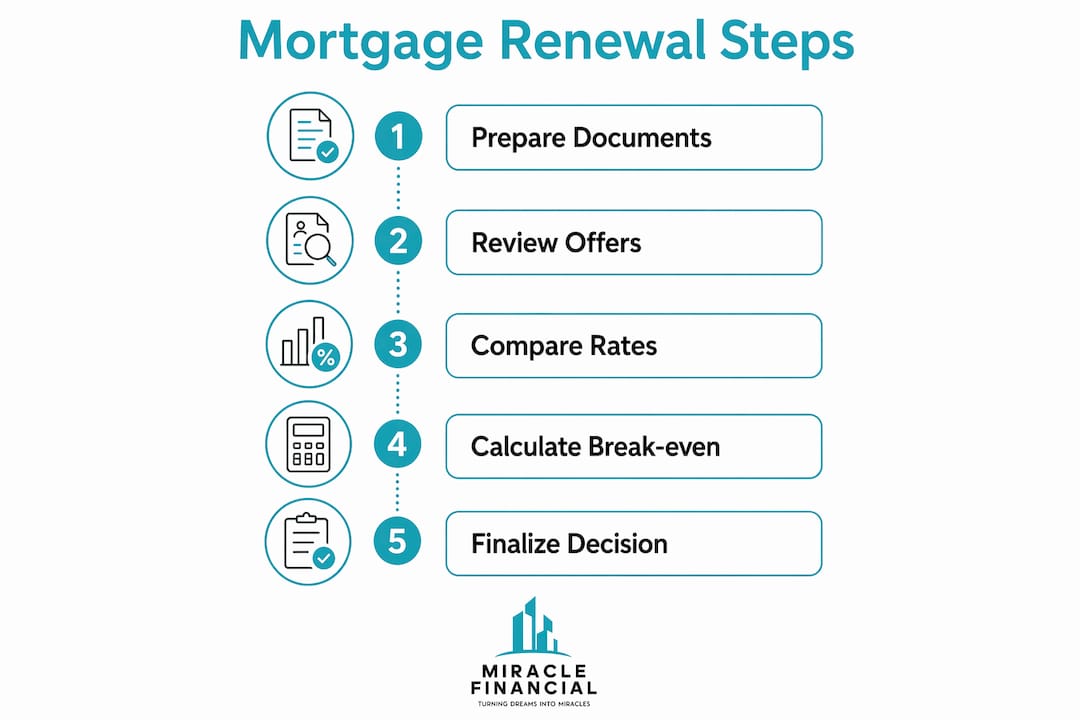
Refinancing growth does not always signal a healthy market. It often signals that borrowers are responding to affordability challenges rather than capitalising on opportunity. Ontario homeowners should evaluate refinancing decisions with a full cost analysis, not just a rate comparison.
What federal mortgage rule changes affected Ontario borrowers in 2025 and 2026?
Federal mortgage rule changes that took effect in late 2024 had significant practical consequences for Ontario borrowers throughout 2025 and into 2026. Three changes stand out.
The insured mortgage price cap increased from $1,000,000 to $1,500,000. This means buyers purchasing properties valued up to $1.5 million can now access insured mortgages with down payments below 20%, which is directly relevant in the Greater Toronto Area where average detached home prices regularly exceed the old threshold. The practical effect is that more Ontario buyers can enter the market with smaller down payments on higher-value properties.
The 30-year amortisation became available for first-time buyers and purchasers of new construction properties under CMHC-insured mortgages. The extended amortisation lowers monthly payments, which improves short-term affordability. However, it carries a surcharge on CMHC insurance premiums and significantly increases total interest paid over the life of the mortgage. A borrower choosing 30 years over 25 years on a $600,000 mortgage at 5% pays meaningfully more in total interest, even though the monthly payment is lower.
The OSFI B-20 stress test rules remained unchanged. Borrowers must still qualify at the greater of their contract rate plus 2%, or 5.25%. This qualifying threshold continues to limit purchasing power for many Ontario buyers, particularly first-time buyers in high-cost markets.
Key implications of the 2025 and 2026 federal rule changes:
- Higher insured price cap: More Toronto-area buyers qualify for insured mortgages, reducing required down payment on properties up to $1.5 million.
- 30-year amortisation trade-off: Lower monthly payments come at the cost of higher total interest and a CMHC premium surcharge.
- Stress test unchanged: Qualifying at contract rate plus 2% remains the standard, limiting how much borrowers can access regardless of product changes.
- New construction incentive: The 30-year option for new builds is designed to stimulate construction activity, not just buyer affordability.
Pro Tip: If you are considering a 30-year insured amortisation, ask your broker to model the total interest cost over the full term compared to a 25-year option. The monthly savings may be $150 to $200, but the lifetime cost difference can exceed $40,000 on a mid-sized Ontario mortgage.
Federal insured mortgage rule changes expand access but can raise effective insurance costs, which means a full cost-benefit analysis is not optional. It is the only responsible way to evaluate these options.
How should Ontario homeowners approach mortgage renewal and refinancing strategically?
The 2025 renewal wave created a clear lesson: borrowers who prepared early secured better outcomes than those who waited. Renewal-heavy periods create underwriting bottlenecks, and lenders prioritise borrowers who arrive with complete documentation and clear financial profiles. Here is a practical framework for approaching renewal and refinancing in the current environment.
-
Start the process 120 days before your renewal date. Most lenders allow you to lock in a rate 90 to 120 days ahead. Beginning early gives you time to compare offers, gather documentation, and avoid the bottleneck that occurs when thousands of borrowers act simultaneously. Review the mortgage renewal workflow to understand each step before you begin.
-
Stress-test your budget beyond principal and interest. Your mortgage payment is not your only housing cost. Property taxes, home insurance, condo fees, and maintenance all affect your true monthly obligation. Budget stress-testing should account for a rate increase of 1% to 2% above your renewal offer to confirm you can absorb future changes.
-
Evaluate fixed versus variable based on your income stability. Fixed versus variable mortgage choice should reflect individual income stability and risk tolerance. A salaried employee with predictable income may tolerate variable rate fluctuations more comfortably than a self-employed borrower with irregular cash flow. Review the types of mortgages available in Ontario to understand how each product behaves across different rate environments.
-
Align your term length with your life plans. A five-year fixed term makes sense if you plan to stay in your home and want payment certainty. A two or three-year term may be preferable if you anticipate selling, relocating, or refinancing before the term ends. Breaking a mortgage mid-term carries penalties that can eliminate any rate savings you achieved.
-
Prioritise documentation quality over rate shopping. Higher renewal approvals often depend more on borrower documentation and debt service affordability than on marginal rate differences. A clean application with current income verification, updated property details, and a clear debt picture moves faster and attracts better lender responses than a poorly prepared application chasing a slightly lower rate.
-
Use scenario analysis before committing to a refinance structure. Compare at least three scenarios: your current mortgage continued, a rate-and-term refinance, and a debt consolidation refinance if applicable. Use a mortgage deal comparison framework to evaluate total cost, monthly payment, and break-even timeline for each option before deciding.
Pro Tip: If your lender sends a renewal offer without explanation, do not sign it immediately. That offer is typically not their best rate. Bring it to a mortgage broker who can negotiate on your behalf or present competing offers from alternative lenders and credit unions.
Key takeaways
Ontario homeowners who approach 2025 mortgage trends with preparation, documentation quality, and a full cost analysis will secure materially better outcomes than those who renew passively or chase advertised rates without context.
| Point | Details |
|---|---|
| Renewal wave peaked in 2025 | High simultaneous renewal volumes created bottlenecks; starting early is the single most effective preparation tactic. |
| Refinancing grew to 29% of lending | Most refinancing was rate-and-term focused, not cash-out; match your refinance type to your actual financial goal. |
| Federal rules expanded insured access | The $1.5M price cap and 30-year amortisation open new options but carry premium costs that require full modelling. |
| Documentation quality drives approvals | Clean, complete applications outperform marginal rate advantages during high-volume renewal periods. |
| Variable rates gained favour | Borrowers chose shorter terms and variable rates to preserve flexibility amid ongoing interest rate uncertainty. |
What I have learned advising Ontario homeowners through the 2025 renewal wave
The most consistent mistake I see Ontario homeowners make is treating mortgage renewal as an administrative task rather than a financial decision. They receive a renewal offer, glance at the rate, and sign. That approach cost many borrowers thousands of dollars in 2025, and it will cost more in 2026 if the habit continues.
The renewal wave created real pressure on lenders and brokers alike. When everyone renews at once, response times slow, and lenders know that many borrowers will simply accept the first offer rather than shop. The borrowers who pushed back, brought competing offers, or worked with a broker who negotiated on their behalf consistently secured better terms.
I also want to address the instinct to chase the lowest advertised rate. That number rarely reflects what you will actually pay once fees, insurance premiums, and prepayment restrictions are factored in. A mortgage at 4.89% with a closed term and heavy penalties is not necessarily better than one at 5.10% with portability and flexible prepayment options. The total cost of the mortgage, not the headline rate, is what matters.
The federal rule changes that expanded insured mortgage access are genuinely useful for certain buyers, particularly first-time buyers in the GTA who were previously locked out by the $1 million price cap. But the 30-year amortisation option requires honest modelling. Lower monthly payments feel like relief, but the additional interest cost over the life of the mortgage is real money. Make the choice with full information, not just the monthly payment figure.
Finally, the rise in Toronto-area delinquencies is a signal worth taking seriously. It does not mean the market is collapsing, but it does mean that financial stress is real and geographically concentrated. If you are in a position where your renewal payment will strain your budget, the time to act is before renewal, not after. Refinancing, debt consolidation, or accessing equity through a second mortgage are all tools that work better when used proactively.
— Miracle
How Miraclefinancial helps Ontario homeowners navigate renewal and refinancing

Miraclefinancial is a Vaughan-based Ontario mortgage brokerage that works with homeowners who need more than a standard renewal offer. Whether you are facing a payment increase at renewal, carrying high-interest debt you want to consolidate, or looking to access your home equity, Miraclefinancial structures solutions around your actual financial situation, not just your credit score. Working with banks, credit unions, alternative lenders, and private lenders across Ontario, the team finds options that traditional banks often decline to offer. If you want to explore mortgage refinancing options or need help preparing for an upcoming mortgage renewal in Ontario, Miraclefinancial provides direct, practical guidance with no obligation to proceed.
FAQ
What were the main mortgage trends in 2025 in Canada?
The 2025 mortgage market was dominated by a peak renewal wave, a rise in refinancing activity to 29% of total lending, and a borrower shift toward variable rates and shorter terms in response to interest rate uncertainty.
How did the 2025 federal mortgage rule changes affect Ontario buyers?
The insured mortgage price cap rose to $1.5 million and 30-year amortisation became available for first-time buyers and new construction purchases, expanding access but adding CMHC premium surcharges that increase total borrowing costs.
Is refinancing a good strategy for Ontario homeowners in 2025 and 2026?
Refinancing makes sense when the monthly savings exceed the total cost of refinancing within your expected time horizon. Rate-and-term refinancing grew significantly in 2025, but each decision requires a full break-even and total cost analysis.
Why did mortgage delinquencies rise in Ontario in 2025?
Ontario’s 90-plus day delinquency rate rose 35%, with the Toronto CMA up 45%, reflecting financial stress among borrowers renewing at higher rates after purchasing at peak prices. The overall rate remains low but the directional trend warrants attention.
When should I start preparing for my mortgage renewal?
Start at least 120 days before your renewal date to allow time for documentation, rate comparison, and lender negotiation. Waiting until your renewal notice arrives typically means missing the best pricing windows.