
Blog
Non-Traditional Mortgage Solutions for Ontario Homeowners


Nearly one third of Canadian homeowners explore non-traditional mortgage solutions when banks say no. As housing markets in Ontario grow more competitive, many people face obstacles with conventional lenders due to self-employment, unique income sources, or credit challenges. Understanding these alternative options can open crucial doors for buyers and owners who want flexibility, speed, and personalized financial strategies to achieve their property goals.
Table of Contents
- Defining Non-Traditional Mortgage Solutions in Ontario
- Types of Alternative Mortgages and Their Uses
- Qualifying for Private and Self-Employed Mortgages
- Risks, Benefits, and Costs of Non-Traditional Options
- Comparing Traditional vs. Non-Traditional Mortgages
- Common Mistakes When Choosing Alternative Solutions
Key Takeaways
| Point | Details |
|---|---|
| Flexible Qualification Criteria | Non-traditional mortgage solutions offer more inclusive qualifying criteria, allowing individuals with unique financial circumstances to access financing. |
| Diverse Mortgage Options | Homeowners in Ontario can choose from various specialized mortgage types, like construction loans and self-employed mortgages, tailored to specific needs. |
| Higher Costs and Risks | While offering accessibility, alternative mortgages typically come with higher interest rates and potential risks that borrowers must carefully evaluate. |
| Importance of Professional Guidance | Engaging with mortgage professionals can help navigate complex alternative lending environments and mitigate financial pitfalls. |
Defining Non-Traditional Mortgage Solutions in Ontario
Non-traditional mortgage solutions represent innovative financial strategies designed to help Ontario homeowners access home financing beyond conventional lending models. Unlike standard bank mortgages, these alternative approaches provide flexible options for individuals who might not qualify through traditional channels. Mortgage types available in Canada demonstrate the evolving landscape of home financing, presenting opportunities for diverse borrower profiles.
These specialized mortgage solutions typically encompass several key categories that address unique financial circumstances. Alternative lending strategies might include private mortgages, self-employed financing, home equity lines of credit, and specialized products for individuals with non-standard income streams or credit histories. For Ontario homeowners facing challenges with traditional bank requirements, these solutions offer crucial pathways to property ownership and financial flexibility.
The primary characteristics of non-traditional mortgage solutions include more flexible qualifying criteria, personalized assessment processes, and tailored repayment structures. While conventional mortgages rely heavily on credit scores and standardized income verification, alternative lending models consider a broader range of financial factors. This approach allows self-employed professionals, commissioned workers, recent immigrants, and individuals with non-traditional income sources to access mortgage financing that might otherwise be unavailable through standard banking institutions.
Key features that distinguish non-traditional mortgage solutions often include:
- Customized approval processes
- Faster application turnaround times
- More lenient credit score requirements
- Consideration of diverse income sources
- Specialized products for unique financial situations
By understanding these alternative mortgage strategies, Ontario homeowners can explore financing options that align more closely with their individual financial realities and long-term housing goals.
Types of Alternative Mortgages and Their Uses
Alternative mortgages provide Ontario homeowners with diverse financing options that extend far beyond traditional bank lending models. Alternative mortgage financing encompasses several specialized approaches designed to meet unique financial circumstances and borrower needs. These innovative mortgage solutions offer flexibility for individuals who might not qualify through conventional lending channels, including self-employed professionals, recent immigrants, and those with non-standard income streams.
Specialized mortgage types include a range of strategic financing options tailored to specific financial situations. Some prominent alternative mortgage categories involve:
- Construction loans: Providing funding for new home builds or major renovation projects
- Second mortgages: Enabling homeowners to access additional home equity
- Self-employed mortgages: Offering financing options for entrepreneurs and independent contractors
- Vendor take-back mortgages: Allowing sellers to provide direct financing to buyers
- Rent-to-own agreements: Creating pathways to homeownership for individuals not yet ready for traditional purchases
Each alternative mortgage type serves a unique purpose, addressing specific financial challenges that standard mortgage products cannot accommodate. For instance, construction loans provide crucial funding for individuals looking to build custom homes, while self-employed mortgages offer tailored solutions for professionals with variable income streams. These specialized products recognize that financial journeys are rarely uniform and require nuanced, personalized approaches.
The key advantage of alternative mortgage solutions lies in their adaptability and comprehensive assessment of a borrower’s financial profile. Unlike traditional lenders who rely heavily on credit scores and standardized income verification, alternative mortgage providers consider a broader range of financial factors. This approach enables more individuals to access home financing by evaluating their overall financial health, potential, and unique circumstances rather than applying rigid, one-size-fits-all criteria.

By understanding these diverse mortgage options, Ontario homeowners can strategically navigate their financing needs, selecting the most appropriate solution that aligns with their specific financial goals and personal circumstances.
Qualifying for Private and Self-Employed Mortgages
Qualifying for private and self-employed mortgages requires a nuanced understanding of alternative lending approaches that go beyond traditional bank requirements. Self-employed mortgage options recognize the unique financial complexities faced by entrepreneurs, independent contractors, and business owners who may not meet standard income verification protocols. These specialized mortgage solutions provide critical pathways for professionals with non-traditional income streams to access home financing.
Mortgage qualification strategies for self-employed individuals typically involve several key documentation and financial assessment methods:
- Providing comprehensive business financial statements
- Demonstrating consistent income through tax returns
- Showcasing business stability and revenue trends
- Maintaining strong credit history
- Presenting detailed business documentation
Alternative lenders employ innovative assessment techniques when evaluating self-employed mortgage applications. Unlike conventional banks that rely strictly on T4 income documentation, these specialized providers may use gross-up income calculations that increase reported income by adding back certain business deductions. This approach allows self-employed professionals to demonstrate their true earning potential, creating more inclusive mortgage qualification criteria that acknowledge the complexity of entrepreneurial income.
The documentation requirements for self-employed mortgages can be more rigorous but also more flexible than traditional lending models. Lenders might request two to three years of income tax returns, business financial statements, client contracts, and proof of consistent revenue streams. Some alternative mortgage providers even offer stated income mortgage options that require minimal income verification, recognizing the dynamic nature of self-employment and providing more accessible financing solutions.
Successful mortgage qualification for self-employed individuals hinges on presenting a comprehensive financial narrative. This involves demonstrating financial stability, maintaining excellent credit, providing thorough documentation, and working with mortgage professionals who understand the unique challenges of non-traditional income sources. By preparing comprehensive financial records and understanding alternative lending criteria, self-employed Ontario homeowners can successfully navigate the mortgage application process and secure the financing they need.
Risks, Benefits, and Costs of Non-Traditional Options
Non-traditional mortgage solutions offer Ontario homeowners innovative financing strategies, but they come with a complex landscape of potential risks and rewards. Private second mortgage considerations reveal the nuanced financial trade-offs inherent in alternative lending approaches. These specialized mortgage options provide crucial flexibility for borrowers who may not qualify through conventional banking channels, but demand careful financial assessment and strategic planning.
Key benefits of non-traditional mortgage solutions include:
- Greater accessibility for self-employed individuals
- More flexible qualification criteria
- Faster approval processes
- Options for individuals with non-standard income
- Potential for debt consolidation
- Opportunities for property investment
The financial landscape of alternative mortgages is characterized by higher interest rates compared to traditional lending models. While these options provide critical access to financing, borrowers must carefully evaluate the long-term cost implications. Interest rates for private mortgages can range significantly higher than conventional bank rates, potentially adding substantial expenses over the mortgage term. This increased cost reflects the elevated risk assumed by alternative lenders when working with borrowers who present more complex financial profiles.
Risk management becomes paramount when exploring non-traditional mortgage solutions. Borrowers should conduct thorough financial assessments, understanding potential scenarios such as higher monthly payments, stricter enforcement terms, and more aggressive collection practices. Some alternative lending arrangements may include more stringent penalty clauses for missed payments or require more comprehensive legal documentation. Comprehensive financial planning, including a robust understanding of personal cash flow and long-term financial goals, becomes essential when navigating these specialized mortgage products.
Ultimately, successful engagement with non-traditional mortgage options requires a balanced approach. Homeowners must weigh the immediate benefits of accessing financing against potential long-term financial implications. Consulting with experienced mortgage professionals who specialize in alternative lending can provide critical insights, helping borrowers make informed decisions that align with their unique financial circumstances and homeownership objectives.
Comparing Traditional vs. Non-Traditional Mortgages
Traditional and non-traditional mortgages represent two fundamentally different approaches to home financing, each with unique characteristics that cater to distinct borrower profiles. Alternative mortgage options reveal the evolving landscape of home financing, demonstrating how lending models have expanded to accommodate increasingly diverse financial circumstances. While conventional mortgages follow rigid, standardized approval processes, alternative lending solutions offer more nuanced and flexible pathways to homeownership.
Key differences between traditional and non-traditional mortgage approaches include:
- Qualification criteria
- Income verification methods
- Interest rate structures
- Documentation requirements
- Approval processing times
- Flexibility for unique financial situations
Traditional mortgages typically require strict documentation, emphasizing stable employment, consistent income, and high credit scores. In contrast, non-traditional mortgage solutions adopt a more holistic assessment approach, considering factors beyond standard financial metrics. These alternative models evaluate a borrower’s entire financial narrative, including business performance, asset potential, and future earning capacity. This approach allows self-employed professionals, entrepreneurs, and individuals with complex income streams to access financing opportunities that conventional lenders might overloook.
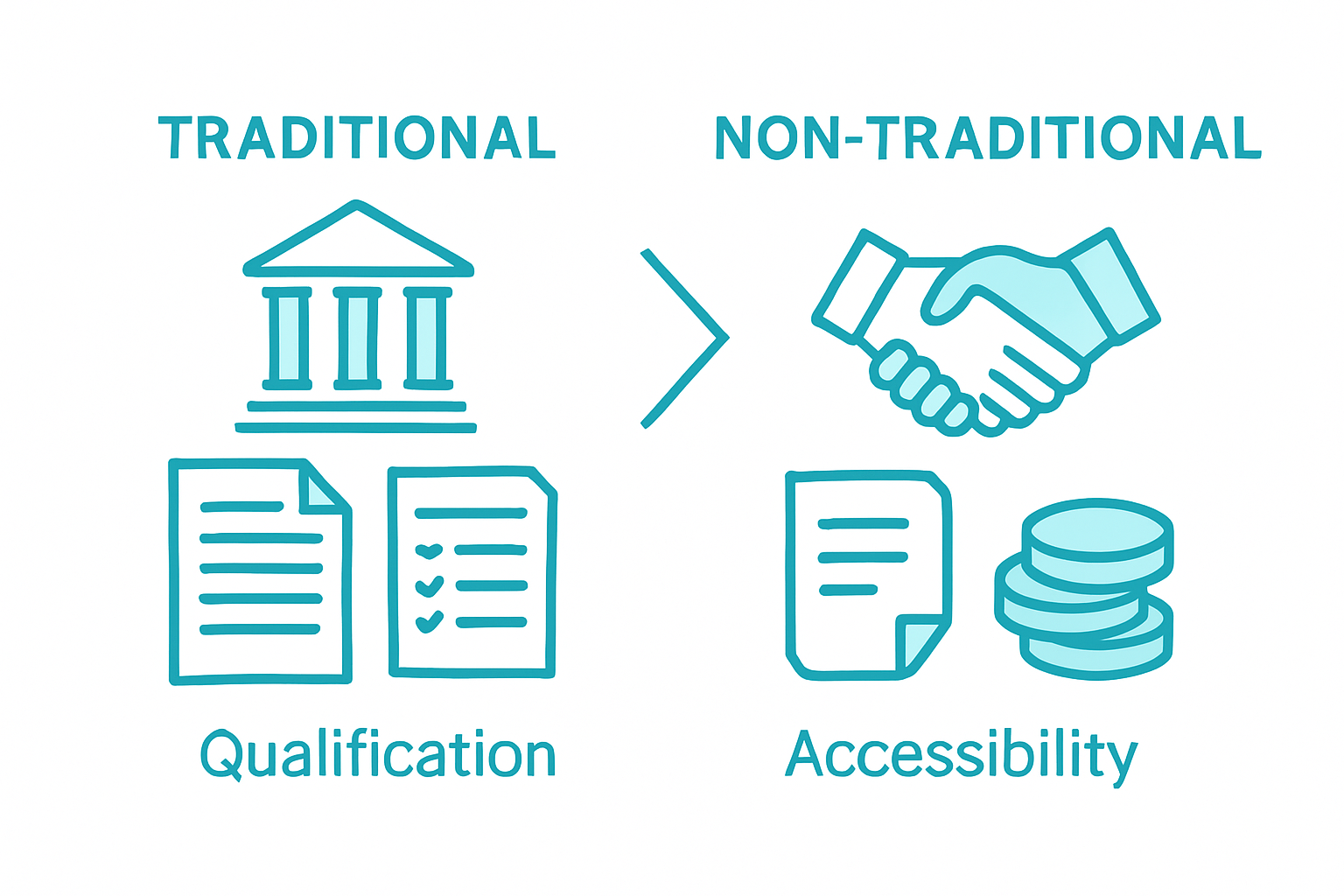
The financial implications of choosing between traditional and non-traditional mortgages extend beyond simple qualification requirements. Non-traditional options often feature higher interest rates to compensate for increased lending risk, but simultaneously offer greater accessibility and personalized financial solutions. Borrowers must carefully weigh the immediate advantages of alternative financing against potential long-term cost considerations. Factors such as loan terms, repayment flexibility, and the specific financial goals of the individual become critical in determining the most appropriate mortgage strategy.
Ultimately, the choice between traditional and non-traditional mortgages is not about finding a universal solution, but discovering the most suitable approach for an individual’s unique financial landscape. Successful mortgage selection requires a comprehensive understanding of personal financial health, long-term objectives, and the nuanced trade-offs inherent in different lending models. Consulting with mortgage professionals who specialize in both traditional and alternative financing can provide invaluable insights, helping borrowers make informed decisions that align with their specific homeownership aspirations.
Common Mistakes When Choosing Alternative Solutions
Navigating alternative mortgage solutions requires strategic decision making and careful financial assessment. Private mortgage regulations highlight the critical importance of understanding complex lending environments before committing to non-traditional financing approaches. Homeowners frequently encounter significant challenges when exploring alternative mortgage options without comprehensive preparation and professional guidance.
Common mistakes in alternative mortgage selection include:
- Overlooking long-term financial implications
- Failing to develop a realistic exit strategy
- Neglecting comprehensive legal and financial consultation
- Underestimating true borrowing costs
- Ignoring potential credit score impacts
- Selecting solutions without thorough comparative analysis
One of the most prevalent errors involves treating alternative mortgages as short-term solutions without considering sustained financial consequences. Borrowers often rush into private lending arrangements without fully comprehending the intricate terms and potential risks. These alternative financing models typically feature higher interest rates and more stringent enforcement mechanisms, demanding a much deeper understanding of contractual obligations and personal financial capacity than traditional mortgage products.
Professional guidance becomes paramount in mitigating potential pitfalls associated with alternative mortgage solutions. Many homeowners mistakenly believe that non-traditional lending represents an easy pathway to financing, overlooking the complex legal and financial considerations inherent in these arrangements. Developing a comprehensive strategy requires meticulous planning, including a clear understanding of personal financial goals, precise assessment of repayment capabilities, and a robust exit strategy that anticipates potential market fluctuations and personal economic changes.
Ultimately, successful navigation of alternative mortgage solutions demands a holistic approach that combines thorough research, professional consultation, and strategic financial planning. Homeowners must resist the temptation of quick fixes and instead invest time in understanding the nuanced landscape of non-traditional lending. By approaching alternative mortgage options with diligence, transparency, and a comprehensive perspective, borrowers can transform potential risks into strategic financial opportunities.
Discover Tailored Mortgage Solutions for Your Unique Financial Needs
Navigating the complexities of non-traditional mortgage options in Ontario can feel overwhelming. Whether you are self-employed, facing non-standard income challenges, or seeking access to private lending, understanding the right alternative mortgage strategy is essential to securing your home financing. Key challenges include flexible qualifying criteria, managing higher interest rates, and developing a clear exit plan. At Miracle Financial, our experienced Ontario mortgage brokers specialise in creating customised solutions that match your financial situation without compromising your long-term goals.
Take control of your financing journey today with Miracle Financial. From expert guidance on self-employed mortgage options to effective debt consolidation mortgages, we combine industry expertise and modern technology to deliver fast approvals and transparent communication. Don’t settle for rigid traditional mortgages when a personalised alternative solution could unlock your homeownership dreams. Visit Miracle Financial now and start building a mortgage plan that works for you.
Frequently Asked Questions
What are non-traditional mortgage solutions?
Non-traditional mortgage solutions are innovative financing strategies that allow homeowners to access funding beyond conventional lending models. They cater to individuals who may not qualify for traditional bank mortgages, offering flexible options for diverse financial circumstances.
How do I qualify for a self-employed mortgage?
To qualify for a self-employed mortgage, you typically need to provide comprehensive business financial statements, consistent income documentation through tax returns, and evidence of business stability. Alternative lenders may use methods like grossing up income to better reflect your earning potential.
What are the risks associated with non-traditional mortgages?
Risks of non-traditional mortgages include higher interest rates compared to conventional options, potentially stringent penalty clauses for missed payments, and the need for thorough financial assessments. Borrowers should consider long-term costs and develop a robust financial strategy.
How do alternative mortgages differ from traditional mortgages?
Alternative mortgages differ from traditional ones primarily in their qualification criteria, income verification methods, and flexibility in assessing a borrower’s financial profile. Non-traditional options often consider a broader range of financial factors, making them more accessible for individuals with versatile income streams.