
Blog
Credit Score and Mortgage Eligibility in Ontario


Most Canadian lenders in Vaughan rely heavily on your credit score when deciding mortgage eligibility. If your score falls below 680, securing home financing may seem out of reach, yet over 30 percent of first-time buyers face this challenge. Understanding how your credit score impacts mortgage offers is crucial. This guide helps you decode lender requirements, explore financing options for low scores, and discover practical steps to boost your approval odds in Ontario’s fast-paced market.
Table of Contents
- Credit Score Basics For Ontario Mortgages
- Mortgage Types And Lender Score Requirements
- How Credit Score Affects Rates And Terms
- Private Lending And Alternatives For Poor Credit
- Steps To Boost Mortgage Eligibility In Vaughan
Key Takeaways
| Point | Details |
|---|---|
| Understand Credit Scores | Credit scores range from 300 to 900 and are crucial for mortgage eligibility; scores above 680 are preferred by lenders in Ontario. |
| Explore Mortgage Options | Different mortgage types have varying credit score requirements; insured mortgages can require scores as low as 620, while investment properties often require 700+. |
| Impact of Credit Scores | Higher credit scores lead to lower interest rates and better loan conditions, whereas lower scores result in higher costs and stricter terms. |
| Improve Eligibility | Focus on maintaining a good credit profile through on-time payments and reducing debt; consider obtaining pre-approval to gauge borrowing capacity before applying. |
Credit score basics for Ontario mortgages
Understanding your credit score is fundamental for mortgage eligibility in Ontario. Credit scores represent a numerical summary of your financial trustworthiness, calculated based on your credit history and ranging between 300 and 900. In Canada, credit bureaus track financial behaviour to generate these critical numbers that lenders use to assess risk.
Mortgage lenders in Ontario typically prefer credit scores above 680, which signals responsible financial management. Your score is determined by several key factors: payment history, total debt levels, length of credit history, credit mix, and recent credit inquiries. Each of these elements contributes differently to your overall creditworthiness, with payment history and current debt levels carrying the most significant weight.
The two primary credit bureaus in Canada Equifax and TransUnion compile these scores, providing lenders with a comprehensive view of your financial reliability. A higher credit score not only increases your chances of mortgage approval but can also help you secure more favourable interest rates. Maintaining a clean credit report requires consistent on-time payments, keeping credit utilization low, and avoiding multiple simultaneous credit applications.
Pro tip: Request a free credit report annually from both Equifax and TransUnion to review your financial standing and identify any potential errors or areas for improvement.
Mortgage types and lender score requirements
Mortgage lending in Ontario involves multiple mortgage types with distinct credit score requirements. Conventional mortgages typically demand the highest credit standards, with most traditional lenders requiring scores of 680 or higher to qualify for optimal terms and rates. These mortgages represent the most straightforward financing option for borrowers with strong credit histories.

Alternative mortgage options exist for borrowers with lower credit scores. Insured mortgages, which require mortgage default insurance, can accommodate credit scores around 620. Private and alternative lenders offer more flexibility, potentially approving mortgages for individuals with scores as low as 600, though these come with higher interest rates and more stringent conditions. The specific requirements vary based on factors like down payment size, income stability, and overall financial profile.
Different mortgage types present unique credit score thresholds. First-time homebuyers might find more lenient options through government-backed programs, while investment property mortgages often demand higher credit scores. Traditional banks tend to have the most conservative requirements, whereas credit unions and alternative lenders may offer more personalized assessment of an applicant’s financial circumstances.
Here’s a comparison of how different mortgage types in Ontario relate to credit score requirements and lending conditions:
| Mortgage Type | Minimum Credit Score | Lending Institution | Typical Interest Rates |
|---|---|---|---|
| Conventional | 680+ | Banks, Credit Unions | Lowest, most favourable |
| Insured | ~620 | Banks, Insurers | Moderate rates |
| Private/Alternative | 600+ | Individual/Corp. Lenders | Highest, strictest terms |
| Investment Property | 700+ | Banks, Credit Unions | Slightly higher rates |
| First-Time Homebuyer | 600-680 | Banks, Government-backed | Moderate, may offer incentives |
Pro tip: Before applying for a mortgage, obtain a comprehensive credit report and work on improving your score by reducing outstanding debts and ensuring consistent, timely bill payments.
How credit score affects rates and terms
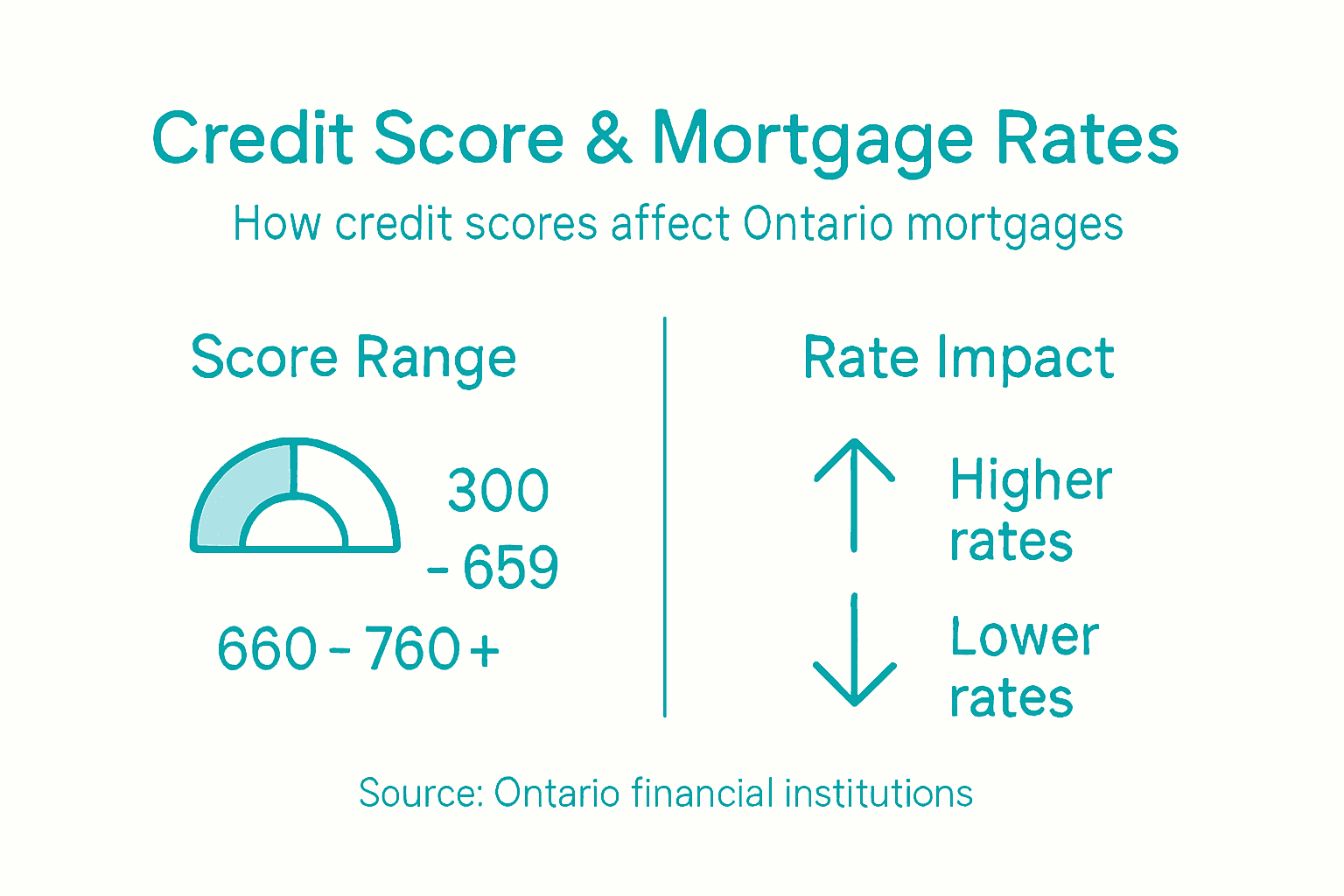
Your credit score plays a pivotal role in determining mortgage rates and lending terms in Ontario. Mortgage lenders assess risk through credit scores, with higher scores directly translating to more favourable borrowing conditions. Borrowers with scores above 760 typically receive the most competitive interest rates, while those with lower scores can expect increasingly higher rates and more restrictive lending terms.
The financial impact of credit scores extends beyond initial interest rates. Even a modest difference in credit score can result in substantial variations in monthly mortgage payments and total interest paid over the loan’s lifetime. For instance, borrowers with scores below 600 might face interest rates exceeding 10% and be required to work with private lenders, significantly increasing the overall cost of homeownership.
Credit scores influence multiple aspects of mortgage lending beyond interest rates. Lenders use these scores to determine loan amount eligibility, down payment requirements, and the strictness of lending conditions. A higher credit score can provide access to larger loan amounts, lower down payment thresholds, and more flexible repayment terms. Conversely, lower scores may necessitate additional documentation, higher down payments, or require mortgage default insurance.
The table below summarises how credit scores impact key mortgage conditions in Ontario:
| Credit Score Range | Interest Rate Impact | Down Payment Requirement | Typical Loan Amount Eligibility |
|---|---|---|---|
| 760 and above | Best rates, lowest costs | Lower percentage | Highest amount possible |
| 680–759 | Competitive rates | Average requirements | High eligibility |
| 620–679 | Moderate rates | May need higher down payment | Limited eligibility |
| Below 620 | High rates, more fees | Often highest required | Lowest amounts, strict limits |
Pro tip: Regularly monitor your credit report and take proactive steps to improve your score, such as paying bills on time, reducing credit utilization, and addressing any outstanding negative entries.
Private lending and alternatives for poor credit
Borrowers with poor credit in Ontario face unique challenges in securing mortgage financing, but several alternative lending options exist beyond traditional bank mortgages. Private mortgage lenders in Ontario provide critical financing solutions for individuals with credit scores that fall below conventional lending standards.
Private lenders typically offer more flexible lending criteria compared to traditional banks, focusing on property value and overall financial situation rather than credit score alone. These lenders include individual investors, mortgage investment corporations, and specialized lending firms that assess risk differently. While interest rates are generally higher than traditional mortgages – often ranging from 8% to 15% – they provide an essential pathway to homeownership for those with challenging credit histories.
Alternative mortgage options can include second mortgages, home equity lines of credit, and short-term bridge financing. These solutions allow borrowers to access funding while simultaneously working to improve their credit profile. Some private lenders specialize in helping borrowers transition back to traditional lending by providing structured repayment plans and credit rehabilitation strategies.
Pro tip: Consider working with a mortgage broker who specializes in alternative lending to navigate private mortgage options and develop a strategic plan for improving your credit profile over time.
Steps to boost mortgage eligibility in Vaughan
Improving mortgage eligibility requires a strategic approach tailored to Vaughan’s competitive housing market. Mortgage qualification strategies focus on demonstrating financial stability and creditworthiness to potential lenders. Prospective homebuyers should begin by thoroughly examining their current financial profile, identifying areas for immediate improvement and long-term financial planning.
Key steps to enhance mortgage eligibility include maintaining a stable employment history, reducing existing debt, and improving credit score. This means consistently making bill payments on time, keeping credit utilization below 30% of available credit limits, and avoiding new credit applications during the mortgage approval process. Saving for a larger down payment can also significantly improve lending prospects, as it reduces the perceived risk for financial institutions and demonstrates financial discipline.
Documentation plays a crucial role in mortgage approval. Vaughan homebuyers should prepare comprehensive financial records, including tax returns, pay stubs, bank statements, and employment verification. Self-employed individuals may need additional documentation to prove income stability. Consulting with a local mortgage professional can provide personalized guidance on navigating the specific requirements of Vaughan’s real estate market and identifying the most suitable mortgage products.
Pro tip: Obtain a pre-approval before house hunting to understand your exact borrowing capacity and demonstrate serious intent to sellers.
Take Control of Your Mortgage Journey with Miracle Financial
Navigating mortgage eligibility in Ontario can feel overwhelming especially when dealing with credit score challenges or complex financial situations. This article highlights the importance of understanding your credit score and how it impacts your mortgage options and rates. If you are struggling with lower scores or need tailored mortgage solutions like private lending or debt consolidation mortgages, you are not alone.
Miracle Financial is a trusted Ontario mortgage broker based in Vaughan ready to help you unlock better financial opportunities. Our experts specialize in helping clients improve mortgage eligibility through smart strategies and personalized support whether you are a first-time homebuyer, self-employed, or looking for private mortgage lenders Ontario. With our deep knowledge of credit impact on financing and access to alternative mortgage options, we empower you to move forward confidently.

Don’t let credit score concerns hold you back any longer. Visit us at Miracle Financial today to get a custom mortgage plan designed just for your financial goals. Start your journey now to secure the best possible rates and terms with a trusted Vaughan mortgage broker dedicated to your success.
Frequently Asked Questions
What is a credit score and how does it affect mortgage eligibility?
A credit score is a numerical representation of your financial trustworthiness, ranging from 300 to 900. Lenders use this score to assess your risk as a borrower, which directly impacts your eligibility for a mortgage.
What credit score do I need for a mortgage in Ontario?
Most lenders in Ontario prefer a credit score of 680 or higher for conventional mortgages. However, alternatives like insured mortgages may accept scores around 620, and private lenders might consider scores as low as 600.
How does my credit score influence mortgage interest rates?
A higher credit score typically results in more favourable interest rates. Borrowers with scores above 760 can often access the lowest rates, while those with scores below 620 may face significantly higher rates and less favorable terms.
What steps can I take to improve my credit score before applying for a mortgage?
To improve your credit score, focus on making timely payments, reducing your overall debt, keeping your credit utilisation below 30%, and avoiding new credit applications before applying for a mortgage.