
Blog
Mortgage Brokers and Debt Consolidation in Ontario


Most Canadian homeowners in Vaughan are feeling the stress of juggling multiple high-interest debts and rising monthly payments. Refinancing through a skilled mortgage broker can be the key to unlocking better cash flow, even if you have a low credit score. This guide reveals how Canadian mortgage experts use home equity to consolidate debt and secure solutions tailored for Vaughan residents facing financial complexity.
Table of Contents
- Mortgage Brokers’ Role in Debt Consolidation
- Types of Debt Consolidation Mortgages in Ontario
- How Refinancing and Home Equity Loans Work
- Private Mortgage Lenders and Low Credit Scores
- Comparing Mortgage-Based and Alternative Solutions
- Risks, Costs, and Common Mistakes to Avoid
Key Takeaways
| Point | Details |
|---|---|
| Role of Mortgage Brokers | Mortgage brokers in Ontario assist homeowners with debt consolidation by leveraging home equity to secure optimal refinancing options. They negotiate better terms than individual borrowers typically can access. |
| Types of Debt Consolidation Mortgages | Ontario homeowners can choose from cash-out refinancing, HELOCs, or second mortgages for consolidating high-interest debts, each with unique benefits and costs. |
| Risks of Debt Consolidation | Potential risks include longer repayment terms which can lead to higher overall costs, and the risk of foreclosure if mortgage payments are missed. |
| Importance of Financial Planning | Homeowners should conduct thorough financial assessments and consider their spending habits to avoid recurring debt issues post-consolidation. |
Mortgage Brokers’ Role in Debt Consolidation
Mortgage brokers play a strategic role in helping Ontario homeowners effectively manage and consolidate their outstanding debts through specialized mortgage refinancing solutions. By leveraging home equity and connecting clients with appropriate lending options, mortgage brokers in the Greater Toronto Area can transform complex financial challenges into streamlined debt management strategies.
The primary function of a mortgage broker in debt consolidation involves assessing a client’s total debt profile, credit history, and current mortgage situation to recommend optimal refinancing approaches. These professionals analyse multiple factors such as interest rates, existing loan terms, credit scores, and available home equity to design customised debt consolidation plans. By working with various lenders, mortgage brokers can negotiate more favourable terms than individual borrowers might secure independently, potentially reducing overall monthly payment obligations and interest expenses.
Debt consolidation through mortgage refinancing typically involves replacing multiple high-interest debts (like credit card balances, personal loans, and lines of credit) with a single, lower-interest mortgage loan. Mortgage brokers help clients understand this process by calculating potential savings, explaining legal implications, and guiding them through documentation requirements. Their expertise becomes particularly valuable for homeowners with complex financial situations, such as those with variable income streams or slightly impaired credit histories.
Pro tip: Before pursuing debt consolidation, gather all existing loan statements and have a clear understanding of your total debt load to help your mortgage broker develop the most effective strategy for your unique financial circumstances.
Types of Debt Consolidation Mortgages in Ontario
In Ontario, homeowners have several strategic options for consolidating high-interest debts through mortgage refinancing, each designed to address unique financial challenges. These mortgage solutions allow individuals to transform multiple outstanding debts into a single, more manageable payment structure, potentially reducing overall interest expenses and simplifying financial management.

The primary types of debt consolidation mortgages in Ontario include cash-out refinancing, home equity lines of credit (HELOC), and second mortgages. Cash-out refinancing involves replacing your existing mortgage with a larger loan and using the additional funds to pay off high-interest debts. Home equity lines of credit provide flexible borrowing options where homeowners can draw funds against their property’s equity, while second mortgages allow borrowing an additional loan secured by the same property without disturbing the original mortgage terms.
Each debt consolidation mortgage type carries distinct advantages and potential risks. Cash-out refinancing often offers the lowest interest rates but may involve legal fees and potential penalties for breaking an existing mortgage contract. HELOCs provide more flexibility with draw-and-repay capabilities, making them attractive for ongoing debt management. Second mortgages can be useful for homeowners with existing low-rate first mortgages who want to avoid refinancing, though they typically come with slightly higher interest rates compared to primary mortgage products.
Here is a concise comparison of the main debt consolidation mortgage options in Ontario:
| Mortgage Solution | Typical Interest Rate | Payment Flexibility | Common Upfront Costs |
|---|---|---|---|
| Cash-Out Refinance | Usually lowest | Fixed monthly | Legal, appraisal, penalty fees |
| HELOC | Variable, mid-range | Flexible access | Setup, appraisal fees |
| Second Mortgage | Highest among options | Separate payments | Legal, lender, broker fees |
Pro tip: Calculate your total debt consolidation costs, including legal fees and potential penalties, to ensure the refinancing strategy will genuinely save you money in the long term.
How Refinancing and Home Equity Loans Work
Mortgage refinancing and home equity loans represent powerful financial tools for Ontario homeowners seeking to strategically manage their debt consolidation needs. These financial strategies enable property owners to leverage their home’s equity, transforming complex debt structures into more manageable financial arrangements with potentially lower interest rates and simplified repayment schedules.
The refinancing process involves replacing an existing mortgage with a new loan, typically at more advantageous terms. Homeowners can access additional funds beyond their current mortgage balance, using the excess to pay off high-interest debts such as credit cards, personal loans, or lines of credit. Home equity loans, in contrast, allow borrowers to obtain a lump sum loan secured against their property’s accumulated value, providing a straightforward method to consolidate multiple debt obligations into a single payment stream.
Each approach carries distinct characteristics and potential benefits. Refinancing often provides lower overall interest rates and can extend or reduce mortgage terms, while home equity loans offer more immediate access to funds with potentially lower closing costs. Both strategies require careful evaluation of current interest rates, existing mortgage conditions, and the homeowner’s long-term financial objectives. Factors such as credit score, current home value, outstanding debts, and income stability play crucial roles in determining the most suitable debt consolidation approach.
Pro tip: Request detailed amortization schedules from your mortgage broker to understand the precise long-term financial impact of refinancing or home equity loan options before making a final decision.
Private Mortgage Lenders and Low Credit Scores
Homeowners with challenging credit histories often find traditional banking institutions reluctant to provide mortgage solutions. Private mortgage lenders in Ontario offer alternative financing pathways for individuals experiencing credit challenges, providing critical support when conventional lending channels remain closed.
Private mortgage lenders specialise in high-risk lending scenarios, evaluating mortgage applications through a more holistic lens compared to traditional banks. While conventional lenders primarily focus on credit scores, private lenders consider additional factors such as property value, income stability, existing equity, and potential for future financial recovery. This approach allows borrowers with low credit scores to access home financing options that would otherwise be unavailable, albeit typically at higher interest rates that reflect the increased lending risk.
The private lending landscape in Ontario encompasses various types of alternative financing sources, including individual investors, mortgage investment corporations, and specialized lending firms. These lenders assess risk differently, often prioritising the underlying asset value and potential for loan repayment over strict credit score requirements. Borrowers with credit scores below 600, recent bankruptcy, consumer proposals, or inconsistent income streams can find more flexible lending criteria through private mortgage solutions, though they should carefully evaluate the associated higher costs and shorter loan terms.
Pro tip: Prepare a comprehensive financial narrative explaining the circumstances behind your low credit score, including steps you’re taking to improve your creditworthiness, to strengthen your private mortgage loan application.
Comparing Mortgage-Based and Alternative Solutions
Ontario homeowners facing significant debt challenges have multiple pathways for financial restructuring, with mortgage-based debt consolidation presenting a comprehensive approach to managing complex financial obligations. Unlike alternative solutions, mortgage-based strategies leverage home equity to provide more substantial and potentially long-term debt resolution.
Mortgage-based solutions offer unique advantages over traditional debt management approaches. By consolidating multiple high-interest debts into a single, lower-interest mortgage payment, homeowners can potentially reduce monthly financial burden and simplify their repayment strategy. Alternative solutions such as personal loans, credit card balance transfers, and debt management programs provide different mechanisms for debt reduction, each with distinct advantages and limitations in terms of interest rates, repayment terms, and impact on credit profiles.
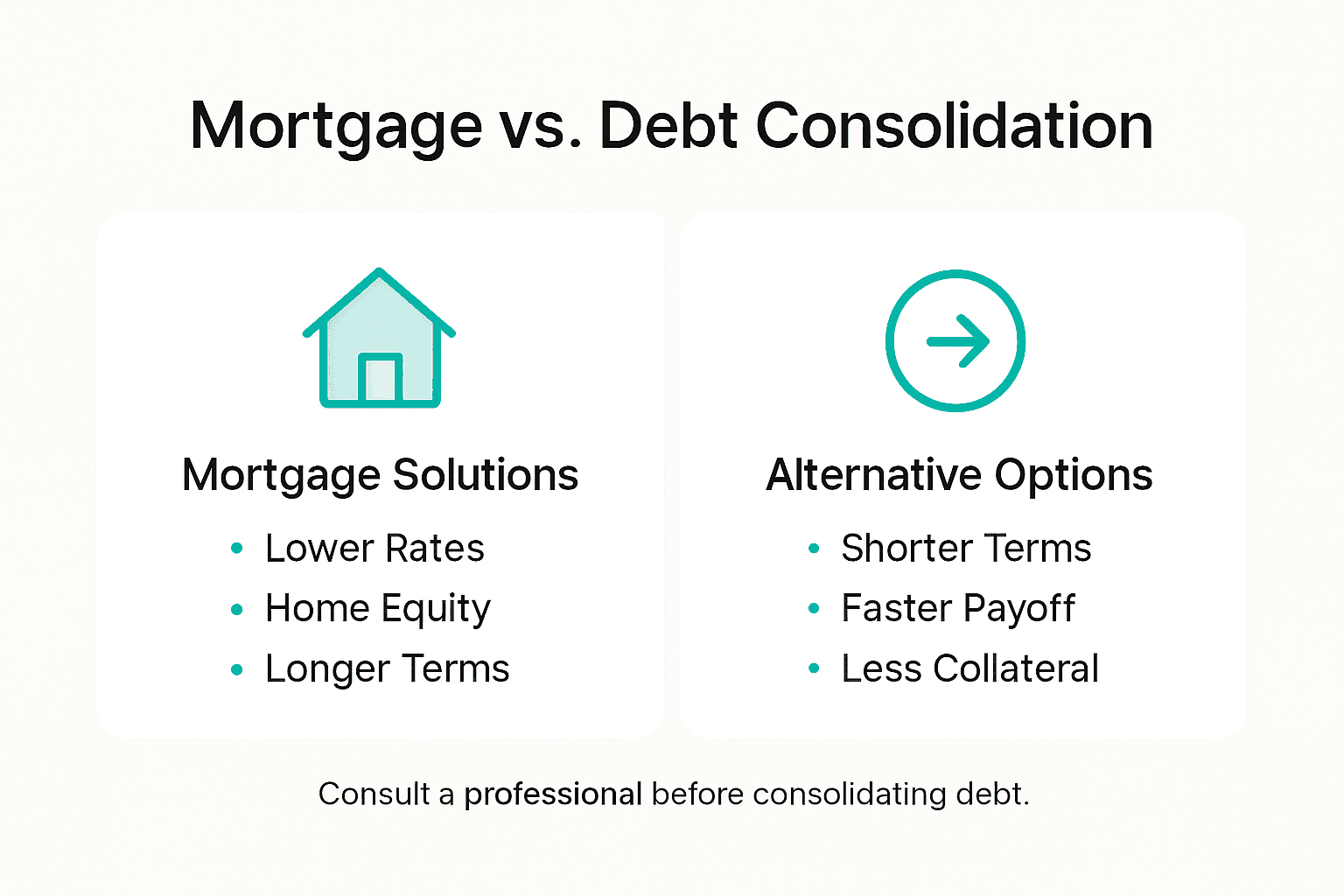
The primary distinctions between mortgage-based and alternative debt solutions centre on accessibility, cost, and long-term financial implications. Mortgage-based consolidation typically provides lower interest rates and longer repayment periods, making it attractive for homeowners with substantial equity. Alternative solutions like personal loans or balance transfers often have shorter terms, higher interest rates, and more stringent qualification criteria. Critically, mortgage-based solutions require home ownership and sufficient equity, while alternative methods might be more accessible to individuals without real estate assets.
Pro tip: Conduct a comprehensive cost-benefit analysis comparing the total interest paid, repayment duration, and potential tax implications across different debt consolidation strategies before making a final decision.
Risks, Costs, and Common Mistakes to Avoid
Debt consolidation strategies require careful navigation, with homeowners needing to understand the potential pitfalls and financial implications. Debt consolidation through mortgages involves significant risks that must be thoroughly evaluated, including potential long-term financial consequences that extend beyond immediate debt relief.
The most critical risks associated with mortgage-based debt consolidation centre on extended repayment periods and potential property loss. By stretching debt over longer mortgage terms, homeowners might inadvertently increase their total interest payments, potentially spending significantly more money over the loan’s lifecycle. Furthermore, securing debt against home equity creates a direct risk of property foreclosure if mortgage payments cannot be maintained, transforming what initially seemed like a financial solution into a more precarious financial situation.
Common mistakes in debt consolidation often stem from inadequate financial planning and unrealistic expectations. Homeowners frequently underestimate the importance of addressing underlying spending habits, viewing debt consolidation as a quick fix rather than a comprehensive financial strategy. Borrowers might consolidate existing debts without implementing meaningful budget controls, potentially leading to repeated debt accumulation. Additional risks include overlooking hidden fees, failing to compare different consolidation options comprehensively, and not fully understanding the long-term implications of restructuring existing financial obligations.
This table summarizes key risks and mistakes homeowners should consider before consolidating debt:
| Risk/Mistake | Impact on Finances | Preventive Action |
|---|---|---|
| Longer repayment term | More interest paid over time | Compare total lifetime costs |
| Losing home equity | Increased risk of foreclosure | Ensure sustainable repayments |
| Ignoring spending habits | Recurring debt issues | Develop strict budgeting plans |
| Overlooking hidden fees | Higher consolidation cost | Request full cost breakdown |
Pro tip: Create a detailed monthly budget tracking your income and expenses before pursuing debt consolidation, ensuring you have a sustainable plan to prevent future debt accumulation and maintain financial stability.
Take Control of Your Debt with Expert Mortgage Solutions in Ontario
Managing multiple high-interest debts can feel overwhelming and risky, especially when your home equity and credit situation complicate your options. If you are seeking a reliable way to simplify repayments while potentially lowering interest costs, understanding debt consolidation mortgages and refinancing strategies is key. At Miracle Financial, our knowledgeable Ontario mortgage broker team specialises in tailored debt consolidation mortgage solutions that transform complex debts into one manageable payment, backed by home equity expertise and flexible lending alternatives.

Empower your financial future today by partnering with a trusted Vaughan mortgage broker who understands how to navigate refinancing mortgages in Ontario and connect you with private mortgage lenders when credit challenges arise. Visit Miracle Financial to discover personalised strategies designed to improve your cash flow, protect your home, and build lasting stability. Don’t wait — act now to access fast, transparent service that puts your financial goals first.
Frequently Asked Questions
What role do mortgage brokers play in debt consolidation?
Mortgage brokers help homeowners manage their debts by assessing their financial situation, recommending mortgage refinancing options, and connecting them with suitable lenders for debt consolidation.
What types of mortgage solutions are available for debt consolidation?
In Ontario, the common types of debt consolidation mortgages include cash-out refinancing, home equity lines of credit (HELOC), and second mortgages, each catering to different financial needs.
How does the refinancing process work for debt consolidation?
Refinancing involves replacing your existing mortgage with a new loan, often at better terms, allowing homeowners to access extra funds to pay off high-interest debts like credit cards and personal loans.
What risks should homeowners be aware of when consolidating debt through mortgages?
Key risks include extended repayment periods leading to higher total interest payments, the potential loss of home equity, and the possibility of falling back into debt without addressing underlying financial habits.
Recommended
- Debt consolidation mortgage examples in Vaughan
- Debt consolidation mortgage scenarios for Vaughan homeowners
- Options if you cannot afford your Ontario mortgage payments
- Complete Guide to Ontario Mortgage Brokers’ Role – Miracle Financial
- 7 Examples of Mortgage Solutions for Ontario Homeowners
- Blog – Miracle Financial
- Why Use a Mortgage Broker GTA – Smart Financial Decisions
- LD Financial Services | Final Expenses Insurance | Life Insurance | Retirement Planning
- Understanding the Role of Brokers in Landlord Insurance – Rental Income Insurance