
Blog
Refinance vs Second Mortgage Ontario 2026: Cut Costs 20%


Choosing between refinancing and a second mortgage can feel overwhelming when you’re trying to consolidate debt and improve cash flow. Many Ontario homeowners face this exact dilemma, unsure which path saves more money or suits their timeline. The good news? Refinancing can reduce monthly payments by up to 20% when done strategically. This guide breaks down both options so you can make the right financial decision for your situation.
Table of Contents
- Introduction To Mortgage Financing Options In Ontario
- Understanding Refinancing
- Understanding Second Mortgages
- Comparing Refinancing And Second Mortgages
- Common Misconceptions About Refinancing Vs Second Mortgages
- Case Studies And Real-World Examples
- Decision Framework For Ontario Homeowners
- How Miracle Financial Can Help Ontario Homeowners
- Frequently Asked Questions
Key Takeaways
| Point | Details |
|---|---|
| Refinancing offers lower rates | Typically 3.5% to 6% interest with longer approval timelines of 3 to 6 weeks. |
| Second mortgages provide speed | Approval in 1 to 2 weeks but higher rates from 5% to 12% reflect increased lender risk. |
| Credit and urgency drive choice | Your credit score and how fast you need funds determine the best option. |
| Cost differences matter | Refinancing involves appraisal and legal fees; second mortgages often have faster closing costs. |
| Both consolidate debt effectively | Each option can improve cash flow by replacing high-interest debts with secured mortgage financing. |
Introduction to Mortgage Financing Options in Ontario
Refinancing means replacing your existing mortgage with a new loan, often at better terms or a different rate. A second mortgage is an additional loan secured against your home equity, sitting behind your primary mortgage in priority. Ontario’s lending environment reflects the diverse financial challenges GTA homeowners face, from managing multiple high-interest debts to freeing up monthly cash flow.
Both refinancing and second mortgages address these challenges through different mechanisms. Refinancing restructures your entire mortgage, potentially lowering your rate and extending your amortization. Second mortgages keep your existing mortgage intact while providing a separate loan for immediate needs.
Common scenarios where Ontario homeowners consider these options include:
- Consolidating credit card debt, personal loans, or car loans into one secured payment
- Funding home renovations or major purchases without draining savings
- Managing cash flow challenges caused by rising living costs or income changes
- Accessing equity for investment opportunities or emergency expenses
Understanding Ontario mortgage financing options starts with knowing how each tool works and which financial situations they solve best. The right choice depends on your equity position, credit profile, timeline, and long-term goals.
Understanding Refinancing
Refinancing involves paying off your current mortgage with a new loan, ideally securing better terms in the process. You might refinance to lower your interest rate, extend your amortization period, or pull out equity for debt consolidation. In Ontario, refinancing rates typically range from 3.5% to 6%, making it attractive for lowering monthly obligations.
Eligibility for refinancing depends on several factors:
- Sufficient home equity, usually at least 20% after refinancing
- Credit score of 650 or higher for best rates, though alternative lenders may accept lower scores
- Documented income proving ability to service the new mortgage
- Current property appraisal meeting lender requirements
Costs associated with refinancing include appraisal fees (typically $300 to $500), legal fees ($800 to $1,500), and potential prepayment penalties on your existing mortgage. These upfront costs can add up, but the long-term savings often justify the investment.
The financial benefits of refinancing eligibility and costs in Ontario shine through lower monthly payments. By extending your amortization or securing a lower rate, you free up cash flow immediately. Consolidating high-interest debts like credit cards (often 19% to 29% interest) into your mortgage dramatically reduces your overall interest burden.
Pro Tip: Always check your current mortgage for prepayment penalties before refinancing. Some mortgages charge three months’ interest or an interest rate differential (IRD), which can be substantial. Factor these costs into your decision to ensure refinancing truly saves money.
The benefits of mortgage refinancing extend beyond just rate savings. You gain predictable payments, simplified finances, and potential tax advantages if using funds for investment purposes.
Understanding Second Mortgages
A second mortgage is an additional loan secured against your home equity, separate from your primary mortgage. It sits in second position, meaning if you default, the primary lender gets paid first from any sale proceeds. This subordinate position increases risk for lenders, which explains the higher interest rates.
Eligibility requirements for second mortgages are often more flexible than refinancing:
- Credit scores as low as 550 may qualify with private lenders
- Proof of income, though alternative documentation often accepted
- Available home equity, typically up to 80% combined loan-to-value
- Faster approval process focusing more on equity than credit history
Interest rates on second mortgages in Ontario vary between 5% to 12%, reflecting the increased lender risk. Terms typically run shorter than primary mortgages, often one to five years, with balloon payments or renewal requirements.

Risks include the subordinate loan position, which affects your options if facing financial hardship. In foreclosure situations, second mortgage lenders may recover nothing if insufficient equity remains after the primary lender is paid. Higher rates also mean larger monthly payments compared to refinancing.
Pro Tip: Second mortgages work best when you need funds quickly and can’t wait for refinancing approval, or when prepayment penalties on your existing mortgage make refinancing too costly. Calculate whether the speed and convenience justify the higher interest cost.
Typical use cases include urgent home repairs, debt consolidation when credit scores prevent refinancing approval, or bridging short-term cash flow gaps. The second mortgage details Ontario homeowners should understand include the trade-off between accessibility and cost.
Understanding second mortgage eligibility and risks helps you decide if faster access to equity outweighs the premium pricing.
Comparing Refinancing and Second Mortgages
The choice between refinancing and a second mortgage comes down to understanding key differences in cost, speed, and eligibility requirements. Here’s how they compare:
| Feature | Refinancing | Second Mortgage |
|---|---|---|
| Interest Rate | 3.5% to 6% | 5% to 12% |
| Approval Time | 3 to 6 weeks | 1 to 2 weeks |
| Credit Score | 650+ preferred | 550+ accepted |
| Upfront Costs | $2,000 to $4,000 | $1,000 to $2,500 |
| Loan Term | 1 to 5 years or longer | 1 to 5 years |
| Monthly Impact | Lower payments | Higher payments |
Second mortgages fund faster with typical approval in 1 to 2 weeks versus 3 to 6 weeks for refinancing in Ontario. This speed matters when facing urgent expenses or time-sensitive opportunities. However, refinancing typically delivers lower interest rates, translating to meaningful long-term savings.
Eligibility differences significantly impact your options. Refinancing demands stronger credit profiles and income documentation, making it harder to qualify if your financial situation has changed since your original mortgage. Second mortgages offer more flexibility, accepting lower credit scores and alternative income verification.
Monthly payment impact varies substantially. Refinancing often reduces payments by consolidating debts at lower rates and extending amortization. Second mortgages add a new payment on top of your existing mortgage, though the combined total may still be less than your current debt obligations.
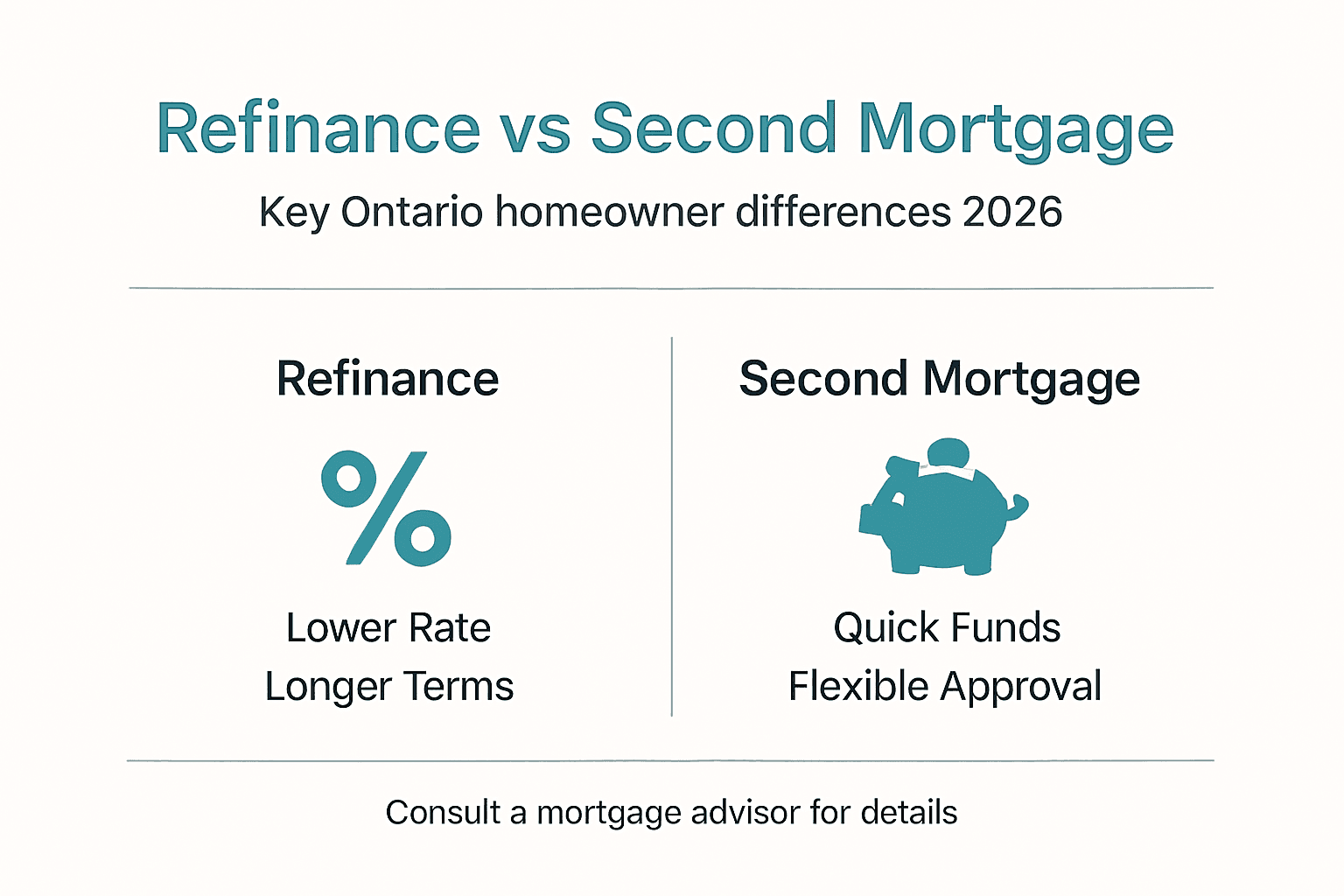
Risk considerations differ too. Refinancing resets your mortgage, potentially extending your debt repayment timeline. Second mortgages carry subordinate loan risk, meaning less protection if property values decline or financial hardship strikes.
Practical decision points include:
- Choose refinancing if you have good credit, can wait several weeks, and want the lowest possible rate
- Select a second mortgage if you need funds urgently, have less-than-perfect credit, or face high prepayment penalties
- Consider total cost over the full loan term, not just monthly payments
- Factor in your ability to qualify for each option based on current income and credit
The refinance vs second mortgage comparison ultimately depends on balancing cost savings against timing needs and qualification requirements.
Common Misconceptions About Refinancing vs Second Mortgages
Several myths cloud homeowner decision-making around these financing options. Refinancing doesn’t always offer the cheapest solution when prepayment penalties exceed potential savings, or when your credit has declined since your original mortgage. Sometimes maintaining your existing low-rate mortgage and adding a second mortgage costs less overall.
Second mortgages aren’t just for people with bad credit. Many qualified homeowners with excellent credit choose second mortgages for speed and convenience, especially when timing matters for investment opportunities or urgent repairs. The flexibility and fast approval often outweigh the higher interest cost for short-term needs.
Refinancing costs vary widely. Some borrowers assume refinancing always involves massive fees, but costs depend on your lender, mortgage terms, and whether penalties apply. Shopping around and understanding your current mortgage terms prevents costly surprises.
Key misconceptions to avoid:
- Believing refinancing automatically saves money without calculating total costs including penalties
- Assuming only desperate borrowers use second mortgages when they’re strategic tools for many situations
- Thinking you must choose one option forever when you can refinance later to consolidate a second mortgage
- Overlooking how your personal timeline and urgency affect which option delivers better value
Understanding second mortgage myths helps you evaluate options based on facts, not assumptions. Your choice should reflect your specific financial profile, timeline, and goals rather than following blanket rules.
Case Studies and Real-World Examples
Real Ontario homeowners demonstrate how these strategies work in practice:
-
Toronto Couple Refinances to Cut Payments 20%: A Scarborough family with $45,000 in credit card debt and a $350,000 mortgage refinanced to $420,000 at 4.2% interest. They extended their amortization from 18 to 25 years, reducing monthly payments from $3,200 to $2,400. The $800 monthly savings eliminated financial stress and allowed them to rebuild emergency savings.
-
Mississauga Homeowner Uses Second Mortgage for Fast Cash: A self-employed consultant needed $60,000 within two weeks for a business opportunity. With a credit score of 680 and $200,000 in equity, they secured a second mortgage at 7.5% interest. The quick approval preserved the time-sensitive opportunity, and they plan to refinance within two years to consolidate at a lower rate.
-
Vaughan Family Combines Both Strategies: A family with excellent credit but high prepayment penalties ($12,000) chose a second mortgage initially for $50,000 at 6.8% interest. After their mortgage term ended 18 months later, they refinanced both mortgages into one at 3.9%, saving approximately $650 monthly while avoiding the earlier penalty.
Lessons from these examples include timing your refinancing with mortgage renewal to avoid penalties, using second mortgages strategically for urgent needs, and planning to refinance later for long-term savings. The real-world Ontario refinancing examples show how flexible thinking and professional guidance optimize outcomes.
Decision Framework for Ontario Homeowners
Follow this six-step framework to choose between refinancing and a second mortgage:
-
Assess Your Current Mortgage: Review your interest rate, remaining term, balance, and prepayment penalties. Calculate whether penalties exceed potential refinancing savings.
-
Calculate Your Funding Needs: Determine exactly how much equity you need to access and for what purpose. Include debt consolidation amounts, project costs, and a buffer for closing expenses.
-
Check Your Credit Profile: Obtain your credit score and review your report for errors. Scores above 650 favor refinancing, while scores between 550 and 650 may require second mortgage options.
-
Compare Rates and Fees: Get quotes for both refinancing and second mortgages. Calculate total costs including interest, fees, and penalties over your expected loan period.
-
Evaluate Your Timeline: Determine how quickly you need funds. Urgent needs within two weeks favor second mortgages, while flexible timelines allow refinancing.
-
Make an Informed Choice: Balance cost, eligibility, timing, and risk tolerance. Consider consulting a mortgage broker for personalized analysis based on your complete financial picture.
Pro Tip: Mortgage brokers access multiple lenders and can often find solutions you wouldn’t discover independently. They help navigate complex eligibility requirements and may secure better rates through lender relationships.
Your decision should align with long-term financial goals, not just immediate needs. The decision framework for refinancing guides you through the analysis systematically. Consider how each option affects your five-year financial plan, retirement savings, and overall debt trajectory.
Working with experienced professionals providing mortgage broker advice on refinancing ensures you understand all implications before committing to either strategy.
How Miracle Financial Can Help Ontario Homeowners
Navigating refinancing and second mortgage decisions requires expertise in Ontario’s lending landscape. Miracle Financial specializes in helping homeowners find the right financing solution based on their unique credit profile, equity position, and financial goals.
Our team analyzes your complete situation to determine whether refinancing or a second mortgage delivers better value. We compare rates across multiple lenders, including traditional banks and private lenders, to secure the best terms available. The streamlined process means faster approvals and clearer communication throughout.

Whether you’re consolidating debt, accessing equity for renovations, or managing cash flow challenges, our mortgage refinancing services provide customized strategies. We also offer specialized second mortgage solutions for homeowners who need faster funding or have unique qualification circumstances.
Contact Miracle Financial today for a personalized consultation. Our Ontario mortgage broker guidance helps you make confident financial decisions that improve your cash flow and build long-term wealth.
Frequently Asked Questions
What credit score is needed to qualify for refinancing in Ontario?
Most lenders prefer credit scores of 650 or higher for refinancing at competitive rates. Scores between 600 and 650 may qualify with alternative lenders at slightly higher rates, while scores below 600 typically require private lending or second mortgage options instead.
How fast can I get funds from a second mortgage compared to refinancing?
Second mortgages typically close in 1 to 2 weeks, while refinancing takes 3 to 6 weeks. The speed difference comes from simpler underwriting focused on equity rather than full financial reassessment, making second mortgages ideal for urgent funding needs.
Are there penalties if I refinance my mortgage early?
Yes, most mortgages charge prepayment penalties calculated as either three months’ interest or an interest rate differential (IRD). The IRD can be substantial if rates have dropped since you secured your mortgage, so always calculate penalties before refinancing to ensure you still save money overall.
Can I use a second mortgage for debt consolidation?
Absolutely. Second mortgages work well for debt consolidation when you need funds quickly or your credit score makes refinancing difficult. The secured loan replaces high-interest unsecured debts, often reducing total monthly payments despite the second mortgage’s higher rate compared to refinancing.
When is refinancing a smarter choice than a second mortgage?
Refinancing makes more sense when you have good credit (650+), can wait several weeks for approval, want the lowest possible interest rate, and either have low prepayment penalties or your mortgage term is ending soon. The long-term savings from lower rates typically outweigh the longer approval process.
How much equity do I need to qualify for either option?
Refinancing typically requires maintaining at least 20% equity after the new loan. Second mortgages allow combined loan-to-value up to 80%, meaning you need at least 20% equity total across both mortgages. More equity improves your rates and qualification chances for both options.