
Blog
Refinancing with high debt in Ontario: a practical guide


TL;DR:
- Ontario homeowners with high-interest debt can often leverage home equity to refinance and consolidate their debts into a lower-rate mortgage.
- Eligibility depends on factors like home equity, income, credit score, and debt ratios, with alternative lenders providing options after bank declines.
Carrying high-interest debt as an Ontario homeowner can feel like running uphill with a heavy pack. Credit card balances, car loans, and lines of credit pile up, your monthly payments climb, and then the bank says no. Many homeowners assume that a bank rejection is the end of the road, but it rarely is. Ontario homeowners can often borrow against home equity to consolidate high-interest debt into a single, lower-rate mortgage payment. This guide walks you through exactly how to assess your situation, choose the right product, take action, and avoid the traps that catch too many borrowers off guard.
Table of Contents
- Assessing your refinancing eligibility with high debt
- Choosing the right refinancing strategy in Ontario
- Step-by-step: how to refinance with high debt in Ontario
- Risks, common mistakes, and how to stay safe
- What most homeowners miss about refinancing with high debt
- Ready for your next step? Expert help for Ontario refinancing
- Frequently asked questions
Key Takeaways
| Point | Details |
|---|---|
| Refinancing is possible | Ontario homeowners with high debt can often refinance by leveraging home equity even after a bank decline. |
| Know your product options | Main refinancing routes include mortgage refinance, second mortgage, and HELOC with different pros and risks. |
| Prepare before applying | Organizing paperwork and understanding your eligibility improves your chances, especially with alternative lenders. |
| Watch for risks and costs | Upfront fees and foreclosure risk make it vital to compare true totals and plan for responsible repayment. |
| Smart habits matter most | Lasting results require better spending and debt habits, not just a quick refinance. |
Assessing your refinancing eligibility with high debt
Now that you understand refinancing is possible, let’s look at whether you’ll realistically qualify and what lenders check. Eligibility is not a single checkbox. Lenders look at several factors simultaneously, and a weakness in one area can sometimes be offset by strength in another.
The four core eligibility factors
Home equity is the most important variable. According to the Financial Consumer Agency of Canada, homeowners can typically borrow up to 80% of their home’s appraised value through a mortgage refinance or second mortgage, while a Home Equity Line of Credit (HELOC) caps at 65%. If your home is worth $700,000 and your current mortgage balance is $350,000, you have up to $210,000 in accessible equity at the 80% threshold.
Income verification confirms you can service the new loan. Lenders calculate two key ratios. The Gross Debt Service (GDS) ratio compares your housing costs to your gross income. The Total Debt Service (TDS) ratio adds all other monthly debt payments to that figure. Most regulated lenders want GDS below 39% and TDS below 44%, though alternative lenders may allow higher thresholds for the right file.
Credit score influences the rate you receive and which lenders will work with you. A score above 680 typically opens bank and credit union options. Scores between 550 and 680 point toward alternative lenders. Below 550, private lending becomes the realistic path, often at higher rates but still far below credit card interest.
Debt-to-income ratios matter beyond the standard GDS and TDS calculations. Some lenders do a broader review of total unsecured debt relative to annual income. A high ratio here does not automatically disqualify you, but it does shape which lender tier is most appropriate.
What happens after a bank decline
A bank decline is not a permanent verdict. Banks operate under strict federal lending guidelines, and many creditworthy borrowers fall outside those rigid parameters. Alternative lenders and private mortgage lenders apply more contextual criteria, weighing the property’s value and the story behind the numbers. If you want to refinance your Ontario mortgage after a bank rejection, working through a mortgage broker dramatically broadens your access to these lender tiers.
Eligibility quick reference
| Factor | Bank threshold | Alternative lender | Private lender |
|---|---|---|---|
| Minimum credit score | 680+ | 550 to 680 | Below 550 |
| Max loan to value | 80% | 80% | 75 to 85% |
| Income documentation | Full | Partial accepted | Asset-based |
| TDS ratio | Under 44% | Up to 50%+ | Flexible |
- Gather your two most recent pay stubs or tax returns (T1 General) if self-employed.
- Pull a current mortgage statement showing your outstanding balance.
- List all outstanding debts with balances and minimum payments.
- Get a rough idea of your home’s current market value from recent area sales.
Pro Tip: Having these four items organised before your first broker conversation cuts the back-and-forth significantly and signals to lenders that you are a prepared borrower. Preparation genuinely accelerates approvals. Exploring your home equity debt solutions before applying gives you a clearer picture of what to expect.
Choosing the right refinancing strategy in Ontario
Once you know your eligibility, the next step is choosing the best product for your circumstances. The three primary tools available to Ontario homeowners are mortgage refinancing, second mortgages, and HELOCs. Each has a different structure, cost profile, and ideal use case.
According to the Financial Consumer Agency of Canada, mortgages, second mortgages, and HELOCs are the major home equity refinancing tools available to Canadian homeowners. Understanding the differences prevents a costly mismatch between product and need.
Comparison of the three main options
| Product | Max loan to value | Rate profile | Best for |
|---|---|---|---|
| Mortgage refinance | 80% of home value | Lowest rate (bank or alternative) | Large debt loads, long-term savings |
| Second mortgage | 80% combined | Higher than first mortgage | Avoiding break penalties, urgent consolidation |
| HELOC | 65% of home value | Variable, flexible draws | Ongoing access, disciplined borrowers |
Mortgage refinancing replaces your existing mortgage with a new, larger one. You use the difference to pay off high-interest debts. This usually offers the lowest available rate, but breaking your existing mortgage before its term ends triggers a prepayment penalty. For large debt loads where the interest savings are significant, this penalty is often worth paying.
Second mortgages sit behind your first mortgage and do not disturb it. This is the right option if your first mortgage has a favourable rate or a large penalty for early exit. Second mortgage rates are higher because the lender assumes more risk, but the overall blended cost of keeping a low-rate first mortgage plus a second can still beat a full refinance in some scenarios. Understanding the difference between a refinance versus second mortgage is key to choosing correctly.
HELOCs provide revolving credit up to 65% of your home’s value. They work like a credit line, so you draw and repay as needed. For borrowers with solid financial discipline, a HELOC offers flexibility. The risk is that access to revolving credit can lead to re-accumulating the very debt you cleared. If behavioural discipline is a concern, a closed product like a refinance or second mortgage is the safer choice.
Quick checklist: which product fits you?
- Do you have a large mortgage penalty? Consider a second mortgage first.
- Is your primary goal eliminating high-rate debt once and for all? A full refinance usually wins.
- Do you need ongoing access to funds for renovation or business purposes? A HELOC may suit.
- Has your bank already declined you? Explore home equity loans in Ontario through alternative or private channels.
- Are you unsure? A mortgage broker can model all three scenarios side by side for your specific numbers.
Statistic to know: Most Ontario homeowners can access up to 80% of their home’s value through a refinance or second mortgage, and up to 65% through a HELOC. On a home worth $800,000, that means up to $640,000 in borrowing capacity (net of your existing mortgage balance) through the higher-LTV products.
Step-by-step: how to refinance with high debt in Ontario
Now that you know your best refinancing option, here’s exactly how to take action from start to finish.
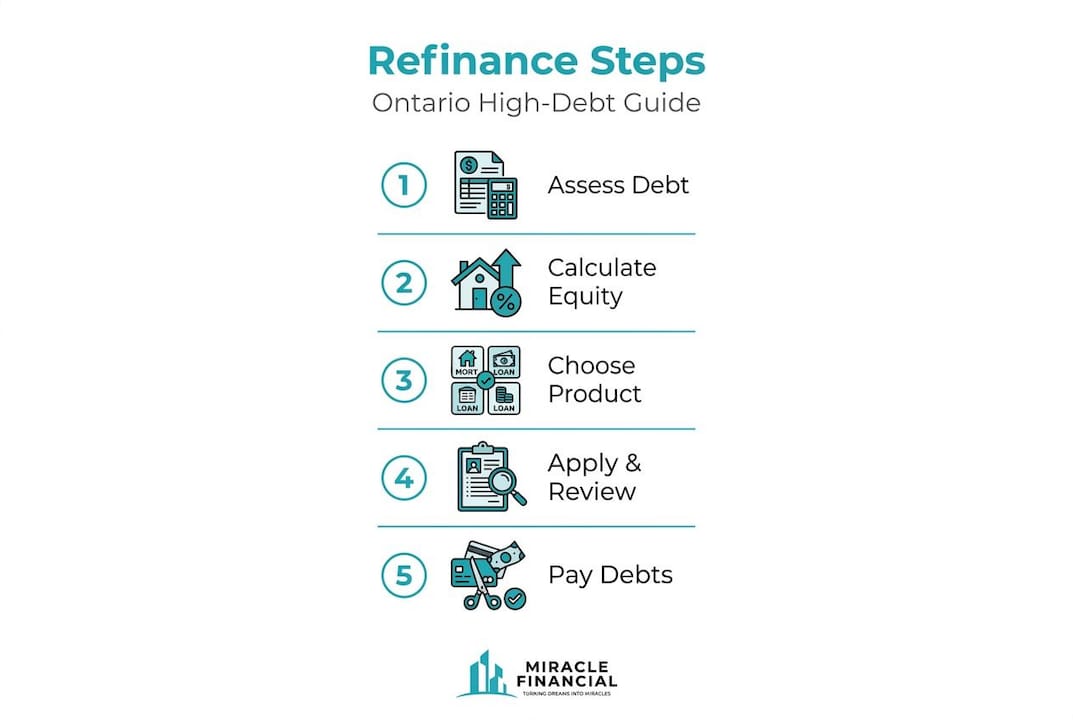
Step 1: Organise your paperwork
Before approaching any lender or broker, gather the following:
- Proof of income: Last two years of T4 slips, recent pay stubs, or if self-employed, T1 Generals and Notices of Assessment.
- Mortgage statement: Current balance, lender name, interest rate, remaining term, and any prepayment penalty estimate.
- Debt list: All credit cards, car loans, personal lines of credit, and student loans with current balances and minimum monthly payments.
- Property information: Recent purchase price or a rough estimate of current value based on comparable sales.
- Identification: Government-issued photo ID and Social Insurance Number.
Step 2: Calculate your available equity
Take your estimated home value, multiply by 0.80 (the standard maximum), then subtract your current mortgage balance. The result is your maximum available equity. If that number covers your debts with room to spare, refinancing is likely viable.
Step 3: Choose a lender tier and product
Based on your credit score, income, and equity, determine whether you are best served by a bank, credit union, alternative lender (also called a “B lender”), or private lender. The product choice (refinance, second mortgage, or HELOC) feeds from this decision.
Step 4: Work with a mortgage broker
Using a mortgage broker is especially valuable if you have been declined by a bank. Brokers access multiple lender tiers simultaneously and structure your application to highlight your strengths. They also negotiate rates and terms you cannot typically access independently.
Pro Tip: Ask your broker to provide a written breakdown of all costs, including legal fees, appraisal, lender fees, and any prepayment penalty on your existing mortgage. As noted in reporting from The Globe and Mail, refinancing involves legal fees, appraisal costs, and possible penalties. Compare these carefully to the interest savings before committing.
Step 5: Submit your application
Your broker submits the application with supporting documents. A property appraisal is usually ordered at this stage. Respond quickly to any lender questions to keep the process moving.

Step 6: Review and sign
Once approved, review the commitment letter carefully. Confirm the rate, term, prepayment privileges, and all fees. Use a real estate lawyer for closing. Costs here typically include legal fees ranging from $1,000 to $2,000 and an appraisal of $300 to $500.
Step 7: Pay off the debts immediately
The funds from your refinance should go directly to clearing the high-interest debts that motivated the decision. Do not let the funds sit in your account. Immediate payoff is the entire point of the exercise and is central to the debt consolidation mortgage guide approach.
Risks, common mistakes, and how to stay safe
Before you sign, it is crucial to understand what can go wrong and how to safeguard your finances.
“If you use a home equity loan or a home equity line of credit to consolidate your debts and then you’re unable to make your new payments, you could lose your home.”
— Financial Consumer Agency of Canada
That warning is direct and worth taking seriously. The Financial Consumer Agency of Canada is explicit that home equity products increase foreclosure risk if debt is not managed carefully after refinancing. Unsecured debts like credit cards carry no such consequence for non-payment. By rolling them into your mortgage, you are putting your home behind them.
Separately, upfront costs can erode savings if they are not carefully weighed against the interest you will save over time. A break-even analysis is essential before signing.
Common mistakes Ontario homeowners make
- Not calculating the break-even point. If your total refinancing costs are $8,000 and you save $300 per month, you need 27 months to break even. If you sell before then, you lose money.
- Accumulating new debt after refinancing. Clearing your credit cards feels like relief. Running them back up creates a worse situation than before.
- Ignoring prepayment penalties. These can reach several thousands of dollars on a fixed-rate mortgage and are often underestimated.
- Choosing the wrong lender tier. Going to a private lender when an alternative lender would have approved you costs unnecessary interest.
- Not stress-testing the new payment. Can you still afford the new mortgage if rates rise or your income dips? This is where many borrowers underestimate risk.
Understanding the full picture of debt consolidation vs refinancing is the foundation for making a confident decision. If you are still unsure whether the numbers work in your favour, reviewing the benefits of refinancing alongside the costs gives you both sides of the ledger.
What most homeowners miss about refinancing with high debt
Here is the perspective that rarely appears in guides like this one, because it is uncomfortable to say plainly: refinancing fixes your balance sheet but not your habits.
We see it regularly. A homeowner in Ontario carries $60,000 in credit card and line-of-credit debt, refinances, and feels enormous relief. Twelve months later, the cards are creeping back up. The mortgage is higher, the debts are returning, and the equity that provided the exit has been partially consumed. The math of refinancing is sound. The behaviour piece is where most outcomes are won or lost.
What successful borrowers do differently is treat the refinance as a reset, not a reward. They set up autopay for the new mortgage immediately. They cancel or significantly reduce the credit limits on the cards they just paid off. They schedule a financial review every six months to check whether spending patterns have shifted.
There is also the matter of emergency planning. One reason high debt accumulates in the first place is the absence of a financial buffer. A single unexpected expense, a car repair, a dental bill, a period of reduced income, lands on a credit card and stays there. Building even a modest emergency fund of one to two months of expenses alongside your refinancing plan changes the odds considerably. Without it, the next crisis feeds the same cycle.
The most effective use of refinancing for debt relief combines the financial mechanics of a well-structured mortgage with a clear, written plan for what comes next. That plan does not need to be elaborate. It needs to be honest and specific.
Ready for your next step? Expert help for Ontario refinancing
If you are carrying high-interest debt and wondering whether your home equity can provide a real way forward, the answer is often yes, even if a bank has already said no.

Miracle Financial works with Ontario homeowners across all credit profiles, income types, and debt situations. Whether you need to explore debt consolidation solutions that fit your current equity position, or you want clear, direct Ontario mortgage refinance advice before committing to anything, the team provides structured, practical guidance. There are no broad-brush answers here. Every file is reviewed individually, and every recommendation is based on your actual numbers. Book a consultation with a specialist and get a clear picture of what is genuinely available to you.
Frequently asked questions
What’s the maximum I can borrow with a high debt load in Ontario?
Most homeowners can borrow up to 80% of their home’s appraised value through a refinance or second mortgage, and up to 65% through a HELOC, minus your existing mortgage balance.
Can I refinance in Ontario if my bank declined my application?
Yes. Alternative lenders and private mortgage lenders evaluate applications differently from banks, and a mortgage broker can match you with the right lender tier for your specific situation.
Does refinancing always lower my total costs?
Not always. Legal fees, appraisal costs, and mortgage penalties can outweigh interest savings if you are not in the home long enough to break even, so always compare total costs before deciding. Reporting from The Globe and Mail confirms that these fees can negate interest savings in some cases.
What happens if I can’t keep up with my new mortgage after refinancing?
The Financial Consumer Agency of Canada warns that defaulting on home equity products may lead to foreclosure, which is a more severe consequence than defaulting on unsecured debt.
What paperwork should I prepare for refinancing with high debt?
Gather your income proof (T4s, pay stubs, or T1 Generals for self-employed), your most recent mortgage statement, a complete list of all debts and minimum payments, and a government-issued ID before starting the application process.
Recommended
- Save on debt: refinance your Ontario mortgage for consolidation
- Home equity loan or refinance in Ontario: best debt solution
- How to refinance with bad credit in Ontario: a homeowner’s guide
- Mortgage refinance Ontario: When it makes sense for you
- Renégocier son prêt : guide pour de meilleures conditions