
Blog
Second mortgage Ontario: How much can you borrow and at what cost


TL;DR:
- Many Ontario homeowners mistakenly believe second mortgages are only for emergencies or that they can access unlimited equity at will. Second mortgages are riskier loans with higher interest rates, limited by a typical 80% combined loan-to-value ratio based on home appraised value. Proper understanding of borrowing limits, costs, and alternatives ensures a smart financial decision that protects long-term equity and affordability.
Many Ontario homeowners assume a second mortgage is a last resort reserved for borrowers in serious financial trouble, or that they can access virtually unlimited equity whenever they need it. Neither assumption is accurate. A second mortgage is a legitimate financial tool with clearly defined borrowing limits based on your home’s appraised value and your existing mortgage balance, and understanding those limits, along with the true cost of borrowing, is what separates a smart equity decision from an expensive mistake.
Table of Contents
- Understanding second mortgages in Ontario
- How much can you borrow with a second mortgage?
- What does a second mortgage cost in Ontario?
- Qualifying for a second mortgage in Ontario
- Alternatives to second mortgages: What else can homeowners do?
- Our view: What Ontario homeowners should really know about second mortgages
- Get expert help unlocking your home equity in Ontario
- Frequently asked questions
Key Takeaways
| Point | Details |
|---|---|
| 80% equity limit | You can usually borrow up to 80 percent of your home’s appraised value minus your current mortgage balance. |
| Higher rates apply | Second mortgages cost more than first mortgages because lenders face higher risk, so expect higher interest rates. |
| Alternative options | If you don’t qualify for a second mortgage, consider refinancing, HELOCs, or reverse mortgages to access home equity. |
| Private lenders | Private lenders can approve borrowers declined by banks, but often charge higher fees and rates. |
| Get expert advice | Professional help can clarify eligibility, costs, and best strategies for using your equity in Ontario. |
Understanding second mortgages in Ontario
A second mortgage is a loan secured against your home that sits behind your primary mortgage in priority. Because it ranks second in the repayment order, any lender offering this type of financing accepts greater risk than your first mortgage lender. If you were ever to default and your property was sold, the first mortgage lender gets paid out before the second mortgage lender sees a dollar.
This risk structure is why, as the Financial Consumer Agency of Canada confirms, second mortgages carry higher rates than first mortgages. The lender’s exposure is real, and the interest rate reflects that.
Ontario homeowners typically consider second mortgage basics for several well-grounded reasons:
- Consolidating high-interest credit card debt or personal loans into one manageable payment
- Funding significant home renovations that increase property value
- Bridging a cash flow gap during a difficult period (medical costs, job transition, business investment)
- Accessing equity when a bank has declined a refinance application
- Avoiding breaking a first mortgage early and paying costly prepayment penalties
“Second mortgages are riskier because they sit behind the first mortgage on collateral, so interest rates on second mortgages are usually higher than on first mortgages.” — Financial Consumer Agency of Canada
Understanding the home equity loan types available in Ontario is the first step toward choosing a solution that fits your actual situation, not just the one that sounds most familiar.
How much can you borrow with a second mortgage?
With a clear concept of second mortgages in hand, it’s crucial to know exactly how much you can access based on your home’s value and outstanding debt. The answer revolves around one central metric: your loan-to-value ratio, commonly called LTV.
Most lenders in Ontario follow a maximum combined LTV of 80%. This means your total borrowing across all mortgages secured against the property cannot exceed 80% of your home’s current appraised value. The standard 80% limit is a well-established underwriting guideline used by institutional lenders, credit unions, and many private lenders across Canada.
The formula is straightforward:
Maximum second mortgage = (Appraised home value × 80%) minus first mortgage balance
Ontario example:
- Home appraised at $600,000
- Remaining first mortgage balance: $400,000
- 80% of $600,000 = $480,000
- Available second mortgage: $480,000 minus $400,000 = $80,000
This is a realistic scenario for many Ontario homeowners who purchased years ago and have built up meaningful equity. Use this formula as a starting point, then review the borrowing limits Ontario homeowners are typically eligible for.
Borrowing scenarios: Ontario examples
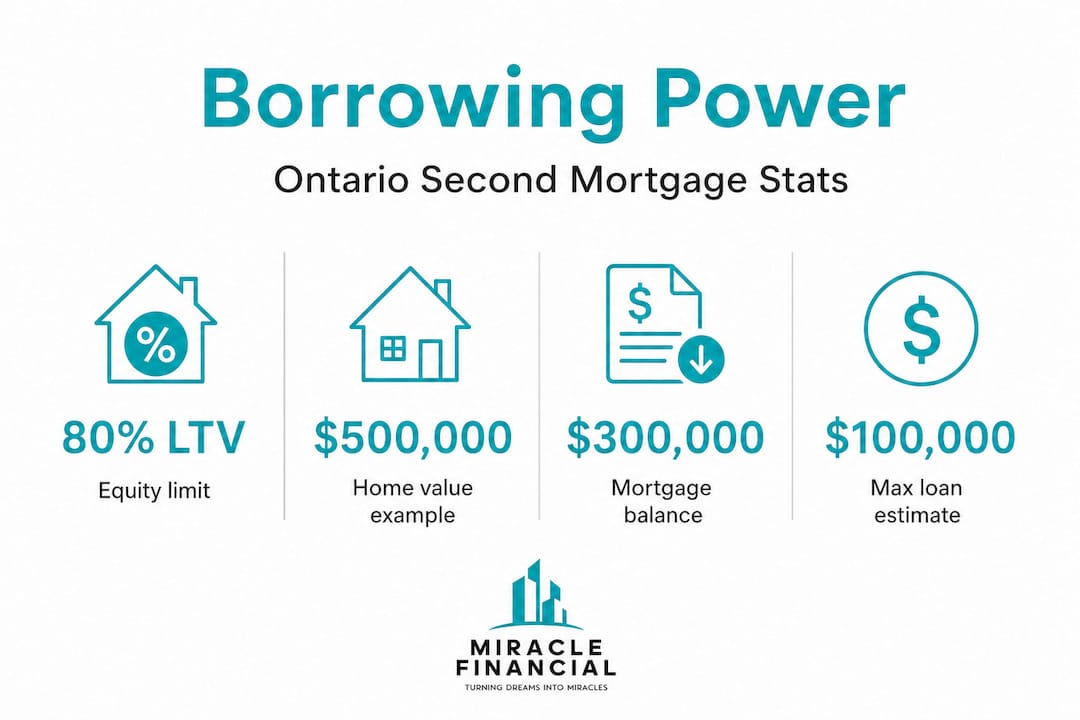
| Home value | First mortgage balance | 80% LTV limit | Max second mortgage |
|---|---|---|---|
| $500,000 | $300,000 | $400,000 | $100,000 |
| $700,000 | $500,000 | $560,000 | $60,000 |
| $900,000 | $550,000 | $720,000 | $170,000 |
| $1,200,000 | $600,000 | $960,000 | $360,000 |
As the table shows, a higher home value does not automatically mean you can access more equity. What matters is how much of the 80% ceiling has already been consumed by your first mortgage. A homeowner with a $1.2 million property and a large mortgage may access a similar second mortgage amount as one with a more modest home and less outstanding debt.
Several factors can affect the second mortgage guide calculations specific to your property:
- Property type: Single-family homes in urban Ontario markets are viewed more favourably than rural properties or condominiums, which may have lower LTV limits
- Appraisal result: If your appraisal comes in below your expected value, your available equity shrinks accordingly
- Lender policy: Private lenders may go slightly above the 80% threshold in certain situations, though this comes with meaningfully higher rates
- Rental or investment properties: These typically have more conservative LTV limits than owner-occupied homes
A professional home equity estimation before you apply helps confirm your actual position before committing to any process or paying upfront fees.
What does a second mortgage cost in Ontario?
Knowing how much you can borrow is just the start. You also need to understand the real costs involved, because second mortgages carry more expenses than many homeowners anticipate going in.

Interest rates
Since second mortgages sit behind first mortgages in priority, lenders compensate for the added risk with higher rates. In Ontario, rate ranges for second mortgages generally look like this:
| Loan type | Typical rate range (2026) |
|---|---|
| First mortgage (bank) | 4.5% to 6.0% |
| HELOC (bank) | Prime + 0.5% to 1.0% |
| Second mortgage (bank/credit union) | 7.0% to 10.0% |
| Second mortgage (alternative lender) | 9.0% to 12.0% |
| Second mortgage (private lender) | 10.0% to 16.0% |
Several mortgage rate factors influence where your rate lands: credit score, equity position, property type, income documentation, and loan term all play a role. Borrowers with strong equity but imperfect credit often find the rate sits in the middle of these ranges, not at the extreme end.
Understanding how a refinance vs second mortgage compares on total cost is important. In some cases, refinancing your first mortgage entirely and absorbing the prepayment penalty may be cheaper over the long run than layering a second mortgage on top at a higher rate.
Fees and closing costs
Typical costs beyond the interest rate include:
- Appraisal fee: $300 to $600, required by most lenders to establish current market value
- Legal fees: $1,000 to $2,500 for a real estate solicitor to register the second mortgage on title
- Lender fee: 1% to 3% of the loan amount, charged by many alternative and private lenders at closing
- Broker fee: 1% to 2% of the loan amount for arranging the financing through a brokerage
- Title insurance: Typically $150 to $400, required by most lenders to protect against title disputes
For context, Ontario cost comparisons for renovation financing show that homeowners frequently underestimate total closing costs by 20% to 30%. The same pattern applies to second mortgage financing. A loan that appears affordable based on the rate alone often looks different once all the fees are tallied.
Reviewing detailed home equity loan costs before signing anything gives you a clearer picture of the true annual cost of borrowing.
Pro Tip: Request a complete fee disclosure in writing before you agree to anything. Many lenders present the interest rate prominently but bury lender fees and legal costs in the fine print. A transparent broker will walk you through every line item at the start, not at closing when it’s too late to negotiate.
Qualifying for a second mortgage in Ontario
After learning about rates and fees, the next step is understanding whether you actually qualify, and what options exist if mainstream lenders have already said no.
What traditional lenders look for
Banks and credit unions evaluating a second mortgage application typically assess:
- Credit score: A score of 620 or higher is generally the minimum for most institutional lenders; scores above 680 improve both approval odds and rate
- Income verification: Employment letters, T4 slips, or business financials for self-employed borrowers confirm your ability to carry the additional payment
- Debt service ratios: Lenders calculate both gross debt service (GDS) and total debt service (TDS) ratios to ensure you aren’t overextended
- Available equity: The 80% LTV equity limit is the foundation of every approval decision, regardless of how strong your credit profile is
- Property marketability: Lenders want confidence that the property would sell reasonably quickly if needed
What happens when banks say no
Being declined by a bank does not close the door. Private lenders operate with considerably more flexibility because they prioritise the equity in your home over your credit history or employment status. This is particularly relevant for self-employed Ontarians who have strong assets but complex income documentation.
Qualifying for a private mortgage works differently: the lender focuses heavily on the property value and the equity available. As long as there is meaningful equity and a credible exit strategy (refinancing, selling, or renewing), most private lenders will consider the application seriously.
Understanding the difference between home equity vs refinance options also matters here, because depending on your credit profile and equity position, a refinance might be more cost effective than a second mortgage even if the upfront process feels more involved.
Pro Tip: If you’ve been declined by a bank, don’t assume your application is weak. Gather your most recent bank statements, proof of any freelance or rental income, and your most current property tax assessment before approaching an alternative or private lender. Demonstrating financial transparency often moves applications forward faster than a higher credit score alone.
Alternatives to second mortgages: What else can homeowners do?
If a second mortgage isn’t the right fit, there are other ways to access equity. Each option has a different structure, cost profile, and qualification pathway.
- HELOC (Home Equity Line of Credit): A revolving credit line secured against your home, usually offered by banks at rates close to prime. It offers flexibility since you draw and repay as needed, but qualifying requirements are strict and approval is typically limited to those with strong credit and confirmed income.
- Mortgage refinancing: Replacing your existing first mortgage with a larger one to access the equity difference. This can offer lower overall rates but may trigger prepayment penalties on your current mortgage.
- Reverse mortgage: Available to homeowners aged 55 and over, this allows you to access equity without monthly payments. The loan is repaid when the home is sold or transferred.
- Private first mortgage: In some cases where the existing first mortgage is nearly paid off, replacing it entirely with a private first mortgage can be simpler than adding a second.
As the FCAC notes, the 80% appraised value limit applies as a standard guideline across most home equity products, not just second mortgages. This means your total borrowing capacity is the same regardless of which product you choose.
“The amount you can borrow using home equity is typically limited to a maximum percentage of your home’s appraised value, across all mortgages combined.” — Financial Consumer Agency of Canada
For homeowners exploring a reverse mortgage solution or comparing all other equity loan types, the right choice depends on age, income, equity position, and how soon you need the funds. There is no universal best option, only the one that aligns with your specific financial circumstances.
Resources on custom home financing and broader real estate equity strategies can also provide useful context when evaluating how equity fits into long-term financial planning.
Our view: What Ontario homeowners should really know about second mortgages
Most homeowners approach a second mortgage with two misconceptions that work in opposite directions. Some dramatically overestimate how much they can borrow, assuming they can access the full equity they’ve built without understanding the LTV ceiling. Others underestimate how much the total borrowing will cost once fees and a higher rate are factored in over a one or two year term.
Both miscalculations are preventable. The single most consistent advice we offer is to get a professional appraisal and a full written fee disclosure before making any application decision. The vast majority of unpleasant surprises in second mortgage transactions don’t happen at approval. They happen at closing, when the final legal and lender fees land on the statement and the borrower realises the net proceeds are smaller than expected.
There’s also a timing reality that experienced mortgage professionals see repeatedly. Homeowners who explore a second mortgage before financial pressure becomes acute are in a far stronger negotiating position. When you’re managing debt from a position of stability rather than urgency, lenders respond differently and rates reflect that. Waiting until credit card balances are at their limit or collections calls have started narrows your options considerably.
The other point worth addressing directly is the perception of private lending. Being declined by a bank does not make you an undesirable borrower. It often simply means your situation doesn’t fit a rigid qualification formula that wasn’t designed for your circumstances. Private lenders filling that space do demand more thorough documentation, not less, and they expect full transparency about your financial position. Borrowers who approach private lenders with complete records and a clear plan for how they’ll exit the loan tend to get better outcomes than those who present incomplete information hoping the equity alone carries the application.
Understanding how a refinance compares to a second mortgage in your specific situation is always worth the conversation before committing to either route.
Get expert help unlocking your home equity in Ontario
If you’ve worked through the numbers and believe a second mortgage could help you manage debt, fund a renovation, or access the equity you’ve built, the next step is a conversation with an experienced mortgage broker who understands how Ontario’s lending landscape actually works.

Miracle Financial works with Ontario homeowners at every stage of the equity process, from initial assessment to approval. Whether you’re looking at an Ontario second mortgage, considering Ontario mortgage refinance options, or need structured debt consolidation advice that actually fits your income and property situation, we connect you with the right lender, at the right terms, without wasting your time. Reach out today for a no-obligation consultation and find out exactly where you stand.
Frequently asked questions
What is the maximum loan-to-value for a second mortgage in Ontario?
Most lenders cap second mortgages at 80% of appraised value, minus your current first mortgage balance, leaving you with the portion of that limit still available.
Do private lenders offer second mortgages to applicants declined by banks?
Yes, private lenders frequently approve second mortgages for borrowers that banks have declined, though the higher risk position of second mortgage lending means rates are higher than what a bank would charge.
What fees should I expect for a second mortgage in Ontario?
Expect to pay appraisal fees, legal fees, a lender fee ranging from 1% to 3% of the loan, and potentially a broker fee, all of which are typically deducted from or paid at closing.
How long does it take to get approved for a second mortgage?
Private lenders can often complete approvals within a few business days when documentation is complete, while banks and credit unions typically take two to four weeks to process a second mortgage application.
What alternatives are there if I don’t qualify for a second mortgage?
HELOCs, mortgage refinancing, and reverse mortgages all allow you to access home equity using the same 80% appraised value guideline, with different qualification requirements and cost structures depending on your age, credit profile, and how you intend to use the funds.