
Blog
Second mortgage vs private mortgage Ontario: key differences


TL;DR:
- A second mortgage is a regulated loan secured against your property, offering lower rates and amortised payments, while a private mortgage is an unregulated, equity-based loan with higher interest and interest-only repayment structures. Private mortgages are typically faster to obtain but come with higher costs and shorter terms, requiring a clear refinancing exit strategy. Ontario homeowners should assess their financial situation and future plans to choose the option that best balances cost, speed, and long-term affordability.
Many Ontario homeowners assume that a second mortgage and a private mortgage are the same thing. They are not, and that misconception can cost you thousands of dollars or lead you into terms that do not fit your situation. Understanding the second mortgage vs private mortgage Ontario key differences is not just an academic exercise. It directly affects your interest rate, your approval odds, your monthly payment structure, and your ability to exit the debt cleanly. This guide breaks down both options clearly so you can make a more informed decision about accessing your home equity for debt relief.
Table of Contents
- Key takeaways
- Second mortgage vs private mortgage Ontario: what sets them apart
- Comparing second mortgages and private mortgages directly
- Costs, risks, and benefits: choosing the right option
- How to apply for each type in Ontario
- My perspective on choosing between these two options
- How Miraclefinancial helps Ontario homeowners with both solutions
- FAQ
Key takeaways
| Point | Details |
|---|---|
| Different lender types | Second mortgages come from regulated institutions; private mortgages come from individuals or corporations overseen provincially by FSRA. |
| Approval criteria differ | Second mortgages weigh income and credit; private mortgages focus primarily on property value and available equity. |
| Cost gap is significant | Private mortgage rates can exceed 15% on second-position loans, plus lender and broker fees deducted at closing. |
| Repayment structure varies | Second mortgages use amortised schedules; private mortgages are typically interest-only with principal due at term end. |
| Exit strategy matters | Private mortgages carry short terms of one to two years, making a clear refinancing plan critical before you sign. |
Second mortgage vs private mortgage Ontario: what sets them apart
Before comparing the two directly, it helps to understand each product on its own terms. Ontario homeowners often encounter both options when banks decline their applications or when they need funds quickly, but the mechanics, costs, and risks differ considerably.
What is a second mortgage in Ontario?
A second mortgage is an additional loan secured against your property while your original mortgage remains in place. You are borrowing against the equity you have built, without disrupting your first mortgage terms. As the two main types of second mortgages, home equity loans give you a lump sum at a fixed rate, while home equity lines of credit (HELOCs) work like revolving credit you draw from as needed.
Lenders typically require you to retain 10% to 20% equity in your home after borrowing, meaning the combined loan-to-value ratio across both your first and second mortgage cannot exceed 80% to 90% of your property’s appraised value. This protects the lender while giving you structured access to your equity.
Common uses for second mortgages in Ontario include:
- Consolidating high-interest credit card or consumer debt into a single lower payment
- Funding home renovations that increase property value
- Covering medical expenses or other urgent financial needs
- Bridging a short-term cash flow gap without breaking the first mortgage
The most important risk to keep in mind is foreclosure priority. If you default, your primary mortgage lender gets paid first from the property sale proceeds, and your second mortgage lender collects only what remains. This subordinate position is why second mortgage rates are higher than first mortgage rates, though they are still generally lower than unsecured credit.
Pro Tip: If you already have strong equity and a stable income, a second mortgage from a bank or credit union will almost always be cheaper than a private loan. Get a quote from a regulated lender before pursuing private financing.
What is a private mortgage in Ontario?
A private mortgage is a loan provided by private individuals or corporations, not federally regulated banks or credit unions. In Ontario, private lenders and the brokers who place loans with them are overseen provincially by the Financial Services Regulatory Authority of Ontario (FSRA), but the approval process and cost structure are very different from what you would encounter at a bank.

The defining characteristic of private mortgage approval is that lenders base decisions primarily on the equity in your property rather than your credit score or income history. This makes private mortgages accessible to self-employed borrowers, those recovering from credit problems, or homeowners who need funds faster than a bank can process an application.
Key characteristics of private mortgages in Ontario include:
- Interest rates starting around 6% for first-position loans, and often exceeding 15% for second-position lending
- Short terms, typically one to two years, with the full principal due at the end of the term
- Interest-only monthly payments, which keep cash flow manageable but do not reduce principal
- Lender fees of 1% to 3%, plus broker fees and legal fees for both parties, deducted from proceeds at closing
For more detail on Ontario private mortgage rates, including how location and property type affect pricing, those costs add up quickly and must be factored into any comparison with a second mortgage from a regulated lender.
Pro Tip: Always ask your broker for the total effective cost of a private mortgage, including all fees deducted at closing. The stated interest rate tells only part of the story.
Comparing second mortgages and private mortgages directly
The difference between second and private mortgage products becomes clearest when you place them side by side. The table below covers the most important factors for Ontario homeowners evaluating debt relief options.
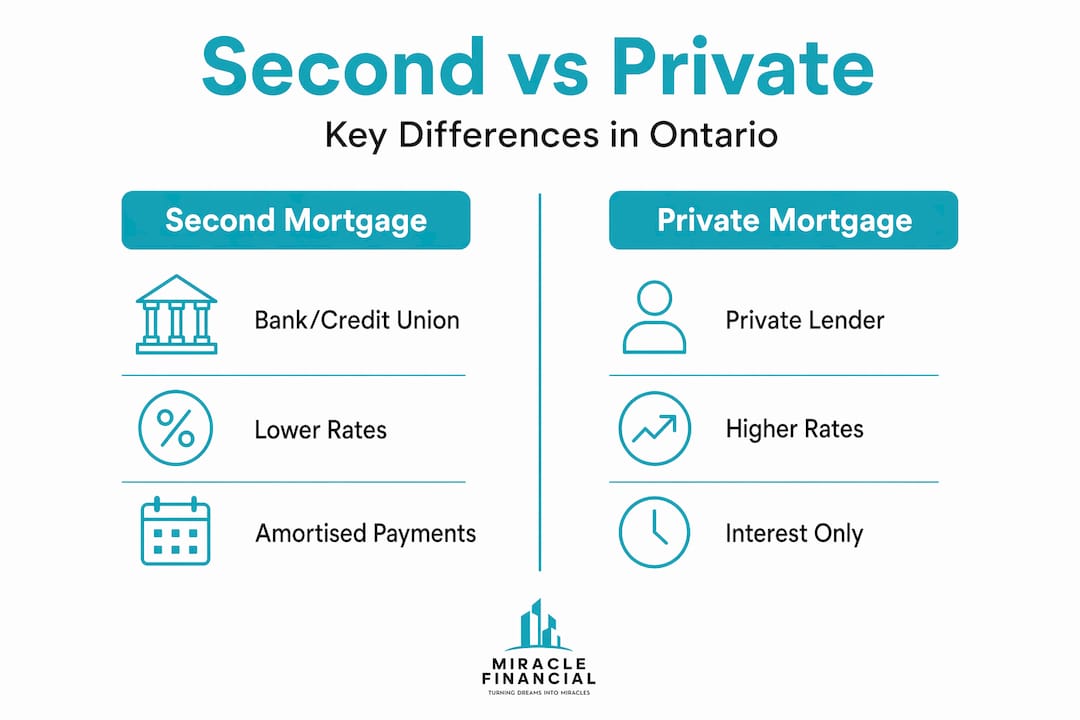
| Factor | Second mortgage | Private mortgage |
|---|---|---|
| Lender type | Bank, credit union, or regulated alternative lender | Private individual or corporation (FSRA overseen) |
| Approval focus | Income, credit score, and equity | Property equity and location, primarily |
| Typical interest rate | 6% to 9% (second position) | 10% to 15%+ (second position) |
| Repayment structure | Amortised over a set term | Interest-only, principal due at term end |
| Loan term | 1 to 5 years or more | 1 to 2 years, typically |
| Loan-to-value limit | Up to 80% to 90% combined | Commonly below 85%, varies by profile |
| Fees at closing | Generally lower | Lender, broker, and legal fees deducted |
| Approval speed | Weeks | Days to one week |
| Credit requirement | Moderate to strong | Flexible, equity-driven |
The repayment structure difference deserves particular attention. Amortised second mortgages reduce your balance with every payment, building equity over time. Private mortgage interest-only payments keep your principal unchanged for the entire term. If you renew a private mortgage multiple times because your financial situation has not improved, the long-term cost can far exceed the original benefit of faster approval.
Foreclosure priority applies in both cases. Both products are secured against your property, meaning missed payments on either can lead to legal action by the lender. If your first mortgage, second mortgage, and private mortgage are all registered against the title, the hierarchy of claims matters enormously if you face default.
The types of mortgage lenders available in Ontario range from major banks to credit unions, alternative lenders, and private individuals. Understanding where each product comes from shapes how you negotiate terms and what recourse you have if a dispute arises.
Costs, risks, and benefits: choosing the right option
The decision between a second mortgage and a private mortgage ultimately comes down to your current financial profile and what you need the funds for. Here is a practical framework for thinking it through.
- Start with your credit and income position. If your credit score is above 600 and you can document your income, a second mortgage from a regulated lender will almost always carry lower rates and fees. The second mortgage advantages in this scenario are significant: amortised payments, lower interest, and no balloon principal due at term end.
- Consider your urgency. Private mortgages can close in days. If you are facing a tax lien, a legal judgement, or an urgent debt payoff deadline, the speed of private approval may outweigh the higher cost, provided you have a clear plan to refinance before the term ends.
- Calculate the total cost, not just the rate. Private loan fees at closing include lender fees, broker commissions, and legal fees for both sides. On a $150,000 private second mortgage, that could mean $6,000 to $10,000 deducted before you receive your funds. A second mortgage from a bank typically carries far lower closing costs.
- Assess your exit strategy. This step is non-negotiable for private mortgages. What will change in your financial situation within the next one to two years that will allow you to refinance into a lower-rate product? If you cannot answer that clearly, a short-term private loan may trap you in a renewal cycle.
- Weigh the impact on your monthly cash flow. Homeowners consolidating debt with a second mortgage often find that replacing multiple high-interest payments with one lower-rate mortgage payment frees up significant cash each month. Private interest-only payments can do the same short-term, but the principal balance does not shrink.
Pro Tip: If you are consolidating credit card debt at 20% interest into a private second mortgage at 12% plus fees, the savings may be smaller than they appear once you account for closing costs and the renewal risk at term end. Run the full numbers with your broker.
How to apply for each type in Ontario
The application process for a second mortgage through a regulated lender follows a familiar path. Your broker or lender will review your credit report, verify your income through T4s or NOAs, obtain a property appraisal, and assess the combined loan-to-value ratio before submitting for approval. The process typically takes two to four weeks.
For a private mortgage in Ontario, the process is faster but requires different preparation:
- A current property appraisal or automated valuation confirming available equity
- A clear statement of how the funds will be used and how the loan will be repaid at term end
- Title search confirming no unexpected encumbrances or liens
- Signed mortgage commitment from the private lender, reviewed by your own legal counsel
- Legal fees paid for both parties at closing, typically deducted from loan proceeds
Working with a licensed mortgage broker for either product is not just practical, it is protective. FSRA-licensed brokers must disclose all fees, represent your interests, and follow clear suitability standards. Approaching private lenders directly without a broker increases your exposure to unfavourable terms and gaps in legal protection.
My perspective on choosing between these two options
In my experience working with Ontario homeowners under financial pressure, the most expensive mistake I see is treating a private mortgage as a long-term solution rather than a short-term bridge. The rate alone should not be the deciding factor. The question that matters most is: what happens at renewal?
I have seen clients enter a private second mortgage with excellent intentions, only to find that their financial situation had not improved enough twelve months later to qualify for a conventional refinance. The lender renews, charges new fees, and the cycle continues. What started as a $120,000 loan at 13% costs tens of thousands more in total than a second mortgage at 7% would have, even accounting for the slower approval process.
That said, private mortgages genuinely solve real problems. When a client has been declined by every bank and credit union, when a foreclosure notice has arrived, or when a tax debt is compounding daily, a private mortgage closes the gap quickly. The product is not the problem. The risk is entering it without a realistic refinancing plan or a broker who will hold you accountable to that plan.
My honest advice: if you qualify for a regulated second mortgage, use it. If you do not qualify yet, use a private mortgage as a bridge and start working on what needs to change, whether that is your credit score, your income documentation, or your debt-to-income ratio, so that your next renewal is into something better.
— Miracle
How Miraclefinancial helps Ontario homeowners with both solutions
If you are weighing a second mortgage against a private lending solution, Miraclefinancial works with regulated banks, credit unions, alternative lenders, and private lenders across Ontario to find the right fit for your actual financial situation. Not a generic product. Not a rushed approval that costs you more than it saves.
Whether you need mortgage refinancing to consolidate high-interest debt, a second mortgage to access equity, or an urgent private mortgage when the bank has said no, Miraclefinancial structures solutions around transparent terms, clear exit strategies, and fees you will understand before you sign. Book a consultation to get a clear picture of what you qualify for and what each option will actually cost you.
FAQ
What is the main difference between a second and private mortgage?
A second mortgage is an additional loan secured by your home from a regulated lender such as a bank or credit union, while a private mortgage comes from an individual or corporation overseen by FSRA Ontario. The key differences are in approval criteria, interest rates, repayment structure, and total cost.
Can a private mortgage be a second mortgage?
Yes. A private mortgage can be registered in either first or second position on your property title. Private second mortgages are common for homeowners who already have a primary mortgage and cannot qualify for a second mortgage from a bank. Rates for private second-position loans are typically higher than first-position private loans.
What are the second mortgage advantages over private lending?
Second mortgages from regulated lenders generally offer lower interest rates, amortised repayment schedules that reduce your balance over time, lower closing costs, and longer terms. These advantages make them a more cost-effective option for homeowners who meet standard income and credit requirements.
How quickly can I access funds through a private mortgage in Ontario?
Private mortgage approvals can close within a few days to one week, compared to two to four weeks for a conventional second mortgage. This speed is one of the main reasons Ontario homeowners choose private lending, particularly when facing urgent financial situations.
Do I need a broker to get a private mortgage in Ontario?
Working with an FSRA-licensed mortgage broker is strongly recommended for private mortgages in Ontario. Brokers must disclose all fees, follow suitability standards, and can access multiple private lenders to find competitive terms. Going directly to a private lender without representation increases your risk of signing unfavourable or unclear terms.