
Blog
Self-Employed Mortgages: Complete Guide for Ontario


Over one in six Canadians is self-employed, yet securing a mortgage remains one of the toughest financial challenges for entrepreneurs in Ontario. Lenders often view self-employed income as unpredictable, which means the process feels much more complicated than it does for traditional employees. Understanding the unique requirements for self-employed mortgages can help you avoid common pitfalls and increase your chances of approval while keeping your business—and your homeownership goals—on track.
Table of Contents
- Defining Self-Employed Mortgages In Ontario
- Eligibility Requirements And Income Verification
- Types Of Lenders For Self-Employed Borrowers
- Step-By-Step Mortgage Approval Process
- Common Challenges And Mistakes To Avoid
- Comparing Self-Employed And Traditional Mortgages
Key Takeaways
| Point | Details |
|---|---|
| Self-Employed Mortgage Essentials | These mortgages require specific income documentation beyond typical pay stubs, including tax returns and financial statements. |
| Eligibility Criteria | Applicants need at least two years of self-employment history, a good credit score, and comprehensive financial records for verification. |
| Lender Options | Self-employed individuals can choose from traditional banks, credit unions, and alternative lenders, each offering varying degrees of flexibility in approval. |
| Approval Process Understanding | The mortgage approval process involves careful documentation preparation and income verification, making strategic financial planning essential for self-employed borrowers. |
Defining Self-Employed Mortgages in Ontario
A self-employed mortgage represents a specialized lending product designed specifically for entrepreneurs, freelancers, and independent contractors who do not receive traditional T4 employment income. Unlike standard mortgages, these financial instruments recognize the unique income verification challenges faced by self-employed professionals in Ontario. Self-Employment Mortgage Solutions require a more nuanced approach to documenting income and assessing borrower reliability.
For self-employed individuals in Ontario, mortgage qualification involves demonstrating consistent and verifiable income through alternative documentation. Lenders typically require additional proof beyond standard pay stubs, such as:
- Personal and business tax returns from the past 2-3 years
- Notice of Assessment (NOA) from Canada Revenue Agency
- Financial statements showing business revenue and expenses
- Contracts or invoices indicating stable income streams
- Corporate tax returns for incorporated business owners
The key difference between traditional and self-employed mortgages lies in income calculation. While employees have straightforward income verification, self-employed professionals must prove their earnings through comprehensive financial documentation. Lenders often use an average of the past two or three years’ net income, which can sometimes result in a lower qualifying income compared to gross employment earnings.
Navigating these complex requirements demands strategic financial planning. Ontario Mortgage Broker Role Guide highlights the importance of working with mortgage professionals who understand the intricacies of self-employed lending. These experts can help structure your financial presentation to maximize mortgage approval potential, potentially leveraging alternative income verification methods and understanding specialized lending programs designed for entrepreneurial Ontarians.
Eligibility Requirements and Income Verification
Self-employed mortgage eligibility in Ontario involves a comprehensive assessment of financial stability and income consistency. According to Canada Guaranty, borrowers must typically demonstrate a minimum of two years of self-employment history with no recent credit delinquencies. This requirement ensures lenders can assess the reliability and sustainability of the applicant’s income stream.
Key eligibility criteria for self-employed mortgage applicants include:
- Minimum two years of documented self-employment
- Consistent and verifiable income history
- Credit score typically above 680
- Proof of business registration
- Comprehensive tax documentation
- Demonstrable financial stability
Income verification for self-employed professionals goes beyond traditional employment documentation. Lenders will scrutinize multiple financial indicators to validate income reliability.
 This typically involves analyzing:
- Personal and corporate tax returns
- Detailed business financial statements
- Consistent revenue streams
- Profit and loss statements
- Business bank account records
Specialized mortgage programs recognize the unique financial situations of entrepreneurs. While traditional employment offers straightforward income verification, self-employed applicants must provide more comprehensive financial documentation. Self-Employment Mortgage Solutions can help navigate these complex requirements, offering tailored strategies to improve mortgage approval chances for Ontario’s vibrant self-employed community.
Types of Lenders for Self-Employed Borrowers
Self-employed professionals in Ontario have multiple mortgage lending options, each with unique approaches to income verification and approval processes. According to Smith Proulx, these options typically include traditional banks, credit unions, and alternative lenders, each offering distinct advantages for entrepreneurial borrowers.
The primary types of lenders for self-employed mortgage seekers include:
- Traditional Banks: Typically most conservative, requiring:
- Minimum two years of consistent self-employment history
- Detailed tax documentation
- Strong credit profile
- Credit Unions: Often more flexible with approval criteria
- May consider less than two years of self-employment
- More personalized lending approach
- Alternative Lenders: Specialize in Business for Self mortgages
- More lenient income verification
- Flexible credit score requirements
Wowa highlights an important distinction among lender types: traditional lenders typically calculate mortgage eligibility using net income from tax returns, which can be challenging for self-employed individuals with significant business expense deductions. In contrast, B lenders and private mortgage lenders often offer stated income mortgages, considering gross income and providing more flexible verification methods.
Private Mortgages represent an additional avenue for self-employed borrowers who might struggle with traditional lending requirements. These specialized lending solutions can bridge the gap between strict bank protocols and the unique financial situations of entrepreneurs, offering tailored mortgage products that recognize the complex income structures of self-employed professionals in Ontario.
Step-by-Step Mortgage Approval Process
The mortgage approval process for self-employed professionals in Ontario requires meticulous preparation and strategic financial documentation. According to Meridian Credit Union, lenders assess income stability by carefully examining financial records, with a particular focus on averaging income from the past two years.
The comprehensive mortgage approval process for self-employed borrowers involves several critical steps:
-
Pre-Qualification
- Initial credit score assessment
- Preliminary income evaluation
- Basic financial health screening
-
Documentation Preparation
- Compile personal tax returns
- Gather business financial statements
- Collect Notices of Assessment
- Prepare profit and loss statements
-
Income Verification
- Demonstrate consistent revenue streams
- Provide two to three years of income documentation
- Verify business registration and stability
-
Credit and Financial Review
- Comprehensive credit report analysis
- Debt-to-income ratio calculation
- Assessment of financial stability
Self-employed borrowers must recognize that lenders scrutinize their financial history more intensively than traditional employees. A strong credit profile, consistent income documentation, and clear business financials are crucial. First Mortgage Ontario emphasizes the importance of presenting a comprehensive financial narrative that demonstrates reliability and income stability.
Navigating this process requires patience and meticulous preparation. While the requirements might seem challenging, self-employed professionals can improve their mortgage approval chances by maintaining organized financial records, maintaining a strong credit score, and working closely with mortgage professionals who understand the unique financial landscape of entrepreneurial income.
Common Challenges and Mistakes to Avoid
Self-employed mortgage applicants face unique hurdles that can significantly impact their loan approval chances. According to Meridian Credit Union, maintaining thorough financial records and ensuring up-to-date tax filings are critical to overcoming the income verification challenges inherent in self-employment.
Most common pitfalls for self-employed mortgage seekers include:
-
Inconsistent Income Documentation
- Irregular income reporting
- Incomplete financial statements
- Lack of clear revenue tracking
-
Credit Profile Issues
- Overlooking credit score maintenance
- High debt-to-income ratios
- Unexplained credit fluctuations
-
Tax and Accounting Mistakes
- Aggressive tax deductions
- Incomplete business expense documentation
- Discrepancies between reported income
Self-employed professionals often inadvertently complicate their mortgage application by minimizing taxable income for tax purposes, which simultaneously reduces their mortgage qualification potential. Self-Employment Mortgage Solutions recommend maintaining a balanced approach that demonstrates both financial efficiency and income stability.
To mitigate these challenges, self-employed borrowers should proactively manage their financial presentation. This includes maintaining consistent income documentation, avoiding sudden large business expenses before mortgage applications, keeping personal and business finances separate, and working closely with mortgage professionals who understand the nuanced financial landscape of entrepreneurial income.
Comparing Self-Employed and Traditional Mortgages
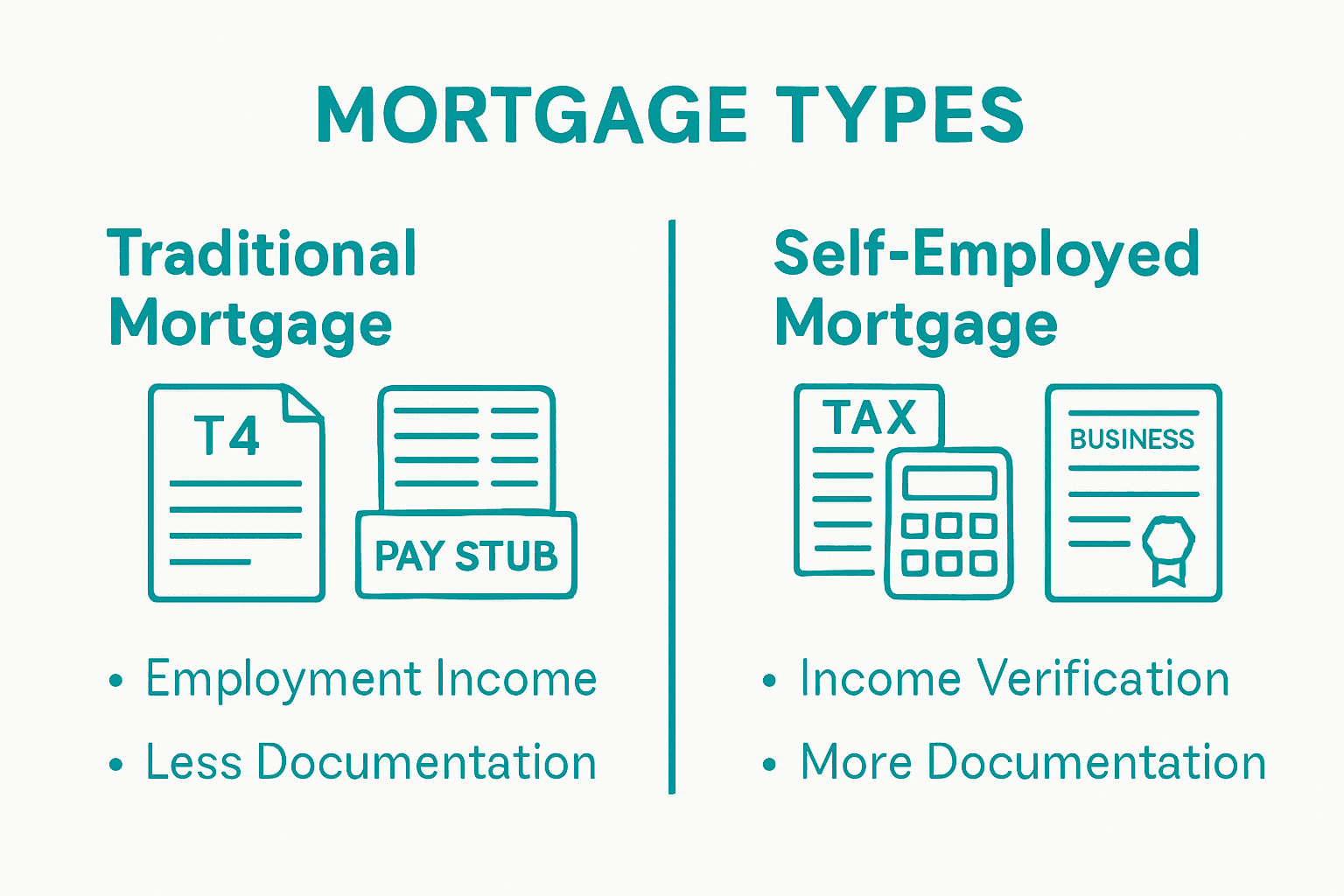
Self-employed mortgage applicants face a distinctly different lending landscape compared to traditional employees.
According to Wowa, the fundamental difference lies in income verification methods, with self-employed borrowers encountering more complex qualification processes that reflect their unique financial structures.
Key differences between self-employed and traditional mortgages include:
Income Verification
-
Traditional Mortgages
- Fixed, predictable salary documentation
- T4 slips as primary income proof
- Straightforward employment verification
-
Self-Employed Mortgages
- Multiple income documentation sources
- Tax returns and financial statements
- Averaged income from multiple years
Financial Risk Assessment
-
Lending Criteria
- Higher scrutiny of income stability
- Potentially larger down payment requirements
- More comprehensive financial documentation
-
Interest Rates and Terms
- Potentially higher interest rates
- More conservative lending approach
- Stricter qualification standards
Self-employed professionals must recognize that lenders perceive their income as inherently more variable and potentially less reliable. Second Mortgage Ontario suggests that entrepreneurs can improve their mortgage prospects by maintaining meticulous financial records, demonstrating consistent revenue streams, and presenting a comprehensive financial narrative that highlights income stability.
Navigating these differences requires strategic financial planning.
 Self-employed borrowers should anticipate more rigorous documentation requirements, be prepared to provide extensive financial history, and work closely with mortgage professionals who understand the nuanced financial landscape of entrepreneurial income verification.
Empower Your Self-Employed Mortgage Journey with Expert Support
Navigating the complex landscape of self-employed mortgages in Ontario can feel overwhelming. From proving your income with detailed tax documents to managing lender expectations around credit scores and business financials every step requires careful planning. If you are seeking a personalized approach that understands your unique challenges as a self-employed professional Miracle Financial is here to help. Our Ontario mortgage broker specialists focus on creating tailored strategies that maximize your mortgage approval potential while simplifying the process.

Take control of your self-employed mortgage application today with a trusted Vaughan mortgage broker who knows the ins and outs of income verification and lender requirements. Visit Miracle Financial now at https://www.miraclefinancial.ca/ to start your journey toward financial confidence. Explore our Self-Employment Mortgage Solutions and connect with experts dedicated to helping you secure the best possible mortgage tailored to your entrepreneurial income and lifestyle.
Frequently Asked Questions
What is a self-employed mortgage?
A self-employed mortgage is a specialized lending product for individuals who earn income through self-employment, freelancers, and independent contractors. It requires unique income verification methods different from traditional employment mortgages.
What documentation is needed for a self-employed mortgage?
Self-employed borrowers typically need to provide personal and business tax returns, Notices of Assessment from the Canada Revenue Agency, financial statements, contracts or invoices, and corporate tax returns for incorporated business owners.
How is income calculated for self-employed mortgages?
Income for self-employed mortgages is usually calculated by averaging the past two to three years’ net income as reported on tax returns, which can result in a lower qualifying income compared to gross employment earnings.
What are the main challenges facing self-employed mortgage applicants?
Common challenges include inconsistent income documentation, maintaining a strong credit profile, and managing aggressive tax deductions, which may complicate income verification and affect mortgage approval chances.
Recommended
- Ontario self-employed mortgage guide
- Self-Employment Mortgage Solutions – Miracle Financial
- How to Choose Private Mortgage Lender in Ontario: Step-by-Step – Miracle Financial
- Blog – Miracle Financial
- Complete Guide to Ontario Mortgage Brokers’ Role – Miracle Financial
- How to Vet a Real Estate Agent in Oakland County – Homes2MoveYou.com