
Blog
Step by Step Mortgage Application Guide for Ontarians


Over 60 percent of Canadian home buyers say the mortgage process feels confusing and stressful at some point. With every document and decision carrying major financial consequences, understanding each step is crucial. This guide breaks down the essential stages of getting approved for a Canadian mortgage, equipping you with straightforward tips and insights to help you feel confident from your first application to final approval.
Table of Contents
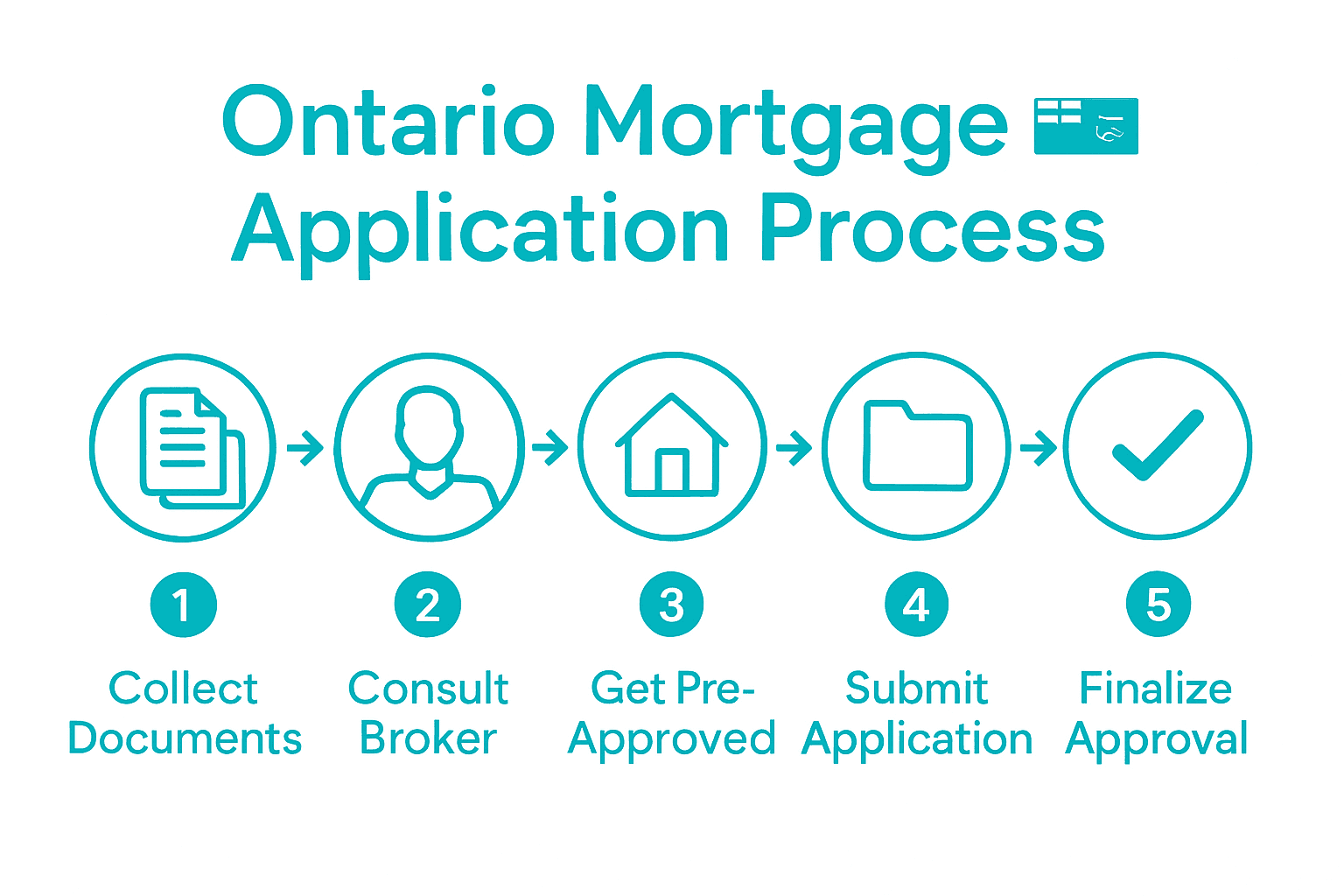
- Step 1: Gather Required Financial Documents
- Step 2: Assess Your Mortgage Options With An Ontario Broker
- Step 3: Complete The Pre-Approval Process
- Step 4: Submit Your Full Mortgage Application
- Step 5: Verify Approval And Finalize Your Mortgage
Quick Summary
| Key Point | Explanation |
|---|---|
| 1. Gather Financial Documents | Collect pay stubs, letters of employment, bank statements, and tax returns to prove financial stability. |
| 2. Work with a Licensed Broker | A mortgage broker can simplify the application process by matching you with suitable lenders and products. |
| 3. Complete Mortgage Pre-Approval | Submit documentation for a detailed review to secure a tentative mortgage amount and lock in interest rates. |
| 4. Submit Full Mortgage Application | Provide comprehensive personal and financial details for final verification to obtain a mortgage commitment. |
| 5. Review Mortgage Agreement | Carefully examine all terms and conditions of the mortgage agreement before finalizing, ensuring alignment with your expectations. |
Step 1: Gather Required Financial Documents
Preparing your financial documents is a crucial first step in the mortgage application process. By carefully organizing your paperwork, you will streamline your application and demonstrate financial readiness to potential lenders.
Start by collecting key documents that validate your financial stability. These typically include recent pay stubs from the past two to three months, which provide proof of steady income. If you are self employed, you will need additional documentation such as notice of assessments from the Canada Revenue Agency, business financial statements, and two years of personal tax returns. For employed applicants, a letter of employment confirming your job status, salary, and length of employment is essential. Your documents should also include bank statements showing account balances, savings, and investment records.
Financial institutions will require comprehensive proof of your assets and liabilities. This means gathering recent statements for all bank accounts, investment portfolios, retirement savings, and any outstanding debts including credit card statements, student loan documents, car loan agreements, and existing mortgage information. The Financial Services Regulatory Authority of Ontario recommends providing detailed information about your current financial obligations.
Pro tip: Create digital and physical copies of all documents. Scan and save electronic versions in a secure folder, while keeping original physical documents in a safe, organized file. This approach ensures you have backup copies and can quickly provide additional information if requested by your mortgage broker.
Here’s a quick comparison of required financial documents for employed versus self-employed applicants:
| Applicant Type | Key Income Documents | Additional Required Proofs | Special Notes |
|---|---|---|---|
| Employed | Recent pay stubs, employment letter | Bank and investment statements | Employment letter confirms salary and tenure |
| Self-Employed | CRA notice of assessments, business financials, 2 years tax returns | Business financial statements, proof of income | Lenders may ask for more detail on income stability |
Step 2: Assess Your Mortgage Options with an Ontario Broker
Understanding the role of a mortgage broker can significantly simplify your mortgage application journey. In Ontario, working with a licensed mortgage broker provides access to a wide range of lending options that might not be immediately apparent when approaching banks directly.
Mortgage brokers are financial professionals who specialize in connecting borrowers with appropriate lending solutions. The Financial Services Regulatory Authority of Ontario recommends consulting licensed mortgage professionals who can help you navigate the complex landscape of mortgage products. These experts will assess your unique financial situation, credit profile, and homeownership goals to recommend mortgage options that align with your specific needs. They can provide insights into fixed versus variable rates, different term lengths, and help you understand the nuanced differences between conventional and high ratio mortgages.
During your consultation, expect a comprehensive review of your financial health. A skilled mortgage broker will evaluate your income, credit score, existing debts, and future financial projections. They will help you understand how much you can realistically afford, explain the pros and cons of various mortgage structures, and potentially save you money by finding competitive rates from multiple lenders. The Government of Canada suggests comparing options from different lenders to ensure you make an informed decision.
Pro tip: Prepare a list of questions about mortgage terms, potential penalties, and flexibility before meeting your broker. This proactive approach ensures you extract maximum value from your consultation and thoroughly understand the mortgage options available to you.
Step 3: Complete the Pre-Approval Process
Understanding the mortgage pre-approval process represents a critical milestone in your home buying journey. This step transforms your homeownership dreams from abstract possibilities into concrete financial planning.
The Government of Canada explains that mortgage pre-approval involves a comprehensive assessment of your financial landscape. During this process, lenders will conduct a detailed review of your income, credit history, existing debts, and overall financial stability. They will determine the maximum mortgage amount you qualify for and potentially lock in an interest rate for a specified period. This evaluation typically requires submitting detailed documentation including proof of income, employment verification, tax returns, and a comprehensive credit check.
Prepare for your pre-approval by gathering all necessary financial documents in advance. This includes recent pay stubs, employment letters, tax notices, bank statements, and a detailed list of your assets and liabilities. The more organised and transparent you are during this process, the smoother your application will proceed. Some lenders may even provide an immediate online response, with rate holds extending up to 120 days. Remember that a pre-approval is not a final mortgage commitment but provides a strong indication of your borrowing potential and helps you understand your budget when house hunting.
Pro tip: Request pre-approval from multiple lenders to compare rates and terms, but do so within a short timeframe to minimize impact on your credit score. Most credit scoring models treat multiple mortgage inquiries within a 14 to 45 day period as a single credit inquiry.
Step 4: Submit Your Full Mortgage Application
Navigating the mortgage process steps in Ontario marks a pivotal moment in your home financing journey. Submitting your full mortgage application transforms your pre-approval into a concrete path toward homeownership.

The Financial Services Regulatory Authority of Ontario details that completing the mortgage application involves providing comprehensive personal and financial information. This stage requires meticulous documentation and transparency. You will need to submit updated financial records including recent pay stubs, tax returns, bank statements, and detailed information about your employment, assets, and existing debts. Lenders will conduct an extensive verification process, examining your financial stability, income consistency, and ability to manage mortgage payments.
Expect a thorough review that goes beyond your initial pre-approval. Lenders will reassess your financial situation, potentially requesting additional documentation or clarification on specific financial details. The Government of Canada notes that this stage may involve further verification by the lender, including a comprehensive credit check and an assessment of the property you intend to purchase. Be prepared to provide explanations for any significant financial changes since your pre-approval and ensure all information is accurate and up to date.
Pro tip: Create a dedicated folder with digital and physical copies of all submitted documents. Maintain clear communication with your mortgage broker and respond promptly to any requests for additional information to prevent delays in your application process.
Step 5: Verify Approval and Finalize Your Mortgage
Reaching the final stage of your mortgage journey requires careful attention and strategic review. Understanding the nuanced details of property purchase in Ontario will help you navigate this critical phase with confidence.
The Financial Services Regulatory Authority of Ontario advises carefully reviewing your mortgage commitment. This involves meticulously examining every detail of the mortgage agreement including interest rates, payment schedules, term lengths, and any specific conditions or clauses. Pay special attention to potential prepayment penalties, renewal terms, and any variable rate conditions that might impact your long term financial planning. Verify that all personal information is accurate and that the mortgage terms align precisely with what was discussed during your initial consultations.
The Government of Canada recommends confirming all mortgage details before signing the final agreement. This includes double checking the approved mortgage amount, verifying the interest rate lock in period, and understanding any conditional approvals that might require additional documentation. If any terms seem unclear or differ from your initial expectations, do not hesitate to seek clarification from your mortgage broker or lender. Request a comprehensive breakdown of all fees, potential future adjustments, and the exact process for future modifications or renewals.
Pro tip: Create a detailed checklist of all mortgage agreement terms and cross reference it with your original pre-approval documents to ensure complete alignment and prevent any unexpected surprises.
The following table summarizes five essential mortgage approval steps and their main lender focus:
| Step | Main Lender Focus | Key Outcome |
|---|---|---|
| Gathering documents | Verifying financial stability | Complete and accurate application |
| Mortgage assessment with broker | Matching products to needs | Recommended loan options |
| Securing pre-approval | Assessing creditworthiness | Tentative mortgage limit set |
| Submitting full application | Final documentation check | Confirmation of ability to repay |
| Verifying and finalizing mortgage | Ensuring agreement accuracy | Legally binding mortgage contract |
Unlock Your Path to Mortgage Success with Miracle Financial
Navigating the complex steps of mortgage application in Ontario can feel overwhelming. Gathering detailed financial documents, understanding pre-approval, and finalizing mortgage terms all require expert guidance. If you are a first-time homebuyer or self-employed, these challenges grow even more demanding. Miracle Financial, your trusted Ontario mortgage broker, specializes in simplifying every stage of the mortgage process. Our Vaughan-based team offers personalized strategies including refinance mortgage Ontario solutions and assistance for low credit score mortgage applicants to ensure your financial goals become reality.

Take control of your home financing journey today and experience fast approvals combined with transparent communication. Whether you are seeking debt consolidation mortgage support or expert advice on investment property financing, Miracle Financial is your ideal partner. Visit us now at https://www.miraclefinancial.ca/ to get started on securing a mortgage tailored to your unique needs.
Frequently Asked Questions
What documents do I need to gather for my mortgage application in Ontario?
To complete your mortgage application, you will need recent pay stubs, employment verification letters, bank statements, tax returns, and documentation of assets and liabilities. Start by organizing these documents into digital and physical copies to ensure a smooth application process.
How can a mortgage broker help me during my mortgage application process?
A mortgage broker can assess your unique financial situation and recommend suitable mortgage options based on your credit profile and homeownership goals. Schedule a consultation with a licensed broker to explore different products and potentially secure better interest rates from multiple lenders.
What steps are involved in obtaining a mortgage pre-approval?
The mortgage pre-approval process begins with a detailed review of your financial documents and credit history by a lender. Prepare all necessary documents such as pay stubs and tax returns, and apply for pre-approval to understand your borrowing potential before house hunting.
What should I expect when submitting my full mortgage application?
When submitting your full mortgage application, expect to provide comprehensive personal and financial information. Ensure all documents are current and accurate, and be ready for a thorough verification process, which may include additional requests for clarification from the lender.
How do I verify approval and finalize my mortgage agreement?
To finalize your mortgage, thoroughly review the mortgage commitment for details like interest rates and payment schedules. Confirm that all terms match your expectations and seek clarification on any unclear points before signing the agreement to avoid future surprises.
Recommended
- Mortgage Process Steps Ontario – From Pre-Approval to Funding
- 7 Ways to Improve Mortgage Approval in Ontario
- Step-by-Step Guide to Private Mortgage Lenders in Ontario – Miracle Financial
- Mortgage Terminology Explained: Complete Ontario Guide – Miracle Financial
- Mortgage Application Checklist: Step-by-Step for Kiwis