
Blog
Types of Mortgage Lenders Ontario – Choosing the Right Fit


More than one in five Canadian homebuyers turn to alternative mortgage lenders each year, highlighting just how complex the search for the right financing partner has become. With so many options available across Ontario, from major banks to private lenders, finding a trusted source can feel complicated. Whether you are a first-time buyer or refinancing, this guide breaks down what every Canadian needs to know about the different types of mortgage lenders available and how to choose with confidence.
Table of Contents
- Defining Mortgage Lenders in Ontario
- Traditional Banks and Credit Unions Compared
- Private and Alternative Mortgage Lenders Explained
- Key Criteria for Choosing a Lender
- Risks, Costs, and Common Mistakes
Key Takeaways
| Point | Details |
|---|---|
| Understand Lender Types | Familiarise yourself with the different types of mortgage lenders, including major banks, credit unions, private lenders, and alternative lenders, as each has unique criteria and offerings. |
| Evaluate Financial Terms | Focus on key financial terms such as interest rates, mortgage terms, and prepayment options to ensure alignment with your long-term financial goals. |
| Consider Flexibility | Assess not just the initial rates, but also the lender’s adaptability to future financial changes, such as refinancing options and payment adjustments. |
| Acknowledge Hidden Costs | Stay aware of potential hidden costs like legal fees or prepayment penalties, which can significantly affect your overall borrowing costs. |
Defining Mortgage Lenders in Ontario
Mortgage lenders represent financial institutions and professionals responsible for providing home financing solutions across Ontario. These entities range from traditional banks to credit unions, private lenders, and mortgage brokers, each offering unique lending approaches tailored to different borrower needs. Understanding the landscape of mortgage lending options helps homebuyers make informed financing decisions.
In the Ontario mortgage market, primary lenders typically include major chartered banks, which provide standard mortgage products with consistent qualification criteria. These institutions often require robust credit histories, stable income documentation, and meet strict lending guidelines. Credit unions represent another significant category, offering more flexible lending terms and often serving local community members with personalized mortgage solutions.
Private mortgage lenders emerge as a critical alternative for borrowers who might not qualify through traditional banking channels. These lenders specialize in providing financing for individuals with unique income situations, lower credit scores, or complex financial backgrounds. They often bridge financing gaps by offering more adaptable lending criteria, though usually at higher interest rates to compensate for increased risk.
Pro Tip: Research Multiple Options: Before selecting a mortgage lender, compare at least three different institutions to understand their unique terms, interest rates, and qualification requirements. This approach helps you secure the most favourable financing arrangement for your specific financial circumstances.
Pro Tip: Evaluate Flexibility: Consider not just the initial interest rate, but the lender’s willingness to accommodate future financial changes, such as potential refinancing or payment adjustment options.
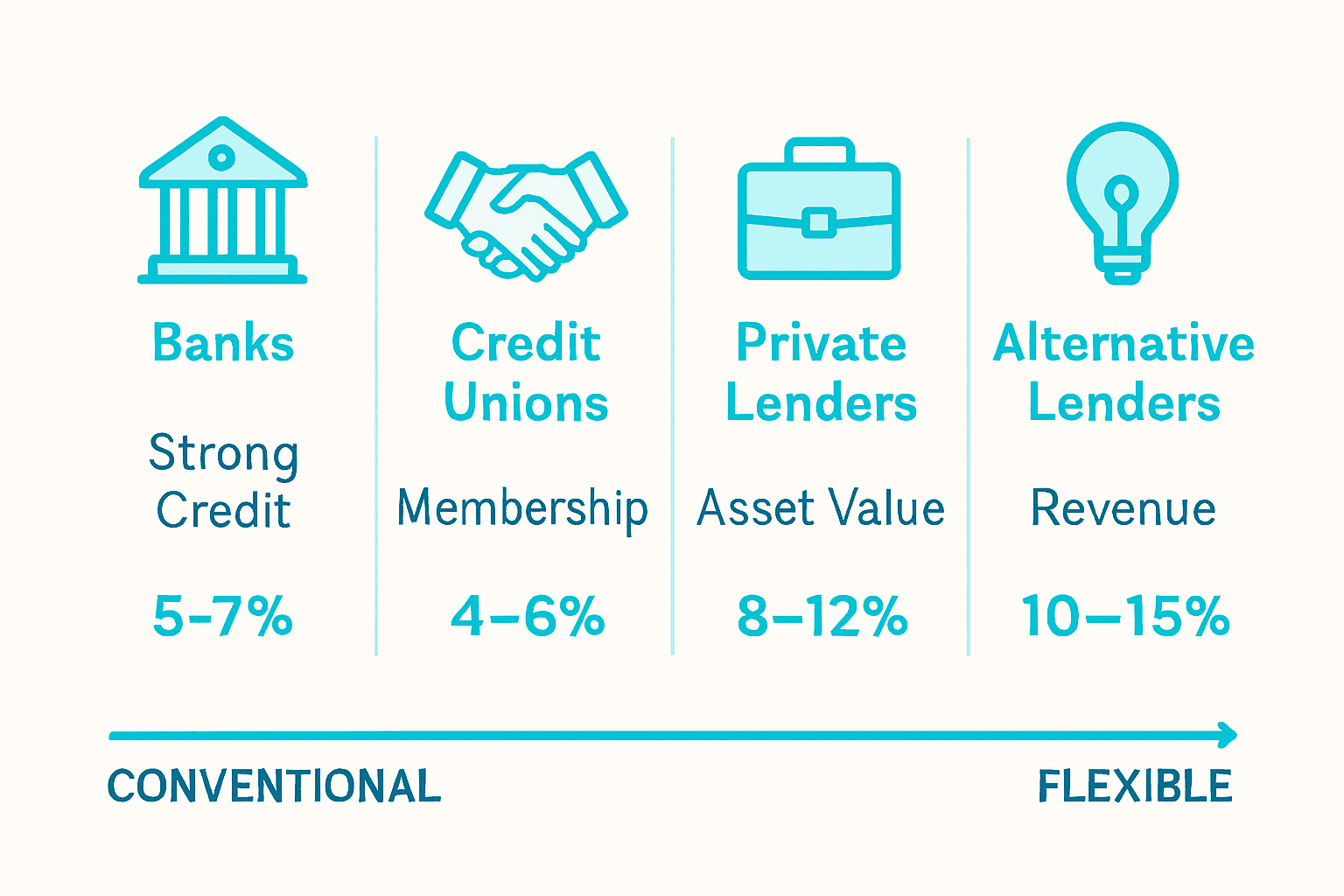
Here’s a snapshot comparing different types of mortgage lenders in Ontario:
| Lender Type | Typical Borrower Profile | Lending Criteria Focus | Common Interest Rate Range |
|---|---|---|---|
| Major Banks | Salaried, strong credit, stable income | Credit score, income, history | Lowest, but strict qualification |
| Credit Unions | Local residents, self-employed, flexible | Member-focused, holistic | Competitive, may be lower locally |
| Private Lenders | Low credit, unique income, new Canadians | Property value, equity | Highest, flexible terms |
| Alternative Lenders | Complex finances, short-term needs | Broader financial assessment | Mid-to-high, product dependent |
Traditional Banks and Credit Unions Compared
Traditional banks and credit unions represent two distinct mortgage lending models in Ontario, each with unique characteristics and approaches to home financing. Recent market data reveals a significant disparity, with major chartered banks holding 72.99% of mortgages compared to credit unions’ 12.85% market share. This landscape demonstrates the dominance of traditional banking institutions while highlighting the specialized role of credit unions.
Major chartered banks like RBC, TD, Scotiabank, and CIBC offer standardized mortgage products with consistent qualification criteria. These institutions typically provide comprehensive financial services, extensive branch networks, and sophisticated digital platforms. Their mortgage offerings often include competitive interest rates, multiple term options, and integrated banking solutions. However, their strict lending guidelines can make qualification challenging for borrowers with non-traditional income streams or complex financial backgrounds.

Credit unions, by contrast, operate as member-owned financial cooperatives with a more localized and personalized approach. They frequently offer more flexible lending criteria, potentially more competitive interest rates, and a community-focused service model. Credit unions excel at understanding regional economic nuances and can provide more tailored mortgage solutions for self-employed professionals, small business owners, and individuals with unique financial circumstances.
Pro Tip: Comparative Shopping Strategy: Don’t limit your mortgage search to one institution type. Request detailed quotes from both major banks and local credit unions to identify the most advantageous terms for your specific financial profile and homeownership goals.
Pro Tip: Relationship Advantage: Consider your existing banking relationships and potential member benefits when exploring mortgage options, as some institutions offer preferential rates or terms for long-standing customers.
Private and Alternative Mortgage Lenders Explained
Recent regulatory data reveals a significant shift in Ontario’s mortgage landscape, with private mortgage lenders gaining substantial market presence, particularly in the Greater Toronto Area and Central Region. These alternative lending institutions have emerged as critical financial solutions for borrowers who cannot secure traditional bank financing, accounting for 18.1% and 17.0% of total mortgages in their respective regions during 2023.
Private mortgage lenders represent financial institutions or individual investors specializing in providing mortgage financing outside conventional banking systems. These lenders typically focus on property value and potential equity rather than strict income verification or credit score requirements. They offer more flexible lending criteria, making them attractive for self-employed professionals, individuals with complex income structures, or those experiencing temporary financial challenges.
Alternative mortgage lenders differ from traditional banks by offering more personalized and adaptable lending approaches. They often consider a broader range of factors when evaluating mortgage applications, including property potential, future earning capacity, and overall financial trajectory. These lenders may provide shorter-term financing options, bridge loans, and more innovative lending solutions that address unique borrower circumstances not typically accommodated by mainstream financial institutions.
Pro Tip: Risk Assessment Strategy: Before engaging with a private or alternative mortgage lender, thoroughly evaluate their interest rates, fees, and repayment terms. Conduct comprehensive research and consider consulting a mortgage professional to understand the long-term financial implications of alternative lending options.
Pro Tip: Documentation Preparation: Compile a comprehensive financial portfolio including property details, income verification, and future financial projections to improve your chances of securing favourable terms with alternative lending sources.
Key Criteria for Choosing a Lender
Selecting the right mortgage lender requires carefully evaluating multiple factors that align with your unique financial goals. Official guidance from financial experts emphasizes the importance of comprehensive assessment beyond simple interest rates, ensuring your mortgage strategy supports long-term financial stability.
Financial Terms and Conditions represent the most critical evaluation criteria when choosing a mortgage lender. Key considerations include interest rates, mortgage term lengths, prepayment options, and penalty structures. Fixed-rate mortgages offer predictability, while variable-rate options provide potential cost savings during periods of declining interest rates. Borrowers should meticulously compare penalty clauses, especially regarding early mortgage termination or refinancing, as these can significantly impact overall financial flexibility.
Beyond numerical metrics, a lender’s reputation, customer service quality, and responsiveness play pivotal roles in the mortgage selection process. Evaluate the institution’s track record in handling unique financial situations, digital service capabilities, and transparency in communication. Some lenders specialize in specific borrower profiles, such as self-employed professionals, first-time homebuyers, or individuals with complex income structures, making alignment with your personal financial circumstances crucial.
Pro Tip: Comprehensive Comparison Strategy: Request detailed written quotes from multiple lenders, comparing not just interest rates but total borrowing costs, including fees, penalties, and potential future adjustment expenses.
Pro Tip**: Documentation Readiness: Prepare a comprehensive financial portfolio including income verification, credit history, and future financial projections before engaging with potential mortgage lenders to streamline the application process.
Risks, Costs, and Common Mistakes
Mortgage experts warn that understanding the potential risks and pitfalls is crucial when navigating Ontario’s complex mortgage landscape. Homebuyers frequently underestimate the long-term financial implications of their mortgage choices, leading to significant unexpected expenses and constraints that can impact their overall financial health.
Hidden Costs represent one of the most significant risks in mortgage selection. Beyond the headline interest rate, borrowers must carefully evaluate additional expenses such as mortgage insurance, legal fees, property transfer taxes, and potential penalty charges for early contract termination. Private and alternative lenders often include more complex fee structures that can substantially increase the total borrowing cost. Variable-rate mortgages, while initially attractive, carry inherent risks of unexpected payment increases if interest rates fluctuate, potentially creating significant financial strain.
The table below summarizes key risks and hidden costs when choosing a mortgage in Ontario:
| Risk/Cost Factor | Description | Why It Matters |
|---|---|---|
| Prepayment Penalties | Fees for early repayment or refinancing | Can limit flexibility and savings |
| Mortgage Insurance | Protection for lender on low-down payment | Increases total borrowing cost |
| Variable Interest | Fluctuates with market rates | Higher payment risk over time |
| Legal & Admin Fees | Closing, legal, and administration charges | Adds upfront and ongoing expenses |
Common mistakes in mortgage selection frequently stem from inadequate financial preparation and limited understanding of contract terms. Borrowers often overlook critical details like prepayment restrictions, refinancing penalties, and the long-term implications of their chosen mortgage structure. Some individuals commit to mortgages without fully assessing their future income stability, potential career changes, or unexpected financial challenges that could impact their ability to maintain consistent payments.
Pro Tip: Risk Mitigation Strategy: Create a comprehensive financial stress test by calculating your mortgage payments at 2-3% higher interest rates to ensure you can maintain payments during potential economic fluctuations.
Pro Tip**: Financial Buffer Planning: Maintain an emergency fund equivalent to 3-6 months of mortgage payments to provide a safety net against unexpected income disruptions or financial challenges.
Find the Perfect Mortgage Match with Expert Guidance
Choosing the right mortgage lender in Ontario can feel overwhelming when facing strict qualification criteria or unique financial circumstances. Whether you struggle with low credit scores, self-employment income verification, or need access to private mortgage lenders, understanding your options is key to securing a mortgage that fits your life and long-term goals. The challenges of navigating varied lender requirements, hidden costs, and flexible terms demand personalized support from trusted professionals.
At Miracle Financial, our Vaughan mortgage broker experts specialise in connecting you with the right mortgage solutions tailored to your unique situation. From refinance mortgage Ontario services to debt consolidation mortgage plans and access to private mortgage lenders Ontario, we combine modern technology with deep industry knowledge to overcome the common roadblocks homebuyers face. Miracle Financial offers transparent communication and fast approvals, ensuring you feel confident every step of the way.

Start your journey with an Ontario mortgage broker who understands the complexity of mortgage types and lender profiles. Visit Miracle Financial now to discover how our team can simplify your mortgage search and secure solutions that match your financial goals. Don’t wait until rising rates complicate your options – take control of your home financing today.
Frequently Asked Questions
What are the different types of mortgage lenders in Ontario?
The main types of mortgage lenders in Ontario include major banks, credit unions, private lenders, and alternative lenders. Each type offers unique financing options tailored to different borrower needs and financial situations.
How do major banks differ from credit unions in terms of mortgage lending?
Major banks typically provide standardized mortgage products with strict qualification criteria, while credit unions offer more personalized, flexible lending options and competitive rates, often focusing on local community members.
What advantages do private lenders offer to borrowers?
Private lenders specialize in providing financing for borrowers who may not qualify through traditional banks. They often have more flexible lending criteria based on property value and equity, making them suitable for those with lower credit scores or unique income situations.
What should I consider when comparing mortgage lenders?
When comparing mortgage lenders, evaluate key factors such as interest rates, loan terms, prepayment options, penalties, and the lender’s reputation for customer service. It’s essential to assess both quantitative and qualitative aspects to find a lender that suits your financial goals.
Recommended
- How to Choose Private Mortgage Lender in Ontario: Step-by-Step – Miracle Financial
- Mortgage Terminology Explained: Complete Ontario Guide – Miracle Financial
- Private Mortgage Lenders in Ontario – Impact on Home Financing
- 7 Examples of Private Lenders Every Ontarian Should Know – Miracle Financial
- Mortgage Insurance in Canada – How It Impacts Homebuyers – Craigburn Capital