
Blog
Understand mortgage break costs in Ontario before refinancing


TL;DR:
- Refinancing in Ontario can incur substantial costs due to prepayment penalties and additional fees, often erasing potential savings.
- Understanding the calculation methods for IRD and other charges, requesting written quotes, and exploring strategies like blend-and-extend can help homeowners minimize these expenses.
Refinancing your mortgage to consolidate high-interest debt sounds like a straightforward path to financial relief, but many Ontario homeowners are caught off guard by how much it actually costs to break their mortgage mid-term. The penalties and fees can easily run into thousands of dollars, sometimes erasing the very savings the refinance was supposed to deliver. Before you act on the assumption that a new, lower rate will solve everything, understanding exactly what breaking your mortgage contract will cost you is not just useful — it is essential.
Table of Contents
- Why breaking your mortgage triggers penalties
- How Ontario prepayment penalties are calculated
- Extra fees and charges: What else to expect
- How to get an accurate penalty quote — and why it matters
- Hidden strategies: When blend-and-extend or renewal can reduce break cost
- Our perspective: The real cost calculation most homeowners miss
- Ready to understand your real refinancing costs?
- Frequently asked questions
Key Takeaways
| Point | Details |
|---|---|
| Penalties aren’t just 3 months’ interest | Fixed-rate mortgages often use IRD, which can raise break costs significantly. |
| Extra fees add up fast | Expect administration, appraisal, and discharge fees when breaking your Ontario mortgage. |
| Written quotes prevent surprises | Always request a lender’s written penalty quote to know your true break cost. |
| Renewal and blend options may help | Strategies like blend-and-extend can lower penalty costs, but still involve certain fees. |
| Compare against refinance savings | Balance total penalty costs against long-term savings before deciding to break your mortgage. |
Why breaking your mortgage triggers penalties
With a clear introduction, let’s address why lenders impose penalties and who faces them.
Lenders are in the business of lending money at agreed rates for agreed terms. When you break a mortgage early, the lender loses the interest income they expected to receive over the remaining term. To protect that income, they charge a prepayment penalty. It is not punitive in the arbitrary sense; it is a contractual mechanism designed to compensate the lender for the financial shortfall your early exit creates.
Not all mortgages carry the same penalty risk. The distinction between open and closed mortgages is fundamental here.
- Open mortgages allow you to break the contract or make large lump-sum payments at any time without penalty. The trade-off is that open mortgages typically carry a higher interest rate than closed mortgages.
- Closed mortgages lock you into specific repayment terms. Breaking a closed mortgage early triggers a prepayment penalty, and most Canadians hold closed mortgages because of their lower rates.
Breaking a closed mortgage mid-term for a refinance typically triggers a prepayment penalty, plus additional charges such as administration, appraisal, and mortgage discharge fees. This means the total cost of breaking your mortgage is almost always higher than the penalty amount alone.
“The stakes are high when you break a mortgage mid-term. Even a seemingly small difference between your contract rate and today’s rates can produce a surprisingly large penalty, particularly for fixed-rate mortgages.”
The penalty also varies depending on whether your mortgage is fixed vs variable, how much remains on your balance, and how far you are from your renewal date. A homeowner with three years left on a fixed-rate term faces a very different cost landscape than one with six months remaining.
How Ontario prepayment penalties are calculated
After understanding why penalties exist, let’s break down exactly how they’re calculated for different mortgage types.
The formula used to calculate your penalty depends primarily on whether your mortgage is variable or fixed rate. The common prepayment penalty rules are straightforward in principle: for variable-rate mortgages it is usually three months of interest, and for fixed-rate mortgages it is the higher of three months’ interest or the Interest Rate Differential (IRD).

Variable vs. fixed penalty comparison
| Mortgage type | Penalty method | Typical cost range |
|---|---|---|
| Variable rate | Three months’ interest | $1,500 to $4,000 |
| Fixed rate (low IRD) | Three months’ interest | $1,500 to $4,000 |
| Fixed rate (high IRD) | Interest Rate Differential | $5,000 to $20,000+ |
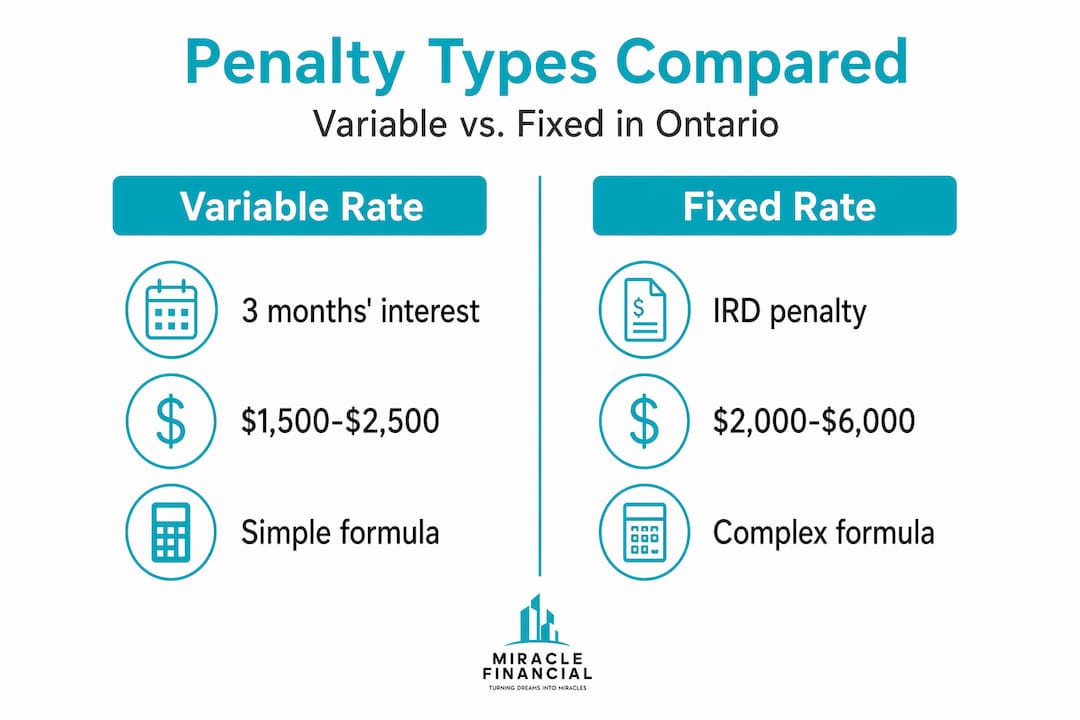
The IRD is where things get expensive. The IRD is calculated by comparing the interest that would have been paid under your existing contract versus the interest calculated at current rates for a term matching your remaining term. If you locked in at 5.5% and current rates for a similar remaining term are 4.5%, the lender is compensated for that 1% difference across your remaining balance and time.
Here is a step-by-step breakdown of how lenders typically calculate an IRD penalty:
- Determine your remaining balance at the time of the break.
- Identify your contract rate, which is the rate you are currently paying on the mortgage.
- Identify the current comparison rate, which is the lender’s rate for a term closest to your remaining term.
- Calculate the rate difference by subtracting the current comparison rate from your contract rate.
- Multiply the rate difference by your remaining balance to find the annual dollar difference.
- Multiply that figure by the number of remaining years to arrive at the total IRD penalty.
For example, if you have $400,000 remaining, two years left, a contract rate of 5.5%, and a current comparable rate of 4.0%, your rate difference is 1.5%. The annual dollar difference is $6,000, and over two years the IRD penalty would be approximately $12,000. This is why fixed-rate breaks mid-term can be so costly.
Statistic callout: IRD penalties on fixed-rate mortgages in Canada have been known to exceed $20,000 on larger balances, particularly when contract rates are significantly above current market rates.
It is also worth noting that lenders may reference posted rates or discounted rates when computing the IRD, and this distinction can meaningfully affect the final penalty. Understanding the legal requirements around Ontario mortgages is part of being a well-prepared borrower.
Extra fees and charges: What else to expect
Penalty formulas are just the start. Homeowners should know about every fee that can add to the cost.
Many Ontario homeowners focus exclusively on the prepayment penalty and overlook the additional fees that stack on top. The total cost of breaking your mortgage and completing a refinance includes several layers of charges beyond the penalty itself. Understanding these from the outset helps you make an accurate cost-benefit assessment.
Typical fees associated with breaking a mortgage
| Fee type | Typical range | Purpose |
|---|---|---|
| Administration fee | $150 to $500 | Lender processing of early break |
| Appraisal fee | $300 to $600 | Property valuation for new mortgage |
| Mortgage discharge fee | $200 to $400 | Removing existing mortgage from title |
| Reinvestment fee | $100 to $500 | Compensating lender for reinvesting funds |
| Legal/notary fees | $800 to $1,500 | Title transfer and documentation |
Here is what each of these fees actually covers:
- Administration fee: Charged by your existing lender to process the early termination of your mortgage contract. This covers the internal work involved in closing your file.
- Appraisal fee: Your new lender will need an independent appraisal to confirm the current market value of your property before approving a refinanced mortgage.
- Mortgage discharge fee: Paid to remove the existing mortgage lien from your property’s title, a legal requirement when switching lenders or restructuring your mortgage.
- Reinvestment fee: This compensates the lender for the administrative and financial cost of deploying your repaid funds into new loans at what may be a lower current rate.
- Legal or notary fees: Any refinancing transaction requires legal documentation and may involve renewal strategies in Ontario that add to the paperwork and associated costs.
Altogether, these additional fees can add $1,500 to $3,500 or more on top of your prepayment penalty. On a refinance designed to save money, that is a significant drag on your first-year savings.
Pro Tip: Always request an itemised written quote from your lender before agreeing to break your mortgage. Ask specifically for every fee involved, not just the penalty, so you can calculate your true break-even timeline with the new lower rate.
How to get an accurate penalty quote — and why it matters
With all fees and penalty formulas described, let’s dive into getting precise quotes to avoid guesswork.
Obtaining a penalty quote sounds simple, but the reality is more nuanced. Ontario homeowners should request a written penalty quote from their lender because the penalty depends on your remaining balance and prevailing rate assumptions at the time, and lenders may use different methodology (posted vs discounted rate inputs) for IRD calculations. A verbal estimate over the phone is not sufficient because rates shift daily, and the methodology used can produce very different results.
Here is how to approach obtaining a reliable penalty quote:
- Request the quote in writing. A written quote documents the lender’s calculation at a specific point in time and gives you something to reference when making your refinancing decision.
- Ask which rate the lender uses for IRD. Some lenders use their posted rates, while others use the discounted rate you actually received. Using the posted rate inflates the IRD and results in a higher penalty.
- Confirm the remaining balance being used. The balance used in the calculation should reflect any prepayments you have already made or plan to make before the break date.
- Clarify the comparison term. Ask what remaining term the lender is comparing your rate against, as this affects the current rate figure used in the IRD.
- Request the full fee schedule. As noted in the previous section, penalties are only part of the picture. The written quote should include all associated fees.
Understanding how to navigate the mortgage renewal process in Ontario can also help you identify whether waiting until renewal makes more financial sense than breaking your mortgage now.
Additionally, be aware that notarising loan documents in Ontario may be required depending on the lender and the nature of the refinancing transaction. These legal costs should be factored into your overall calculation.
Pro Tip: If you are comparing two different lenders or refinancing scenarios, request penalty quotes from both your current lender and the new lender on the same day. Rate fluctuations can change the IRD penalty from one week to the next, so timing matters.
Hidden strategies: When blend-and-extend or renewal can reduce break cost
Accurate quotes set the stage for clever strategies — here’s how to potentially cut your penalty.
Before committing to breaking your mortgage outright, it is worth exploring whether alternative strategies could reduce or eliminate the penalty entirely. Two options that Ontario homeowners should ask their lenders about are blend-and-extend and early renewal.
FCAC notes that there can be renewal options such as “blend-and-extend” that may avoid a full prepayment penalty in some scenarios, potentially reducing break costs, though these options may involve administrative fees of their own.
“A blend-and-extend arrangement combines your existing contract rate with the new, lower market rate, resulting in a blended rate applied to a new extended term. You get a lower rate without paying the full IRD penalty, but the blended rate will be higher than the current market rate.”
Here is how to pursue these strategies effectively:
- Contact your existing lender first. Ask directly whether a blend-and-extend option is available given your current contract terms and the remaining time on your mortgage.
- Request the blended rate calculation in writing. The lender should provide you with the exact blended rate, the new term length, and any applicable fees.
- Compare the total cost of blend-and-extend against a full break. Sometimes the blended rate saves you more over the new term than breaking and refinancing at a lower rate, once penalties are factored in.
- Explore waiting until renewal. If your mortgage term ends within the next six to twelve months, it may cost less to wait and refinance at renewal with no penalty. Understanding the renewal workflow for Ontario homeowners can help you time this decision precisely.
- Ask about early renewal options. Some lenders allow early renewal without triggering a full prepayment penalty, especially within 90 to 180 days of your renewal date.
Pro Tip: Blend-and-extend is not always the better deal. Run the full numbers for both scenarios before deciding. A mortgage broker can perform this analysis quickly and often identify options your current lender may not proactively offer you.
Our perspective: The real cost calculation most homeowners miss
Most homeowners approaching a refinance ask the right first question: “What is the penalty?” But there is a more important question that rarely gets asked early enough: “How long will it take for the savings from refinancing to cover the total cost of breaking?”
This is the break-even analysis, and it is the actual decision-making tool that determines whether refinancing makes financial sense right now or should be deferred. If your total break cost including penalty, discharge, appraisal, legal, and administration fees amounts to $15,000, and your monthly savings from the new rate are $400, your break-even point is 37.5 months. If you plan to sell, move, or refinance again before then, you will have lost money.
The homeowners who benefit most from refinancing are those who have a long runway ahead on their current property, enough equity to absorb the costs into the new mortgage, and a genuine rate or debt consolidation benefit that outpaces the break cost within a reasonable timeframe. For high-interest debt consolidation, the calculus can still favour breaking the mortgage even with a large penalty, because consumer debt at 19% to 23% interest is simply more destructive than any prepayment penalty over time.
Where homeowners get hurt is in acting quickly under pressure without running the numbers. The clarity that comes from understanding every cost, from the IRD to the discharge fee, is what separates a refinance that works from one that creates a new financial problem.
Ready to understand your real refinancing costs?
Navigating mortgage break costs in Ontario involves more variables than most homeowners realise, from IRD calculations that shift with interest rates to stacked fees that quietly add thousands to the total. At Miracle Financial, we work with Ontario homeowners every day to break down these numbers clearly so that the decision to refinance is grounded in accurate, complete information, not assumptions.

Whether you are dealing with high-interest credit card debt, considering debt consolidation, or simply exploring whether refinancing makes sense right now, our team of experienced mortgage brokers will walk you through a full cost analysis before you commit to anything. We work with banks, credit unions, alternative lenders, and private lenders across Ontario to find the right path for your specific situation. Reach out to Miracle Financial to get a clear picture of your real refinancing costs today.
Frequently asked questions
How much are typical refinance penalties in Ontario?
Fixed-rate penalties can run into thousands of dollars due to the IRD calculation, while variable-rate mortgages are usually charged three months’ interest, which is considerably lower.
What fees, besides the standard penalty, will I pay to break my mortgage?
Breaking a closed mortgage typically triggers a prepayment penalty plus administration, appraisal, and discharge fees, which can collectively add $1,500 to $3,500 or more to the total cost.
Can I negotiate my prepayment penalty or avoid it altogether?
Some lenders offer options like blend-and-extend or early renewal; FCAC notes these options may reduce or avoid a full prepayment penalty, though administrative fees may still apply.
How does the interest rate differential (IRD) penalty work?
The IRD is calculated by comparing the interest you would have paid under your contract against interest at current rates for a term matching your remaining term, and the difference becomes your penalty.
Should I always request a written penalty quote before refinancing?
Yes, because penalty quotes vary based on remaining balance, current rates, and lender methodology, and a written quote ensures full cost transparency before you commit.