
Blog
What is a blanket mortgage? ontario investor guide


TL;DR:
- A blanket mortgage is a single loan secured by multiple properties, simplifying payments and reducing closing costs for investors. However, the risk of cross-collateralization means default can lead to foreclosure on all assets, and strict eligibility criteria apply. It is best suited for experienced investors with strong equity, stable income, and clear exit strategies.
A blanket mortgage is defined as a single loan secured by two or more properties, with all properties serving as collateral under one financing arrangement. The industry also refers to this product as a blanket loan. Real estate developers, house flippers, and investors holding residential or commercial portfolios use blanket mortgages to consolidate payments and reduce closing costs across multiple assets. For Ontario homeowners exploring debt consolidation or investors building a property portfolio, understanding how this financing tool works can mean the difference between a manageable loan structure and an unnecessarily complex web of individual mortgages.
How does a blanket mortgage work?
A blanket mortgage operates as one loan covering multiple properties, with one monthly payment replacing the separate payments you would otherwise make on each individual mortgage. The lender registers a charge against every property in the arrangement, meaning the entire portfolio secures the debt.
The mechanics work in four stages:
- Loan origination. You apply for a single blanket loan covering all properties you wish to include. The lender assesses the combined value of the portfolio, your creditworthiness, and your experience managing investment properties before approving the loan amount.
- Collateral registration. The lender registers a charge on each property. This is called cross-collateralisation. It means every property in the portfolio backs the full loan balance, not just its proportional share.
- Monthly payments. You make one payment covering the entire loan. This simplifies cash flow management considerably, particularly for investors holding five or more properties.
- Property release. When you sell or refinance an individual property, the partial release clause allows you to remove that property from the loan without paying off the entire balance. The release price is a pre-negotiated figure, typically a percentage of the property’s appraised value or sale price.
The release clause is the most misunderstood feature of a blanket loan. Without a negotiated release clause, selling one property requires paying off the entire loan, which effectively locks you into holding the full portfolio. Always confirm the release clause terms before signing.
Most blanket mortgages also carry balloon payment structures, meaning the full remaining balance becomes due at the end of a shorter term, often three to seven years. You must either refinance or sell properties before that date.

Pro Tip: Ask your lender to define the release price formula in writing before you close. A vague formula can result in a release price far higher than you anticipated, making it difficult to exit individual properties profitably.
What are the benefits and risks of a blanket mortgage?
The primary advantage of a blanket mortgage is reducing administrative burden. One set of closing costs and one monthly payment replaces the separate paperwork, legal fees, and payment schedules you would manage across multiple individual loans. For investors scaling a portfolio in Ontario, that efficiency translates directly into time and money saved.
Key benefits include:
- Simplified payments. One monthly payment covers all properties, reducing the risk of missed payments on individual loans.
- Lower closing costs. Paying legal, appraisal, and administrative fees once instead of multiple times reduces upfront costs significantly.
- Portfolio flexibility. The release clause allows you to sell properties individually and redeploy capital without triggering a full loan payoff.
- Easier portfolio growth. Adding properties to an existing blanket loan is often simpler than applying for new individual mortgages each time.
The risks are equally significant and deserve careful consideration before you proceed.
Cross-collateralisation is the defining risk of a blanket mortgage. Default on one property can lead to foreclosure on all properties in the arrangement. Lenders hold the legal right to pursue any or all assets in the portfolio if payments are missed. This risk profile is fundamentally different from holding separate mortgages, where a problem with one property does not automatically threaten the others.
Additional risks include:
- Higher down payments. Lenders typically require larger down payments than conventional residential mortgages, reflecting the increased complexity and risk of the arrangement.
- Balloon payment pressure. When the term ends, you must refinance or sell. If property values have declined or credit conditions have tightened, refinancing may be difficult.
- Remaining coverage test failures. After releasing a property, lenders require the remaining portfolio to still meet loan-to-value or debt coverage ratios. If the remaining properties fall short, the lender may deny the release or require a paydown. Many investors overlook this requirement and find themselves unable to sell properties as planned.
Pro Tip: Model your portfolio’s loan-to-value ratio after each planned sale before you commit to a blanket loan. If releasing your most valuable property would breach the coverage test, you may need to restructure the deal or negotiate different release terms upfront.
Blanket mortgage vs. traditional mortgage: which fits your situation?
Understanding the differences between a blanket loan and a traditional mortgage helps you choose the right structure for your financial goals. The table below compares the two options across the criteria that matter most to Ontario investors and homeowners.
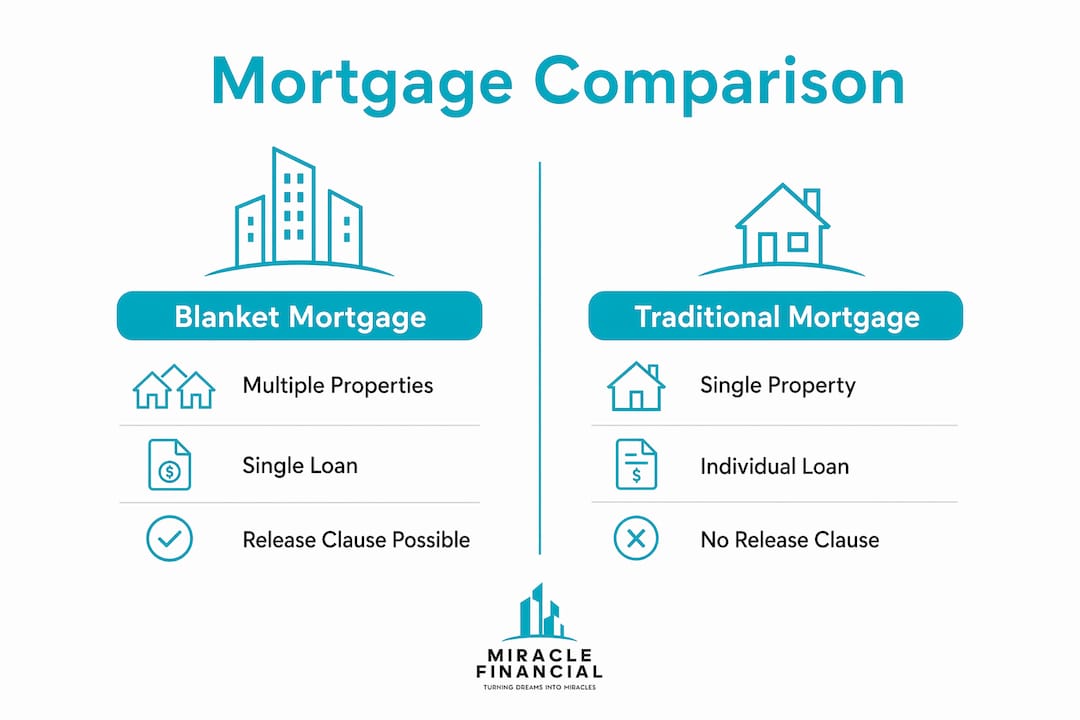
| Feature | Blanket Mortgage | Traditional Mortgage |
|---|---|---|
| Number of properties | Two or more | One |
| Monthly payments | One combined payment | Separate payment per property |
| Closing costs | One set of fees | Fees per property |
| Collateral | All properties cross-collateralised | Individual property only |
| Down payment | Higher, typically 25–35% | Typically 5–20% |
| Release of individual property | Possible with release clause | Not applicable |
| Eligibility | Experienced investors, higher credit | Broader eligibility |
| Balloon payment risk | Common | Less common |
| Best suited for | Portfolio investors, developers | Owner-occupiers, single-property buyers |
A traditional mortgage suits most owner-occupiers and first-time buyers in Ontario. A blanket loan makes sense when you own or plan to acquire multiple properties and want to consolidate financing under one structure. Ontario mortgage trends in 2025 show tighter lending conditions at major banks, which means blanket loans are increasingly arranged through alternative lenders and private lenders rather than the Big Five.
For investors who do not qualify for a blanket loan but need flexible multi-property financing, private mortgages and second mortgage options offer alternative structures worth comparing.
Who qualifies for a blanket mortgage in ontario?
Blanket mortgages carry stricter eligibility requirements than conventional loans. Lenders design these products for experienced investors and businesses, not first-time buyers or homeowners with limited real estate experience.
Typical requirements in Ontario include:
- Credit score. Most lenders expect a minimum score of 680–720, with stronger scores receiving better terms. Some alternative lenders will consider lower scores with compensating factors such as significant equity or cash reserves.
- Down payment. Expect to put down 25–35% of the combined portfolio value. The higher requirement reflects the cross-collateralisation risk lenders are absorbing.
- Financial reserves. Lenders want to see liquid assets covering several months of loan payments across the full portfolio. This demonstrates your ability to service the debt during vacancy periods or unexpected repairs.
- Property management experience. Lenders assess your track record. Owning and managing multiple properties successfully strengthens your application considerably.
- Portfolio quality. The properties themselves must meet the lender’s standards for condition, location, and income potential. Distressed properties or those in declining markets may be excluded.
- Debt service coverage ratio. The combined rental income from all properties must cover the loan payments by a margin the lender considers acceptable, typically 1.2 or higher.
Blanket loans are sophisticated financial arrangements recommended for experienced investors rather than beginners. If you are new to real estate investing, building equity in individual properties first and working with a mortgage broker to understand your options is the more prudent path.
Using blanket mortgages for debt consolidation and real estate investment
Blanket mortgages serve two distinct practical purposes in Ontario: consolidating existing property debt and financing the growth of an investment portfolio.
For debt consolidation across multiple properties:
- Identify all existing mortgages on your investment properties, including their balances, rates, and remaining terms.
- Calculate the combined outstanding balance and compare it against the current appraised value of the portfolio to determine available equity.
- Apply for a blanket loan that pays out all existing individual mortgages, replacing them with one loan at a potentially lower blended rate.
- Use the savings from reduced closing costs and simplified administration to improve cash flow or accelerate debt repayment.
This approach works particularly well for investors who accumulated properties over several years with separate lenders at varying rates. Consolidating into one blanket loan through a single lender can reduce monthly obligations and simplify tax reporting. For homeowners exploring debt consolidation mortgage options in Ontario, this structure deserves serious consideration alongside second mortgages and refinancing.
For scaling an investment portfolio:
- Acquire your first two or more properties and negotiate a blanket loan covering all of them from the outset.
- Use the release clause to sell properties that have appreciated, freeing capital for reinvestment without triggering full loan repayment.
- Add new acquisitions to the existing blanket loan structure where the lender permits, avoiding the cost and time of new individual mortgage applications.
- Monitor the portfolio’s loan-to-value ratio continuously. Staying well below the lender’s coverage threshold preserves your ability to release properties when market conditions favour selling.
Investors building passive income through rental properties find blanket loans particularly useful once a portfolio reaches three or more properties, because the administrative savings compound with each additional asset.
Key takeaways
A blanket mortgage consolidates multiple properties under one loan, giving investors one payment and one set of costs, but the cross-collateralisation risk means a single default can threaten the entire portfolio.
| Point | Details |
|---|---|
| Core definition | A blanket mortgage is one loan secured by two or more properties with a single monthly payment. |
| Release clause is critical | Without a negotiated release clause, selling one property requires paying off the entire loan balance. |
| Cross-collateralisation risk | Default on any one property gives the lender the right to foreclose on all properties in the arrangement. |
| Stricter eligibility | Lenders require higher credit scores, larger down payments, and demonstrated property management experience. |
| Coverage test requirement | After releasing a property, the remaining portfolio must still meet loan-to-value or debt coverage ratios or the lender may deny the release. |
The honest reality about blanket mortgages in ontario
From my experience working with Ontario investors and homeowners, blanket mortgages are genuinely useful tools, but they are misapplied far more often than they should be.
The most common mistake I see is investors treating the release clause as a guaranteed exit. It is not. The remaining coverage test means your ability to sell one property depends on the health of everything else in the portfolio at that moment. If values have softened or vacancy rates have risen, the lender may refuse the release entirely. That is a situation no investor wants to face when they have a buyer lined up.
The second mistake is underestimating the balloon payment. A three or five year term sounds manageable until refinancing conditions tighten, as Ontario borrowers experienced acutely in 2023 and 2024. Investors who entered blanket loans without a clear refinancing strategy found themselves under significant pressure.
My honest advice: blanket mortgages work best for experienced investors with strong equity positions, stable rental income, and a clear plan for each property in the portfolio. If you are consolidating debt across properties you intend to hold long-term, the administrative simplicity is real and valuable. If you are relying on the release clause to fund your next acquisition, model every scenario carefully before you commit.
Working with a mortgage broker who understands both the structure of blanket loans and the current Ontario lending environment is not optional. It is the single most important step you can take before applying.
— Miracle
How Miraclefinancial can help you structure a blanket loan
Blanket mortgages require lenders who understand complex multi-property financing, and not every institution in Ontario offers them. Miraclefinancial works with banks, credit unions, alternative lenders, and private lenders across Ontario to structure deals that fit your real financial situation.

Whether you are looking to refinance multiple properties into a single loan, consolidate high-interest debt across your portfolio, or explore whether a blanket loan makes sense for your next acquisition, Miraclefinancial provides direct, practical advice without the runaround. We specialise in solutions for investors and homeowners that major banks often decline. If you want to understand your options and get a clear picture of what you qualify for, book a consultation with our team today.
FAQ
What is a blanket mortgage in simple terms?
A blanket mortgage is a single loan that covers two or more properties at once, with all properties serving as collateral and one monthly payment replacing separate individual mortgages.
Can a homeowner use a blanket mortgage for debt consolidation?
Yes. A homeowner or investor who owns multiple properties can use a blanket loan to consolidate existing individual mortgages into one loan, potentially reducing overall costs and simplifying monthly payments.
What happens if i sell one property under a blanket mortgage?
If your loan includes a partial release clause, you can sell one property and remove it from the loan by paying the pre-negotiated release price, without paying off the entire loan balance.
Are blanket mortgages available through major canadian banks?
Major Canadian banks rarely offer blanket mortgages directly. These products are more commonly arranged through alternative lenders, credit unions, and private lenders, particularly in Ontario.
What credit score do i need for a blanket mortgage in ontario?
Most lenders require a minimum credit score of 680–720 for a blanket loan, along with substantial assets, a larger down payment, and demonstrated experience managing investment properties.