
Blog
What is mortgage porting? Ontario homeowner’s guide


TL;DR:
- Mortgage porting transfers your existing mortgage to a new property only if it is included in your contract and approved by your lender. Requalification, timing, and potential blended rates impact the financial benefits, making early planning essential. When porting is unfeasible or costly, refinancing or alternative options may better suit your long-term financial goals.
When you move to a new home in Ontario, you might assume your existing mortgage rate and terms come with you automatically. That assumption is one of the most common and costly misconceptions in Canadian real estate. Understanding what is mortgage porting, how lender approval works, and what conditions must be met can save you thousands of dollars in penalties and help you make a genuinely informed decision before listing your current property. This guide covers everything Ontario homeowners need to know: the porting process, lender requirements, financial implications, timing, and when another option may actually serve you better.
Table of Contents
- Key takeaways
- What is mortgage porting and how does it work?
- Lender requirements and eligibility criteria
- Financial implications: costs, penalties, and blended rates
- Timing, bridge financing, and alternatives if porting fails
- Best practices when porting your mortgage in Ontario
- What I’ve learned from watching homeowners navigate mortgage porting
- How Miraclefinancial can help you make the right call
- Common questions about mortgage porting
Key takeaways
| Point | Details |
|---|---|
| Porting is not automatic | Mortgage porting must be a feature in your mortgage contract and requires lender approval each time. |
| Requalification is required | You must pass current income, credit, and stress test requirements even when porting with the same lender. |
| Blended rates change your costs | Borrowing more on your new home means your old rate blends with a new rate, affecting your monthly payments. |
| Timing windows are narrow | Most lenders allow only 30 to 120 days between your property sale and your new purchase closing. |
| Early planning protects you | Confirming portability and coordinating with a broker before listing avoids last-minute penalties and surprises. |
What is mortgage porting and how does it work?
Mortgage porting is the process of transferring your existing mortgage, including its interest rate, term, and conditions, from your current home to a new property you are purchasing. Rather than breaking your mortgage and paying prepayment penalties, you carry the contract forward. Think of it as moving your mortgage the same way you might transfer a subscription: the terms stay, but the address changes.
It is worth distinguishing porting from two related concepts. Mortgage refinancing replaces your existing mortgage with a new one, often at current market rates. A mortgage assumption, which is far less common in Canada today, involves a buyer taking over the seller’s mortgage entirely. Porting is neither. It keeps you, the original borrower, in the same contract on a new property.
Here is how the mortgage porting process typically unfolds in Ontario:
- Confirm portability in your mortgage contract. Portability is a contract feature, not a universal right. Not all mortgage products include it, and some have restrictions. Check your documentation before you make any decisions.
- List your current home and accept an offer. Your sale closing date will anchor the timeline your lender uses to approve the port.
- Apply to port your mortgage with your lender. This is a formal application, not a simple notification. Your lender will review your income, credit, and the new property.
- Requalify under current underwriting standards. Lenders require reapplication and reassessment on the new property, including the mortgage stress test.
- Coordinate closing dates. Your lender will specify a window, typically 30 to 120 days, to complete the port between sale and purchase.
- Close on your new property. The mortgage transfers to the new home with the original rate and remaining term intact, subject to any adjustments for additional borrowing.
If the new property requires a larger mortgage than your current balance, your lender will typically advance additional funds at today’s rate and blend the two rates into a single weighted average. This is covered in detail later in this guide.
Lender requirements and eligibility criteria
Understanding the requirements for mortgage porting is where many Ontario homeowners run into trouble. The assumption that porting is automatic or straightforward can lead to disappointing outcomes at exactly the wrong moment in a real estate transaction.
Mortgage porting eligibility depends on several factors:
- Portability must be written into your contract. Not all mortgages are portable or may carry specific restrictions. Variable-rate mortgages, for example, may have different portability terms than fixed-rate products. Review your agreement carefully before assuming you qualify.
- You must pass the current stress test. The federal mortgage stress test requires you to qualify at the higher of your contract rate plus two percentage points, or the Bank of Canada’s qualifying rate. This applies even if you are staying with the same lender.
- Income and credit must still meet lender standards. Your financial profile is reassessed at the time of porting. If your situation has worsened since your original approval — reduced income, increased debt, or a lower credit score — the lender may decline the port entirely.
- The new property must qualify. Lenders assess the new home just as they would for a fresh mortgage application. Rural properties, condominiums with high fees, or homes with structural concerns can be declined.
- Timing windows are non-negotiable. Most Ontario lenders impose a 30 to 120 day window between your current property sale closing and your new purchase closing. If your dates fall outside this range, the port may be forfeited.
- Porting fees may apply. Administrative or underwriting fees are common, and some lenders charge a porting fee specifically for processing the transfer.
If you are uncertain about your mortgage qualification profile, reviewing resources on improving mortgage approval in Ontario before you apply to port can help you avoid a denial that affects your timeline.
Pro Tip: Before listing your home, call your lender and ask two specific questions: is my mortgage portable, and what is the porting window? Get the answers in writing. This conversation takes fifteen minutes and can prevent weeks of scrambling.
Financial implications: costs, penalties, and blended rates
The financial side of mortgage porting is where the real complexity lives. Many homeowners focus on keeping their rate and miss the full picture of what porting actually costs and how it may change their payments.
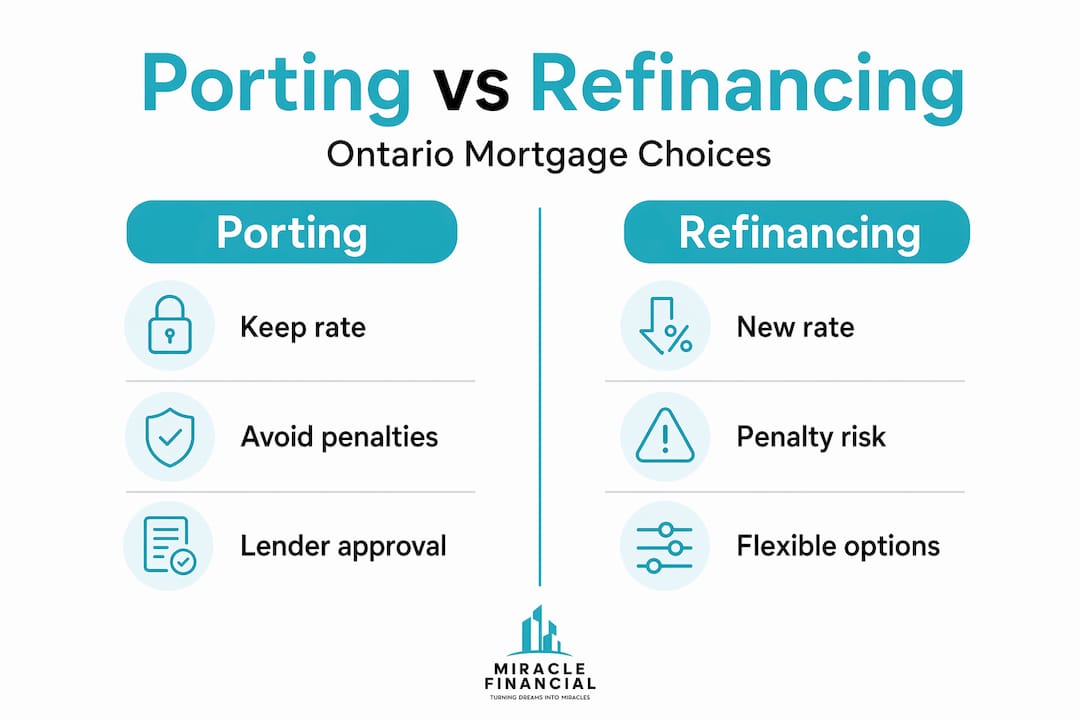
Here is a side-by-side comparison of porting versus refinancing to help clarify the financial trade-offs:
| Factor | Mortgage porting | Refinancing |
|---|---|---|
| Prepayment penalty | Generally avoided | Typically applies (can be significant) |
| Interest rate | Existing rate (or blended if more borrowed) | Current market rate |
| Qualification required | Yes, full requalification | Yes, full requalification |
| Fees | Appraisal, admin, porting fee, title costs | Appraisal, legal, discharge, registration fees |
| Best suited for | Low-rate mortgage holders moving to similar value home | Homeowners whose rate is already near market rate |
| Blended rate risk | Applies when new mortgage exceeds old balance | Not applicable |
When you port a mortgage and the new home requires a larger loan amount, the lender advances the difference at the current rate and calculates a weighted average across both amounts. For example, if you are carrying $300,000 at 2.5% and need an additional $100,000 at today’s 5.5% rate, your new blended rate will reflect the proportional weight of each. The result will be lower than the full current rate, but higher than your original rate. Some homeowners are surprised that their monthly payment increases even after a successful port.
Porting typically incurs fees including an appraisal on the new property, title insurance and registration, potential underwriting charges, and in some cases a dedicated porting administration fee. These are real costs and should factor into your calculation before you decide.

The scenario where porting clearly wins is when your existing rate is significantly below current market rates and your new home requires a similar or smaller mortgage balance. The scenario where refinancing may suit you better is when your remaining mortgage term is short, your rate is already close to current rates, or when you need to restructure your finances more broadly.
Pro Tip: Ask your lender for a written comparison of your all-in costs to port versus your prepayment penalty to break the mortgage. This single document will tell you definitively which option saves you more money.
Timing, bridge financing, and alternatives if porting fails
Getting the timing right is one of the most practically challenging parts of the mortgage porting process, particularly in Ontario’s real estate market where sale and purchase dates rarely align perfectly.
Most lenders require the closing on your new home to occur within the porting window after your current home’s sale closes. If your purchase closes before your sale, you face a gap. If it closes after the window, you may lose the port entirely. Here is what you need to know about managing that gap:
- Bridge loans cover short-term gaps. When you need to close on your new home before your current sale finalises, bridge financing covers the down payment using the equity in your existing property as security. This is a short-term solution, not a long-term product, and it carries its own interest and fees.
- Coordinate dates early. Work with your real estate agent and mortgage broker to align closing dates before you firm up offers. A few days of planning at the start avoids a great deal of expense later.
- If the port is denied, you have options. Refinancing is the most common alternative. A mortgage refinance in Ontario allows you to access new terms and rates, restructure your debt, or consolidate obligations under one payment.
- A second mortgage may bridge a temporary gap. If your primary mortgage does not suit the new property and porting is declined, a second mortgage in Ontario can provide short-term access to equity while you arrange longer-term financing.
- Blend-and-extend is another path. Some lenders allow you to blend your current rate with a new rate while extending your term, rather than porting. This avoids penalties while adjusting your rate to current conditions. It may not carry the same savings as porting a low-rate mortgage, but it simplifies the process.
Understanding how mortgage refinancing works gives you the context to compare these alternatives properly and choose what fits your financial situation.
Best practices when porting your mortgage in Ontario
Most porting problems are preventable. The homeowners who navigate this process successfully are almost always the ones who started asking questions early, before signing any real estate offers.
- Start the conversation before you list. Contact your lender or mortgage broker to confirm your mortgage is portable and to understand the exact conditions and timelines. Confirming eligibility early prevents the kind of surprises that force expensive last-minute decisions.
- Read your mortgage contract. The porting clause will specify the conditions, timing, and any restrictions. If you do not have the document, request it from your lender now.
- Update your financial documentation in advance. Gather recent pay stubs, T4s, tax returns, and bank statements. Requalification is not automatic, and having documentation ready accelerates approval.
- Do not assume your rate is untouched. Many homeowners mistakenly assume their existing rate transfers unchanged regardless of the new loan amount. If you are borrowing more, a blended rate applies and your monthly payment will increase accordingly.
- Run the numbers on both options. Calculate your all-in costs for porting, including fees and any blended rate impact, versus the cost of breaking your mortgage and refinancing at a current rate. The lower rate is not always the financially better outcome when penalties and fees are factored in.
- Understand the impact on your long-term goals. Porting preserves your current term and amortisation schedule. If your financial goals have changed since you took out the mortgage — such as a desire to consolidate debt or reduce your overall monthly obligations — refinancing may serve those goals more effectively.
Pro Tip: If you are self-employed or recently changed jobs, get your mortgage pre-approval reassessed before you list your home. A porting application that fails at the last minute because of an income documentation issue can have real consequences for your purchase timeline.
What I’ve learned from watching homeowners navigate mortgage porting
I’ve seen a consistent pattern in how this plays out for Ontario homeowners. The ones who struggle with porting are rarely underprepared as homeowners. They are simply underprepared for this specific process, because they made a reasonable but incorrect assumption: that keeping their mortgage rate when moving was a given.
What I’ve observed is that treating porting as guaranteed without confirming the contract terms, reassessing qualification, and coordinating timing leads directly to last-minute refinancing or costly penalties. These outcomes were avoidable in almost every case I’ve come across.
The other thing that surprises people is the blended rate calculation. They hear “porting” and picture their rate staying exactly the same. When the blended rate lands higher than expected because of additional borrowing, it can feel like a bait-and-switch. It is not. It is a contractual outcome that was there to read from the beginning. My view is that porting makes strong financial sense when you have a genuinely below-market rate, your new home requires a similar or smaller mortgage balance, and your financial profile is clean. When any one of those conditions is uncertain, the comparison between porting and refinancing becomes much closer than people expect.
Early advice from a knowledgeable mortgage broker changes outcomes. Not because brokers have access to magic solutions, but because knowing the rules of the process well in advance gives you time to prepare, document, and sometimes restructure, rather than react.
— Miracle
How Miraclefinancial can help you make the right call

Whether you are weighing the benefits of mortgage porting or trying to determine if refinancing serves your situation better, Miraclefinancial works with Ontario homeowners to sort through the real numbers, not the assumptions. Our team reviews your mortgage contract, assesses your lender’s porting conditions, and helps you compare all-in costs across your options so you can move with confidence.
If your port is denied, your financial situation has changed, or you want to consolidate debt while you move, explore your mortgage refinancing options in Ontario or review when refinancing makes sense for your specific circumstances. Contact Miraclefinancial early in your moving process, before you accept an offer, and protect yourself from decisions that cost more than they should.
Common questions about mortgage porting
What is mortgage porting, exactly?
Mortgage porting is the transfer of your existing mortgage rate, term, and conditions from your current home to a new property you are purchasing. It requires lender approval and requalification, and it must be a feature written into your original mortgage contract.
Can you port your mortgage if your finances have changed?
Not always. Lenders reassess your income, credit, and ability to pass the current stress test when you apply to port. If your financial situation has worsened since your original approval, the port may be declined.
How long do you have to complete a mortgage port in Ontario?
Most Ontario lenders allow between 30 and 120 days between your sale closing and your new purchase closing. If your dates fall outside that window, you may forfeit the port and face prepayment penalties.
What happens to your rate if you borrow more on the new home?
Your lender will blend your existing low rate with the current market rate on the additional funds, creating a weighted average rate across the full new balance. Your monthly payment will reflect this blended rate, not your original rate alone.
Is porting always better than refinancing?
Not necessarily. Porting saves money when your existing rate is significantly below current market rates and your loan amount stays similar. If your prepayment penalty is low or your rate is close to current rates, refinancing may be equally or more cost-effective when all fees are considered.
Recommended
- Bridge loan basics for buyers moving between homes
- How Mortgage Refinancing Works: Ontario Complete Guide – Miracle Financial
- Ontario mortgage terms explained: smarter home financing
- Mortgage Terminology Explained: Complete Ontario Guide – Miracle Financial
- What is mortgage underwriting: a guide for Ontario homeowners