
Blog
What is mortgage underwriting: a guide for Ontario homeowners


Most Ontario homeowners think mortgage approval hinges solely on credit scores and down payments, but mortgage underwriting evaluates four critical factors that determine whether lenders approve your application. This risk assessment step examines your credit history, income stability, property value, and financial reserves to decide if you qualify for financing. Understanding underwriting mechanics helps you prepare better documentation, anticipate lender concerns, and ultimately secure favourable mortgage terms. This guide explains what mortgage underwriting involves, how the process works in Ontario, and practical strategies to navigate it successfully for better financing outcomes.
Table of Contents
- Key takeaways
- What is mortgage underwriting and why does it matter?
- How mortgage underwriting works: processes and documentation
- Mortgage underwriting decisions and recent trends in Ontario
- How to navigate mortgage underwriting for better loan outcomes
- How Miracle Financial can support your mortgage journey
- What is mortgage underwriting?
Key Takeaways
| Point | Details |
|---|---|
| Four Cs framework | Underwriting uses the four Cs credit capacity collateral and capital to assess mortgage risk and determine qualification and terms. |
| Comprehensive risk evaluation | Underwriting is a thorough financial assessment that weighs multiple risk factors beyond routine paperwork including income stability and property value. |
| Preapplication improvement steps | To improve your chances start by paying down debts correcting errors and building a stronger credit score before you apply. |
| Documentation essentials | Automated underwriting handles straightforward cases while manual review addresses complex situations such as self employed borrowers with irregular income. |
What is mortgage underwriting and why does it matter?
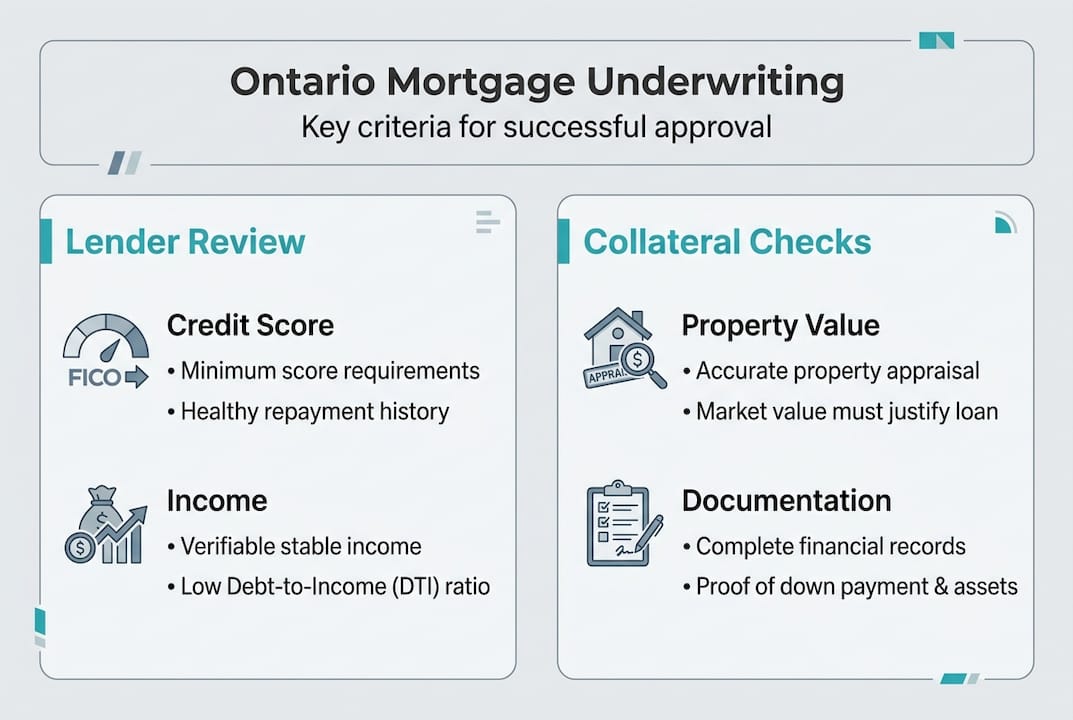
Mortgage underwriting is the lender’s risk assessment process that determines whether you qualify for a home loan and at what terms. Think of it as the final gatekeeper between your mortgage application and actual approval. Lenders use a framework called the four Cs to evaluate your application systematically.
The four Cs break down as follows. Credit examines your payment history, outstanding debts, and credit score to gauge financial responsibility. Capacity measures your income stability and debt-to-income ratio to confirm you can afford monthly payments. Collateral assesses the property value through appraisals to ensure the home secures the loan adequately. Capital reviews your down payment size and financial reserves to determine your investment stake and cushion against hardship.
Underwriting directly affects whether lenders approve your mortgage, the interest rate they offer, and the loan amount they authorise. A strong underwriting profile means lower rates and better terms. A weak profile might result in denial, higher costs, or requirements for additional documentation.
Many borrowers mistakenly view underwriting as mere paperwork processing. In reality, it’s a comprehensive financial evaluation that weighs multiple risk factors simultaneously. Underwriters scrutinise inconsistencies, verify employment stability, and calculate whether your income can sustain mortgage payments alongside existing obligations. They also consider property condition and market value to protect the lender’s investment.
Understanding underwriting criteria helps you improve mortgage approval chances by addressing weaknesses before applying. If your credit score sits below 650, paying down debts and correcting errors beforehand strengthens your profile. If your income fluctuates, documenting consistent earnings over two years reassures underwriters. Knowing what lenders examine lets you prepare strategically rather than react defensively when issues arise.
Pro Tip: Request a credit report three months before applying so you have time to dispute errors and improve your score before underwriters review it.
How mortgage underwriting works: processes and documentation
Mortgage underwriting combines automated systems and manual review to assess applications efficiently while catching nuances that algorithms miss. Automated underwriting systems scan your financial data against lending criteria within minutes, flagging applications that meet standard thresholds for quick approval. These systems excel at straightforward cases where income, credit, and assets align cleanly with guidelines.
Manual underwriting handles complex situations that automated systems cannot evaluate properly. Self-employed borrowers, those with irregular income streams, recent credit events, or unique property types require human judgement. Underwriters examine context, such as business trends for entrepreneurs or explanations for past financial hardship, to make informed decisions beyond algorithmic rules.
Lenders require specific documentation to verify the information you provide. Pay stubs from the past 30 to 60 days confirm current employment and income levels. Notices of Assessment from the Canada Revenue Agency validate declared income for tax purposes. T4 slips provide annual earnings summaries that underwriters cross-reference with other documents. Tax returns covering the previous two years reveal income consistency and any business deductions that affect qualifying income. Bank statements and investment account records prove you hold sufficient funds for down payment and closing costs.

Accurate documentation submitted promptly prevents delays that can jeopardise rate holds or purchase timelines. Incomplete files force underwriters to request additional information, extending the mortgage approval process by days or weeks. Inconsistencies between documents raise red flags that trigger deeper scrutiny or outright denial.
Organise your documentation before applying to streamline underwriting:
- Scan and store digital copies of all financial documents in clearly labelled folders
- Update bank statements and pay stubs to reflect the most recent 60 days
- Gather two years of tax returns and NOAs if self-employed or commissioned
- Obtain employer letters confirming position, salary, and employment duration
- Compile proof of any additional income sources like rental properties or investments
Pro Tip: Keep digital copies accessible on your phone or cloud storage so you can respond immediately if underwriters request additional documentation during review.
Mortgage underwriting decisions and recent trends in Ontario
Underwriting decisions reflect both your personal financial profile and broader market conditions that influence lender risk appetite. Ontario’s mortgage landscape in 2026 shows delinquency rates rising to levels not seen since 2012, though they remain below one per cent overall. These trends shape how cautiously underwriters evaluate new applications.
| Region | Delinquency rate Q2 2025 | Delinquency rate Q4 2025 | Change |
|---|---|---|---|
| Ontario | 0.23% | 0.30% | +0.07% |
| Toronto | 0.20% | 0.24% | +0.04% |
| National | 0.22% | 0.26% | +0.04% |
The renewal cycle intensifying through 2026 creates additional pressure as 60 per cent of mortgages renew during this period. Borrowers who qualified at lower rates now face higher payments, increasing default risk. Underwriters respond by scrutinising income stability more carefully and requiring larger financial cushions to absorb payment increases.
Rising delinquencies signal that some borrowers struggle with current economic conditions. Underwriters tighten guidelines accordingly, demanding stronger credit profiles and lower debt ratios. Applications that might have sailed through two years ago now face additional questions about job security, income sources, and contingency plans.
Private mortgage lenders offer alternatives when traditional underwriting proves too restrictive. These lenders emphasise property equity over income verification, providing solutions for self-employed borrowers, those with recent credit issues, or investors managing multiple properties. Private mortgages carry higher interest rates, typically ranging from 7 to 12 per cent, but they bridge financing gaps that conventional lenders cannot accommodate.
Understanding these trends helps you anticipate lender concerns during your application. If you’re renewing during this peak cycle, demonstrating income growth or reduced debt strengthens your position. If traditional underwriting seems unlikely to approve your application due to income complexity, exploring private options early prevents last-minute scrambling.
Market conditions also affect property appraisals, which form the collateral component of underwriting. Cooling markets mean appraisals may come in below purchase prices, requiring larger down payments to maintain loan-to-value ratios. Underwriters factor regional market stability into risk assessments, favouring properties in areas with steady demand over volatile markets.
Pro Tip: Monitor Ontario mortgage renewal trends and interest rate forecasts six months before your term expires so you can adjust your financial strategy if underwriting standards tighten further.
How to navigate mortgage underwriting for better loan outcomes
Preparing strategically before applying improves your underwriting results significantly. Follow these steps to position yourself for approval and favourable terms:
- Review your credit report three to six months before applying to identify and correct errors that could lower your score
- Reduce outstanding debts to improve your debt-to-income ratio, aiming for total monthly obligations below 35 per cent of gross income
- Stabilise your employment situation by avoiding job changes during the application period unless absolutely necessary
- Accumulate additional savings beyond your down payment to demonstrate financial reserves that reassure underwriters
- Organise all required documentation in advance so you can respond immediately to underwriter requests
- Consult a mortgage broker familiar with Ontario underwriting standards to pre-assess your application and address weaknesses
Improving your credit score requires consistent effort over several months. Pay all bills on time without exception, as payment history comprises the largest portion of your score. Keep credit card balances below 30 per cent of limits to optimise utilisation ratios. Avoid opening new credit accounts shortly before applying, as hard inquiries temporarily lower scores and suggest financial stress to underwriters.
Reducing your debt-to-income ratio makes you more attractive to lenders by demonstrating manageable financial obligations. Calculate your ratio by dividing total monthly debt payments by gross monthly income. If the result exceeds 40 per cent, prioritise paying down high-interest debts like credit cards and personal loans. Even small reductions improve your profile, as underwriters view lower ratios as indicating greater capacity to absorb mortgage payments.
Document organisation prevents delays that frustrate both you and underwriters. Gather these items before submitting your application:
- Recent pay stubs covering 60 days
- Two years of tax returns and Notices of Assessment
- Three months of bank statements for all accounts
- Proof of down payment source, especially if funds come from gifts or investments
- Employment verification letters on company letterhead
- Explanations for any credit issues, job gaps, or large deposits
Communicating effectively with your mortgage broker and lender throughout underwriting keeps the process moving smoothly. Respond to document requests within 24 hours whenever possible. Provide complete information rather than partial answers that require follow-up. If underwriters raise concerns, address them directly with explanations and supporting evidence rather than becoming defensive.
Underwriters appreciate transparency about financial challenges. If you experienced a period of unemployment, credit default, or business loss, prepare a brief written explanation that outlines the circumstances, steps you took to resolve the situation, and evidence of current stability. Proactive disclosure with context often satisfies underwriter concerns more effectively than letting them discover issues independently.
Timing your application strategically also matters. Avoid applying during peak spring market periods when underwriters handle maximum volume and scrutiny intensifies. Late summer and autumn often see faster processing and slightly more flexible standards as lenders work to meet annual targets.
Pro Tip: Work with a local Ontario mortgage broker who understands regional underwriting nuances and maintains relationships with multiple lenders, increasing your chances of finding one whose criteria match your financial profile.
How Miracle Financial can support your mortgage journey
Navigating mortgage underwriting becomes significantly easier with expert guidance from professionals who understand Ontario’s lending landscape. Miracle Financial specialises in preparing borrowers for successful underwriting by organising documentation, identifying potential issues before they become problems, and matching clients with lenders whose criteria align with their financial situations.

Our team knows exactly what Ontario underwriters examine and how to present your financial profile in the strongest possible light. We streamline document preparation, verify information accuracy, and communicate directly with lenders throughout the underwriting process to resolve questions quickly. Whether you’re purchasing your first home, refinancing to improve cash flow, or investing in rental properties, we provide tailored mortgage solutions that fit your specific circumstances. Our local expertise in Ontario mortgage broker services and Newmarket area financing means we understand regional market conditions and lender preferences that affect underwriting decisions. Book a consultation today to discuss how we can position your application for optimal underwriting results.
What is mortgage underwriting?
What does mortgage underwriting mean?
Mortgage underwriting is the lender’s risk assessment process where they verify your financial information, evaluate your creditworthiness, and determine whether to approve your loan application. Underwriters examine your credit history, income stability, property value, and available capital to decide if you meet lending criteria. This step occurs after pre-approval but before final mortgage approval.
How long does mortgage underwriting typically take?
Automated underwriting decisions can occur within minutes for straightforward applications, while manual underwriting typically takes three to five business days. Complex cases involving self-employment, multiple income sources, or unique properties may require one to two weeks for thorough review. Delays often result from incomplete documentation or the need for additional verification.
Can I check my underwriting status during the process?
You can request status updates from your mortgage broker or lender throughout underwriting. Most lenders provide periodic updates at key milestones, such as initial review completion, document verification, and final decision. Avoid contacting underwriters directly, as communication should flow through your broker or loan officer to prevent confusion.
What happens if underwriting denies my mortgage application?
Denial requires lenders to provide specific reasons explaining why your application did not meet their criteria. Common causes include insufficient income, high debt ratios, low credit scores, or property appraisal issues. You can address these concerns and reapply after improving your financial profile, or explore alternative lenders with different underwriting standards.
What are my next steps after underwriting approval?
After underwriting approval, you’ll receive a commitment letter outlining your mortgage terms, conditions, and any remaining requirements before closing. Review the letter carefully, satisfy any outstanding conditions like final employment verification, and coordinate with your lawyer to schedule the closing date. Your mortgage renewal process begins well before your term expires, so plan ahead for future underwriting reviews.
How do private mortgages differ in underwriting requirements?
Private mortgage underwriting emphasises property equity and value over income verification and credit scores. Private lenders typically require 20 to 35 per cent equity in the property and focus on exit strategies for repayment rather than traditional income ratios. This approach provides financing options for borrowers who cannot meet conventional underwriting standards due to self-employment, credit challenges, or complex financial situations.