
Blog
What to do after Ontario mortgage refinance decline


TL;DR:
- Many Ontario homeowners face mortgage decline due to stress test and debt ratios.
- Alternative and private lenders offer solutions after bank rejection, focusing on equity.
- Quick action and exploring different options increase chances of positive mortgage outcomes.
Getting declined for a mortgage refinance is one of the most stressful financial experiences an Ontario homeowner can face, particularly when you are counting on that approval to manage high-interest debt or free up monthly cash flow. This situation is far more common than many people realise. Up to 150,000 Canadian borrowers are facing mortgage stress and refinance difficulties due to a combination of elevated interest rates and shifting home values. The good news is that a decline from one lender is not the end of the road. This guide walks you through exactly why banks say no, and what steps you can take right away to move forward.
Table of Contents
- Why banks decline mortgage refinances in Ontario
- What to do immediately after a mortgage refinance decline
- Bank vs private/alternative lenders: Key differences for Ontario homeowners
- Alternative solutions: Second mortgages, HELOCs, and debt consolidation
- Our take: What most Ontario homeowners miss after a decline
- Expert help with mortgage refinancing and debt solutions in Ontario
- Frequently asked questions
Key Takeaways
| Point | Details |
|---|---|
| Bank declines are common | Many Ontario homeowners face refinance denials due to updated stress test rules and stricter lending criteria. |
| Immediate steps matter | Review bank feedback, gather documents, and seek a second opinion fast after a decline. |
| Private lenders offer alternatives | Private and alternative lenders may approve homeowners based on equity even when banks won’t. |
| Explore debt solutions | Second mortgages, HELOCs, and debt consolidation can help you manage high-interest debt if refinances aren’t approved. |
Why banks decline mortgage refinances in Ontario
Now that you know how common refinance trouble is, let’s break down why banks make this decision. Understanding the reasons behind a decline is important because it tells you precisely what needs to change, or which alternative path makes the most sense for your situation.
The stress test and debt ratio hurdles
The most significant barrier for most Ontario homeowners is the Office of the Superintendent of Financial Institutions, commonly known as OSFI, stress test. This regulatory tool requires lenders to confirm that borrowers can afford their mortgage payments at a qualifying rate, which is typically either the contract rate plus two per cent or 5.25 per cent, whichever is higher. Banks prioritise regulatory compliance over individual equity, meaning that even if you have substantial home value built up, a bank cannot approve you if you cannot pass the stress test.
Under 2026 OSFI rules, every refinance triggers a full requalification, while straight renewals where the mortgage amount stays the same are generally exempt. This is a critical distinction. If you are simply renewing at the same balance, banks apply different standards. But the moment you want to access equity, consolidate debt, or change your mortgage structure, you face a full income and debt ratio review.
Common reasons banks say no
The following factors account for the majority of refinance declinations in Ontario:
- Failing the stress test: Your income does not support the higher qualifying rate, even if you have been paying your mortgage on time for years.
- High total debt service ratio (TDSR): Banks cap total debt obligations, including credit cards, car loans, and your proposed new mortgage, at around 44 per cent of gross income.
- Low or declining property appraisal: If your home’s appraised value has dropped, your loan-to-value ratio increases, which means the bank sees more risk in lending you additional funds.
- Insufficient verifiable income: Self-employed borrowers who cannot document income through traditional means often struggle here, even with excellent cash flow.
- Poor credit score or recent derogatory history: A score below 680 can trigger an automatic decline at most major banks.
- Incomplete or missing documentation: Sometimes a refinance is declined simply because paperwork was not properly organised, which is often corrected with a second attempt.
It is also worth noting that notarizing loan documents in Ontario is a required step in many refinance transactions, and errors in this process can delay or derail approvals.
| Decline reason | How common | Impact level |
|---|---|---|
| Stress test failure | Very common | High |
| High debt service ratio | Common | High |
| Low property appraisal | Moderate | High |
| Income documentation issues | Common | Medium to high |
| Credit score below 680 | Moderate | Medium |
| Missing documentation | Less common | Low to medium |
Before reviewing a refinance qualification checklist, it helps to know exactly which of the above factors applied to your situation, because each one has a different solution.
What to do immediately after a mortgage refinance decline
Understanding the “why” is only the first step. Here is what to do as soon as you receive a decline so that you can move from disappointment to action as efficiently as possible.
Your first actions after receiving a decline
- Read the decline letter carefully: Lenders are required to provide a reason for their decision. Read it carefully and note the specific factor cited, whether it is income, credit, appraisal value, or debt ratio.
- Request your credit report immediately: Obtain a free copy of your credit report from Equifax or TransUnion Canada. Look for any errors, outdated accounts, or fraudulent entries that may have dragged your score down unfairly.
- Request a copy of the property appraisal: You have the right to receive a copy of the appraisal that was ordered during your application. If the value appears lower than expected, review comparable sales in your neighbourhood, because appraisals are sometimes disputed and revised.
- Gather and organise your financial documents: Collect your most recent two years of tax returns, Notices of Assessment from CRA, recent pay stubs or business income statements, bank statements for the last three months, and a complete list of your outstanding debts and monthly obligations.
- Do not apply to multiple lenders at the same time: Each hard credit inquiry from a new mortgage application can lower your score by a few points. Multiple simultaneous applications amplify this effect and may further hurt your chances.
- Speak with an independent mortgage broker: A broker who works with a wide range of lenders, including alternative and private options, can assess your full profile and identify realistic approval pathways that are not available through your bank alone.
“The decline may feel personal, but it is almost never about your character or effort. It reflects a lender’s regulatory constraints and risk appetite at a specific moment in time. The solution is finding the right lender for your actual situation.” — Miracle Financial
It is important to remember that up to 150,000 Canadian borrowers are navigating similar mortgage stress right now. You are not an outlier. The system creates barriers that legitimate homeowners with solid equity can and do overcome through alternative channels.
Pro Tip: Understanding the benefits of refinancing can help you articulate your goals clearly when speaking with a broker or alternative lender, which increases the chance of finding a solution that truly fits your needs.
Bank vs private/alternative lenders: Key differences for Ontario homeowners
If a bank says no, you still have other lender options. Here is how they compare, so you can make an informed decision about which route suits your circumstances best.
How approval criteria differ
Banks operate under strict federal regulations and OSFI guidelines, which means income verification and stress test compliance are non-negotiable. Private and alternative lenders, by contrast, focus more on home equity and offer faster access to funds, though typically at higher interest rates than banks. This difference in underwriting philosophy opens doors for Ontario homeowners who have been declined by traditional institutions.

Alternative lenders, sometimes called “B lenders,” include credit unions and trust companies that operate under provincial regulation rather than federal OSFI rules. They sit between banks and private lenders in terms of rates and flexibility. Private lenders are individuals or companies that use their own capital, giving them the most flexibility of all but also the highest cost.
| Feature | Bank | Alternative (B) lender | Private lender |
|---|---|---|---|
| Approval basis | Income and credit score | Income and equity | Primarily equity |
| Stress test required | Yes (full) | Sometimes | No |
| Interest rates | Lowest | Moderate | Highest |
| Approval speed | 2 to 4 weeks | 1 to 2 weeks | 3 to 7 days |
| Minimum credit score | ~680 | ~550 to 620 | No minimum |
| Typical loan term | 1 to 5 years | 1 to 3 years | 6 to 24 months |
Understanding private lenders in Ontario and how they assess applications can help you prepare a stronger submission from the start. Different types of mortgage lenders apply different criteria, and knowing those distinctions saves you time and protects your credit during the application process.
Key factors to weigh before choosing a private or alternative lender include:
- Available equity: Most private lenders require at least 20 to 25 per cent remaining equity after the loan, meaning a loan-to-value ratio no higher than 75 to 80 per cent.
- Exit strategy: Private mortgages are typically short-term, so you need a realistic plan to refinance or repay when the term ends.
- Total cost of borrowing: Factor in lender fees, broker fees, legal costs, and the higher interest rate to assess whether the solution genuinely improves your financial position.
Pro Tip: A private mortgage lending in Ontario arrangement often works best as a bridge solution, giving you 12 to 24 months to rebuild your credit profile or increase your documented income before transitioning back to a lower-rate lender.
Alternative solutions: Second mortgages, HELOCs, and debt consolidation
Beyond banks and private lenders, some alternative strategies may help you manage debt or unlock cash flow without requiring a full mortgage refinance.
Second mortgages
A second mortgage is a loan secured against your home’s equity that sits behind your existing first mortgage. You keep your original mortgage in place, which is particularly valuable if you have a low rate locked in on that mortgage that you do not want to lose. Second mortgages are available through both alternative lenders and private lenders, and approval is based primarily on available equity.
Typical second mortgage scenarios include:
- Debt consolidation: Using a second mortgage to pay off high-interest credit card balances, personal loans, or lines of credit, reducing monthly obligations significantly.
- Emergency home repairs: Funding urgent repairs or renovations that cannot wait for a conventional approval.
- Bridging a financial shortfall: Covering a temporary income gap while you stabilise your financial position.
HELOCs after a bank decline
A Home Equity Line of Credit, known as a HELOC, allows you to borrow against your equity as needed, up to a pre-approved limit, and pay interest only on what you use. Banks offer HELOCs, but they require the same income verification and stress test compliance as a refinance. After a bank decline, a HELOC from a bank is typically not available. However, some alternative lenders offer equity-based lines of credit with more flexible underwriting.
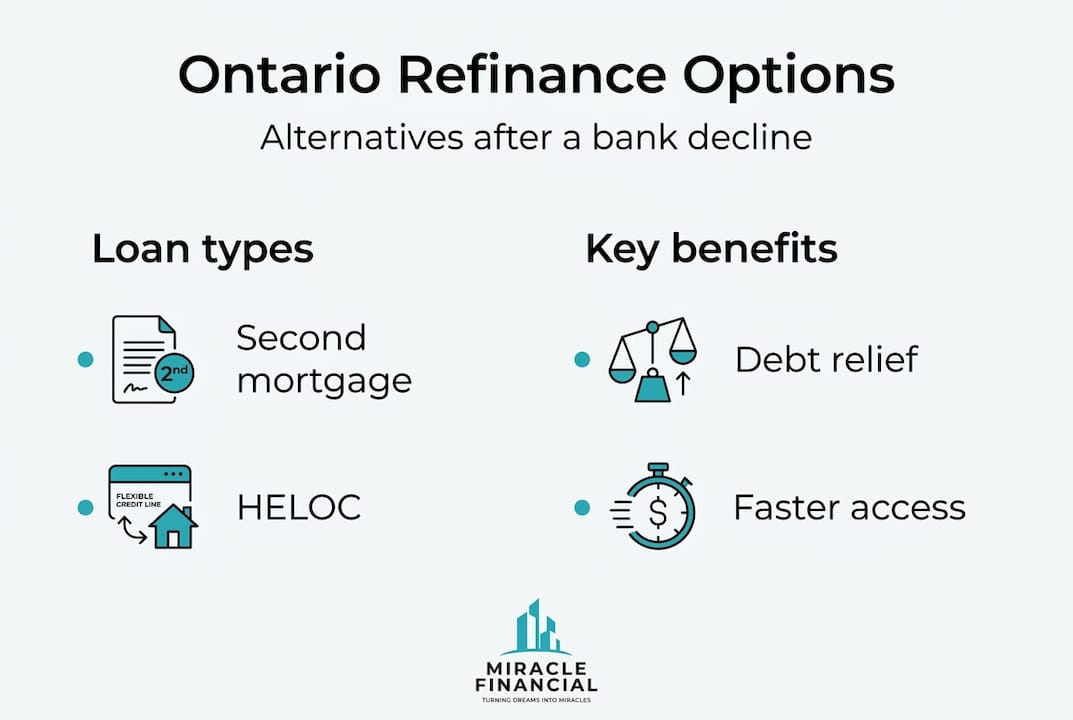
Private and alternative lenders can provide faster access to funds, which is most helpful when immediate cash flow relief is required and waiting weeks for a bank decision is not practical.
| Solution | Best for | Typical rate range | Speed of access |
|---|---|---|---|
| Second mortgage | Debt consolidation, lump sum needs | 8% to 14% | 3 to 10 days |
| HELOC (alternative) | Flexible ongoing access | 9% to 15% | 1 to 3 weeks |
| Private refinance | Full restructuring of mortgage | 8% to 12% | 5 to 10 days |
| Debt consolidation loan | Combining unsecured debts | Varies | 1 to 2 weeks |
Reviewing mortgage solution examples for Ontario homeowners in similar situations can clarify which approach matches your specific equity position and debt load. For a clear side-by-side comparison of your full mortgage options, the breakdown of refinance versus second mortgage considerations is worth reading before making a decision.
Pro Tip: The benefits of debt consolidation through a second mortgage often outweigh the higher interest rate when compared to carrying 19 to 22 per cent interest on credit cards. Run the numbers across your full debt picture to see the true monthly savings.
Our take: What most Ontario homeowners miss after a decline
After working with hundreds of Ontario homeowners in your position, one pattern stands out: the biggest mistake is not taking the wrong path, it is giving up too soon. A bank decline feels final, but it is actually just one data point from one lender operating under one set of rules.
Most people do not realise how many legitimate Ontario mortgage solutions exist outside the traditional banking system. The mortgage market in this province is genuinely layered, with B lenders, credit unions, MICs, and private lenders all operating under different criteria. A homeowner with strong equity and manageable income who is declined by a bank may be approved within days by an alternative lender.
The second most common mistake is waiting too long to seek a second opinion. Every month of carrying high-interest debt at 19 per cent or more costs real money. Moving quickly, even if that means accepting a short-term higher-rate solution, is almost always better than waiting months hoping the bank will reconsider. A decline is not a verdict. It is an invitation to look at the full picture and build a smarter plan.
Expert help with mortgage refinancing and debt solutions in Ontario
Being declined by your bank does not mean you are out of options. Miracle Financial specialises in helping Ontario homeowners move forward after a bank says no, and we work with a broad network of alternative and private lenders who assess your application based on your full financial picture.

Whether you need mortgage refinance help to access equity, a debt consolidation strategy to reduce high-interest obligations, or access to private mortgages that approve based on equity rather than income alone, our team provides personalised solutions without the frustration of repeating the same bank process. We review your situation quickly, explain your realistic options clearly, and help you move forward with confidence. Contact Miracle Financial today to speak with a mortgage professional who understands exactly what you are facing.
Frequently asked questions
Can I still refinance if my bank declined me in Ontario?
Yes, you may qualify with a private or alternative lender, even if your bank says no, as these lenders focus more on equity and provide faster access even after bank declinations. The right approach depends on your available equity and current debt ratio.
Why do stress tests block so many Ontario mortgage refinances?
2026 OSFI rules trigger a full requalification for every refinance, regardless of equity, requiring borrowers to qualify at a higher rate than their actual contract rate. This means many homeowners with years of equity built up still cannot pass a bank’s income-based requirements.
What are my best options to consolidate debt if my mortgage refinance was declined?
Consider a second mortgage, an alternative HELOC, or working with a private lender for debt consolidation if a bank declines you, as private and alternative lenders provide solutions for those who do not qualify with banks. Each option carries different rates and timelines suited to different situations.
Are mortgage renewals affected by the 2026 OSFI refinance rules?
No, straight renewals are exempt if no increase in the mortgage amount is requested, meaning you will not need to pass the stress test again at renewal. Only refinances that change the mortgage amount or structure trigger full requalification.
How do private mortgage rates compare to banks in Ontario?
Private lenders generally charge higher rates than banks, but approve more borrowers based on home equity rather than income or debt ratios alone. For homeowners in a time-sensitive situation with solid equity, this trade-off often makes practical and financial sense.