
Blog
What to do if you can’t afford your Ontario mortgage payments


TL;DR:
- Falling behind on mortgage payments causes significant stress, but early action and communication with lenders can preserve your options. Homeowners should recognize warning signs, document all interactions, and explore relief measures like deferrals, refinancing, or debt consolidation. Acting promptly and strategically increases the chance of stabilizing finances and avoiding foreclosure.
Falling behind on mortgage payments is one of the most stressful situations a homeowner can face, and you are far from alone in Ontario right now. Between elevated interest rates, rising household costs, and unexpected life events, thousands of Ontarians are quietly struggling to keep up. The good news is that solutions exist at every stage of the process, whether you have just missed a payment or are worried about what happens next month. This guide walks you through exactly what to do, from recognising the warning signs early, to contacting your lender, to exploring longer-term strategies like debt consolidation and refinancing.
Table of Contents
- Recognising the problem and acting early
- First steps: contact your lender and document everything
- Mortgage relief measures: what’s available and how do they work?
- Finding stability: budgeting, consolidation, and planning next steps
- Hard-won lessons on facing mortgage stress in Ontario
- Explore tailored solutions for Ontario homeowners
- Frequently asked questions
Key Takeaways
| Point | Details |
|---|---|
| Act early | Contact your lender at the first hint of trouble to keep more options open. |
| Document everything | Maintain a paper trail of all communications and agreements with your lender. |
| Deferral is not forgiveness | Deferred payments must be repaid, often with interest, so use the relief period wisely. |
| Consider consolidation | Debt consolidation or refinancing can help lower monthly payments and avoid default. |
| National stats are just context | ONTARIO homeowners face unique risks—don’t rely on national averages to judge your risk. |
Recognising the problem and acting early
The most important thing to understand is that mortgage distress rarely appears without warning. There are almost always signals weeks or months before a payment is actually missed, and those signals deserve immediate attention.
Common warning signs of impending mortgage distress include:
- Using credit cards or lines of credit to cover your regular mortgage payment each month
- Consistently making only minimum payments on other debts while prioritising the mortgage
- Missing or deferring utility bills, property tax payments, or insurance premiums
- Feeling anxious each time your mortgage payment date approaches because the funds may not be there
- Receiving notices about increasing payments due to a mortgage renewal at a higher rate
Why does early action matter so much? Because your options narrow significantly with each passing month of inaction. FCAC expects homeowners experiencing financial difficulties and at risk of mortgage default to contact their mortgage provider as soon as possible, and federally regulated lenders are expected to provide tailored mortgage relief measures in response.
In Canada, the term arrears refers specifically to mortgage payments that are overdue by three or more months. According to the Canadian Bankers Association, Canada’s national arrears level has remained low by historical standards, but that national figure tells you nothing about your personal risk. Ontario homeowners face unique pressures from higher housing costs, variable rate exposure, and cost-of-living increases that can accelerate distress well before the national average would suggest.
“The earlier you communicate with your lender, the more options remain open to you. Waiting until you have already missed multiple payments limits what both you and your lender can do.”
If you are unsure where to start after a missed payment, reviewing the available missed mortgage payment steps can help you prioritise your next move. Understanding how renegotiating your mortgage works is also useful background before you speak with your lender.
Pro Tip: Document every conversation you have with your lender from the very first call. Write down the date, the name of the representative, and the key points discussed. This paper trail protects you and keeps the process clear.
Once you understand how urgent early action can be, the next step is to reach out to your lender and explore your relief options.
First steps: contact your lender and document everything
Many homeowners delay calling their lender because they are embarrassed or worried about triggering negative consequences. In reality, proactive communication is the single most effective thing you can do. Lenders are not looking for reasons to foreclose. They are looking to resolve problems, and they have more flexibility when contacted early.
Here is a step-by-step approach for your first contact:
- Gather your financial information before you call. Have your most recent mortgage statement, a summary of your monthly income, a list of your debts and monthly expenses, and the reason for your financial difficulty ready before picking up the phone.
- Call the dedicated hardship or mortgage support line. Most major Canadian lenders have a specific department for mortgage difficulties, separate from general customer service. Ask to speak with a mortgage hardship specialist.
- Explain your situation clearly and honestly. Describe whether your difficulty is temporary (such as a job loss or medical issue) or more structural (such as a rate increase that has permanently raised your payment beyond your means). Lenders respond differently based on the nature of the hardship.
- Ask specifically what relief options are available. Do not wait for the lender to volunteer information. Ask directly about payment deferrals, payment reductions, amortisation extensions, and any internal hardship programmes.
- Request everything in writing. Any agreement, deferral approval, or payment plan must be confirmed in writing before you consider the matter resolved. A verbal confirmation is not sufficient.
- Follow up promptly on any paperwork. Lenders may send documents for you to sign to formalise the relief arrangement. Delays on your end can cause the agreement to lapse.
FCAC’s core expectation is that you contact your lender early and obtain any relief agreement terms in writing, so you fully understand the repayment obligations after the relief period ends. This is particularly important with deferrals, where interest continues to accrue and must eventually be repaid.
A strong understanding of mortgage basics will also help you ask better questions and evaluate any offer your lender makes. Knowing how amortisation and interest calculations work gives you a clear picture of what any relief measure will actually cost you in the long run.
Exploring the range of mortgage solutions for homeowners before your call can also prepare you to ask about options you may not have considered.
Pro Tip: Keep a dedicated folder, either physical or digital, where you save every email, letter, and written summary of phone calls related to your mortgage difficulty. If a dispute arises later, this record is invaluable.
With your lender communication underway and a plan to document everything, the next step is to understand the mortgage relief options that may be offered.
Mortgage relief measures: what’s available and how do they work?
Once you contact your lender, several specific relief measures may be available depending on your situation, your lender’s policies, and how long you have had the mortgage. Understanding each option before you enter negotiations makes a significant difference.
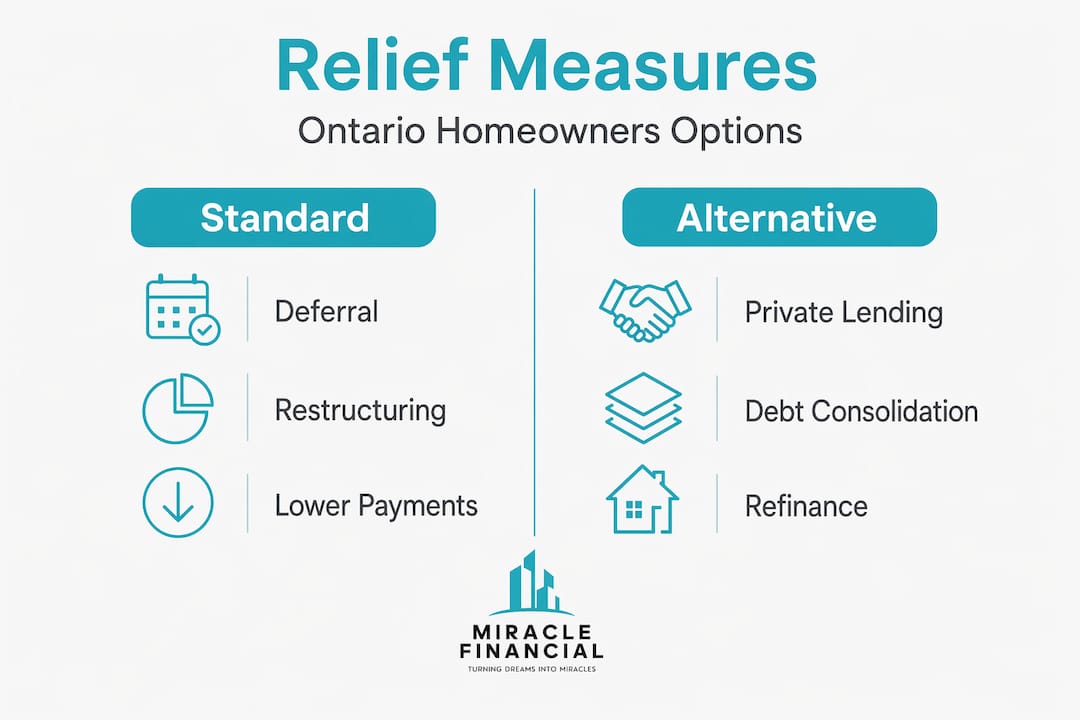
| Relief measure | How it works | What it costs you later |
|---|---|---|
| Payment deferral | Pause payments for a set period, typically up to 4 months | Deferred amounts plus interest repaid after period ends |
| Payment reduction | Temporarily lower your monthly payment | Shortfall repaid later, may extend amortisation |
| Amortisation extension | Increase the remaining loan term to lower payments | More total interest paid over the life of the loan |
| Refinancing | Replace your current mortgage with a new one at new terms | May reset costs, penalties may apply, new qualification required |
| Debt consolidation | Roll high-interest debts into your mortgage | Lower monthly outflow, but longer repayment horizon |
A mortgage payment deferral is a temporary relief measure in which you agree with your financial institution to delay mortgage payments for a set period, usually up to approximately four months, with interest and repayment of deferred amounts applying after the deferral ends. This is a critical detail that many homeowners miss: deferral is not forgiveness. The money is still owed, and interest continues to accumulate during the deferral window.
What happens after a four-month deferral?
- Your lender may increase your monthly payment slightly to recover the deferred amount over the remaining amortisation period
- Alternatively, your amortisation may be extended by a few months to spread the deferred balance without raising individual payments
- In some cases, a lump-sum repayment of the deferred balance may be requested at renewal
While national arrears remain low by historical standards across Canada, Ontario-specific pressures such as higher property values, living costs, and variable rate exposure can still create acute personal risk. Treat national averages as useful context but not as personal reassurance.
Exploring non-traditional mortgage solutions alongside standard bank programmes can reveal options that better fit your specific circumstances. If you are unsure what type of mortgage structure would suit your needs going forward, reviewing the types of mortgages available to Ontario homeowners provides a useful foundation. You can also simulate mortgage relief scenarios to see how different options affect your total repayment cost.
Having learned how relief measures can offer temporary breathing room, it is crucial to know how to stabilise your finances for the longer term.
Finding stability: budgeting, consolidation, and planning next steps
A deferral or payment reduction buys you time. What you do with that time determines whether your financial situation improves or simply delays the same crisis by a few months.
Use the relief window to rebuild your budget with purpose:
- List every source of monthly income, including employment, rental income, government benefits, and any side income.
- List every fixed monthly expense, starting with your mortgage, then property taxes, insurance, utilities, and minimum debt payments.
- Identify discretionary spending that can be reduced or eliminated temporarily.
- Calculate your monthly shortfall or surplus to understand exactly how large the problem is and what solutions are realistic.
- Set a target monthly savings amount that you will redirect toward debt repayment or an emergency reserve once the relief period ends.
| Budget line item | Priority level | Action during relief period |
|---|---|---|
| Mortgage payment | Critical | Maintain per relief agreement terms |
| Property taxes | Critical | Ensure no arrears build with municipality |
| Utility bills | High | Negotiate payment plans if needed |
| High-interest credit card debt | High | Redirect freed-up funds here first |
| Discretionary spending | Low | Reduce substantially during relief window |
Debt consolidation is one of the most effective longer-term strategies available to Ontario homeowners in distress. By rolling high-interest unsecured debts, such as credit cards and personal loans, into your mortgage at a lower interest rate, you can significantly reduce your total monthly debt payment. The debt consolidation mortgage guide for Ontario offers a detailed look at how this process works and what to expect.

It is also worth noting that FCAC is clear that temporary deferrals are not forgiveness, and deferred amounts are recovered by the institution after the deferral ends, either through amortisation extension or higher payments. This means a deferral is best viewed as time to repair your budget or qualify for longer-term restructuring, not as a permanent fix.
If your credit score has been affected by late payments, it is still possible to find solutions. There are mortgage options for low credit scores through alternative lenders and private lenders that assess your situation more holistically than a traditional bank. Understanding how to optimise your repayment schedule is also a useful exercise when planning what comes after relief ends.
Key bullet points for longer-term stability:
- Review your debts in order of interest rate, highest to lowest, to prioritise repayment
- Avoid taking on new unsecured debt during the relief period
- Work with a licensed mortgage broker to assess whether refinancing makes sense once your situation stabilises
- Build a minimum one-month emergency reserve before resuming normal spending
Pro Tip: Act on consolidation and restructuring before new arrears build. Every additional month of missed or reduced payments narrows the options available through traditional lenders and may push you toward higher-cost private lending options sooner than necessary.
After putting your immediate and long-term plans into action, it is helpful to step back and consider a broader perspective on what works and what pitfalls to avoid.
Hard-won lessons on facing mortgage stress in Ontario
One thing that guides like this one do not always say plainly: waiting even a single month longer than necessary can meaningfully reduce your choices. It is not a dramatic statement. It is a practical reality. Lenders, both regulated and private, assess risk based on your current status, and a homeowner with one missed payment is viewed very differently from one with three or four.
The most overlooked step in the entire process is documentation. Homeowners who keep thorough records of every conversation, every promise, and every written agreement are in a far stronger position when disputes arise or when they need to demonstrate their history of good-faith effort to a new lender or mortgage broker.
National statistics about low arrears rates are genuinely reassuring at a population level, but they can create a false sense of safety for individual homeowners. Ontario’s cost structure is unique, and your personal circumstances are unique within that. Do not wait for a statistic to tell you that your situation is serious. If it feels serious, it is worth acting on immediately.
The most successful outcomes we see in mortgage distress situations come from homeowners who layer multiple strategies together rather than relying on any single fix. That might mean combining a short-term deferral with a budget overhaul, followed by a consolidation refinance once the homeowner has stabilised their income. The examples of mortgage solutions that have worked for real Ontario homeowners illustrate this kind of layered, custom approach well.
Relief programmes are a window for real change, not a destination. Use that window intentionally.
Explore tailored solutions for Ontario homeowners
Navigating mortgage distress on your own is difficult, particularly when each lender’s relief options differ and the stakes for your home are high. Miracle Financial works with Ontario homeowners across the full spectrum of financial situations, including those who have already missed payments, those who have been declined by their bank, and those who need a fast solution before their situation worsens.

Whether you need to reduce your monthly payments through Ontario mortgage refinancing, roll high-interest debts into a single manageable payment through Ontario debt consolidation, or simply talk through your options with someone who understands the Ontario market, we are ready to help. Our team structures mortgage solutions around your real-life situation, not a generic checklist. Book a free consultation today to start building a plan that works for where you actually are.
Frequently asked questions
What is a mortgage payment deferral and how does it affect my loan?
A mortgage payment deferral lets you pause payments temporarily, but deferred amounts plus interest must be repaid after the deferral period ends, often through higher payments or an extended amortisation period.
How many months can I miss mortgage payments before default?
In Canada, lenders typically define a mortgage as being in arrears after three months of missed payments, though lenders may begin contact and action earlier than that threshold.
Will contacting my lender hurt my credit score?
Contacting your lender proactively does not affect your credit score and may actually help keep your account in good standing by opening a documented relief arrangement before any missed payments are reported.
Can I still refinance or consolidate my debt if I’m behind on payments?
Yes, options may still exist through alternative or private lenders even if you have missed payments, but acting sooner consistently results in more choices and more favourable terms.
What documents should I keep when communicating with my mortgage provider?
Keep all written correspondence, signed agreements, deferral confirmation letters, and dated notes from phone discussions to protect your interests and verify agreed-upon terms if any dispute arises later.